
Author
Knowing how to read a tire date code takes ten seconds and can save you from a blowout. Every tire sold in the US carries a DOT code, and its last four digits tell you exactly when the tire was made. On an RV or trailer, that date matters more than the tread, because most RVs sit far more than they roll.
When I inspect a tire, I work in a fixed order: first the pressure, then a visual check of the structure, the wear pattern, any deformation or bulges, and only then the tread depth. Along the way, reading the sidewall tells me three things the tread never will: how old the tire is, and whether its load and speed ratings suit the vehicle. The date code is the quickest of those to read. This guide shows you where to find it, how to read it, and what age limits make sense for RV and trailer tires. It’s part of our complete RV tires guide.
How to Read a Tire Date Code
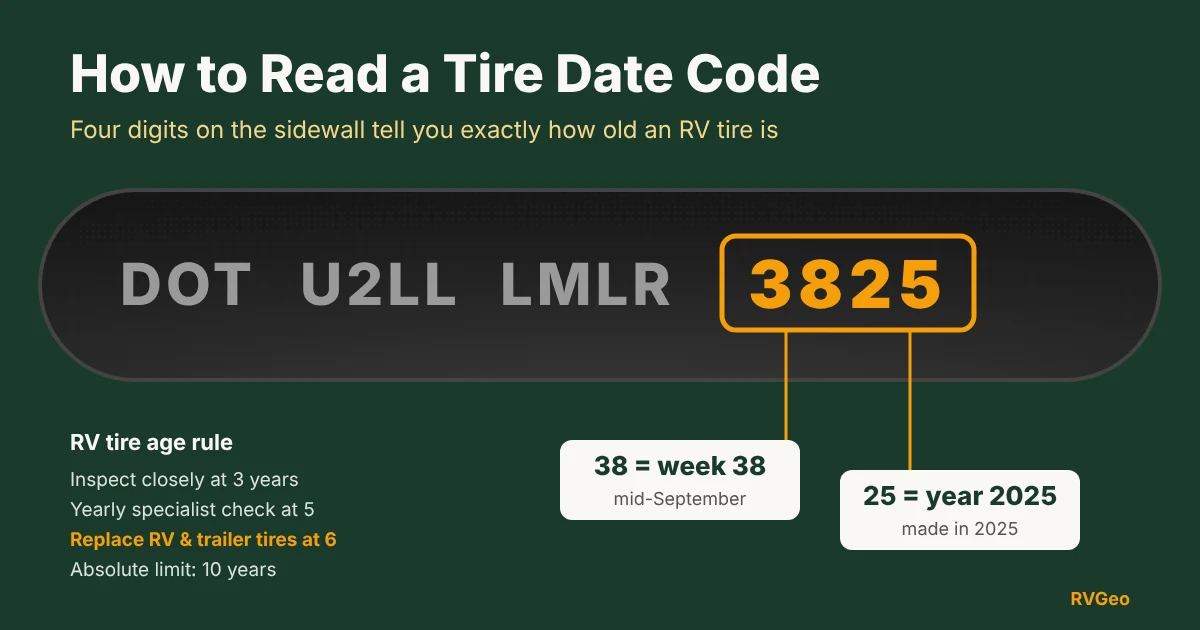
The age of a tire is printed in its DOT Tire Identification Number (TIN). According to NHTSA, the last four digits of the TIN show the week and year the tire was made.
- First two digits: the week of manufacture (01 to 52).
- Last two digits: the year.
- Example: “3825” means week 38 of 2025, mid-September 2025. Read it as week/year: 38/25.
- Older example: “3221” means the 32nd week of 2021, roughly early August 2021.
The full TIN starts with “DOT” followed by plant and size codes, then the date. Only the final four digits tell you the age.
No readable date code? Treat it as a defect. In inspection, a tire whose DOT code is worn off, damaged or missing is an anomaly: you can’t confirm its age, so you can’t vouch for it. Check the other sidewall first. If the code is unreadable on both sides, assume the tire is too old and replace it.
Where Is the Date Code on a Tire?
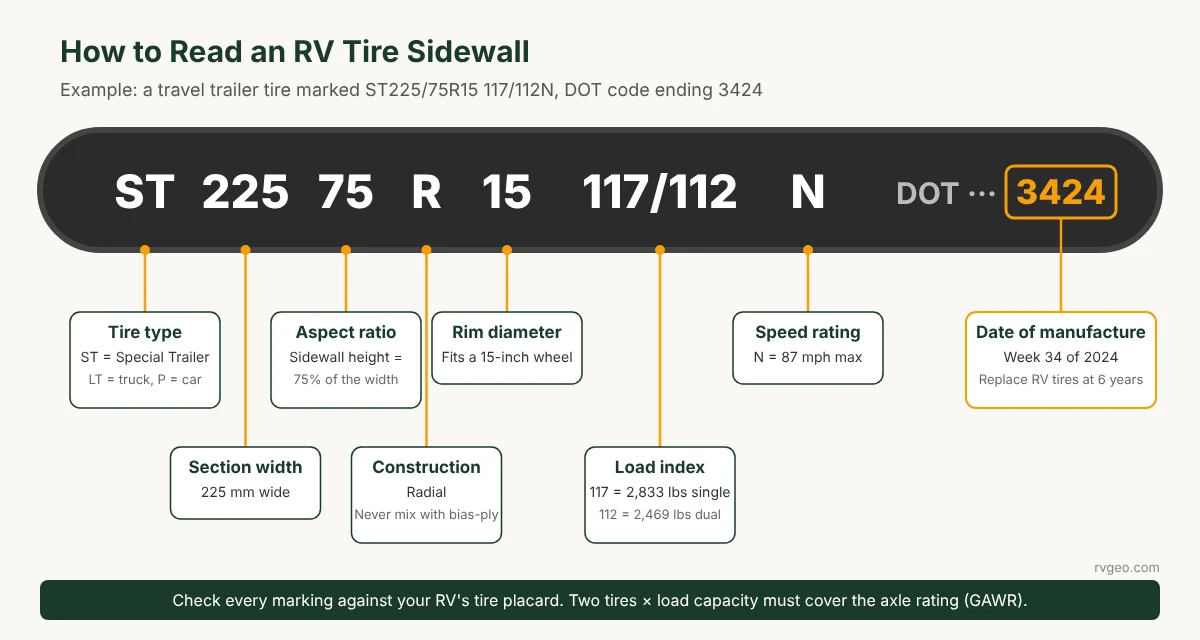
The tire date code location is the lower sidewall, near the rim, at the end of a string of characters that starts with “DOT.” Look for a short oval or rectangle containing four digits, often slightly raised compared with the rest of the code.
- Check both sides. NHTSA notes the full TIN may appear on only one side of the tire.
- On RVs and trailers, it’s often on the inside sidewall, facing the axle. Use a flashlight, or slide a phone camera behind the tire.
- On duals, the inner tire’s code usually faces the outer tire. A phone camera is the easiest way to read it.
Depending on where the code sits and how much room you have, you can often read it with the naked eye. On large rigs, though, especially motorhomes on heavy truck chassis, the full code is frequently on the inside face, and you need another way to see it:
- Roll the RV a short distance so the code moves to a part of the tire you can reach and see.
- Use an inspection mirror and a flashlight, or a phone camera held behind the tire with the flash on.
- Have it read on a lift or over a pit at a tire shop, where the inner sidewalls are easy to see.
- Check the paperwork: many tire shops record the DOT code of each tire on the invoice when they mount it.
How to Tell the Age of a Tire in 10 Seconds
- Find “DOT” on the sidewall.
- Follow the code to its last four digits.
- Read the first two as the week and the last two as the year.
- Subtract from today’s date. That’s the tire’s age.
A tire marked “1219” was made in the 12th week of 2019. In late 2026, it’s more than seven years old: past the 6-year limit I apply to RV and trailer tires. Replace it.
Trailer tire date code
Trailer tires use exactly the same DOT date code as car and truck tires. The difference is what the date means: ST trailer tires often age out sooner, because trailers sit outdoors for months and run near their load limits. The age table below reflects that. Keep in mind that age limits are averages: how often the trailer is used, how many miles it covers and how long it sits in the sun all move them.
What if there are only three digits?
Tires made before 2000 used a three-digit code. If you find one, the tire is more than 25 years old and should be replaced without further discussion.
RV Tire Age Limit: How Old Is Too Old?
NHTSA reports that some vehicle and tire manufacturers recommend replacing tires that are six to ten years old, regardless of tread wear. It also flags tire aging as a particular concern for RVs and other vehicles used infrequently.
RVs push tires toward the short end of that range. They sit loaded in one position, often outdoors, then run hot on long highway days. Tire engineer Roger Marble notes in RV Travel that trailer owner’s manuals he reviewed suggest only three to four years of ST tire life.
Tire makers set their own markers. Michelin calls for a specialist inspection every year once a tire is five years old and sets ten years as the absolute limit. Continental recommends replacing motorhome, caravan and trailer tires older than six years, whatever the tread.
Here’s the rule I apply, counted from the date code:
| Tire age | What to do | Source |
|---|---|---|
| From 3 years | Inspect closely before every season: sidewall cracks, hardening, deformation | Inspector’s field practice |
| From 5 years | Specialist inspection at least once a year | Michelin |
| 6 years | Replace motorhome, caravan and trailer tires. No extensions. | Continental + inspector’s rule |
| 10 years | Absolute limit for any tire, spares included | Michelin |
| Any age | Replace now if you find deep cracks, bulges or deformation | Inspector’s field practice |
| Date code unreadable | Treat it as too old and replace it | Inspector’s field practice |
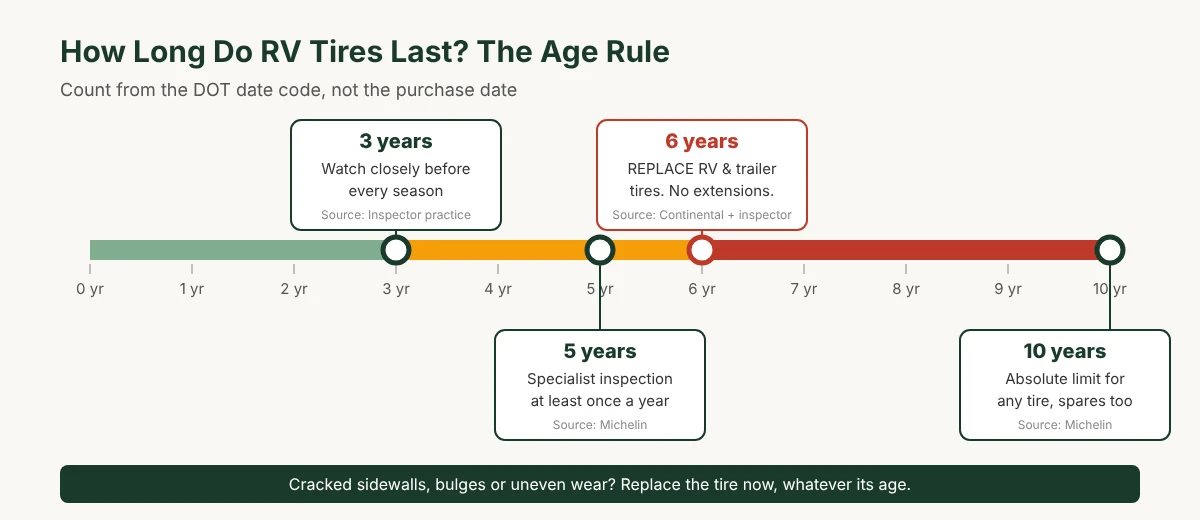
Why six years for RVs and trailers, when some makers allow more? A trailer or motorhome spends most of its life parked, in the sun, slowly losing pressure on tires that carry its full weight in one spot. Stretching them further is a risk I wouldn’t take. These limits are averages: heavy use, high mileage or years outdoors can bring replacement forward. There is no federal age limit for tires in the US; this is an inspection rule, and your tire maker’s or RV maker’s guidance applies when it’s stricter.
Why Good Tread Isn’t Enough
Tread depth measures wear. It says nothing about what’s happening inside the tire. As a tire ages, the rubber compounds harden and the bond between the rubber and the steel belts weakens. A tire in that state can pass a penny test and still separate at highway speed.
Usage decides which one runs out first. Busy trucking fleets I’ve talked with rarely keep a tire beyond two years: at their mileage, the tread wears out long before the rubber has time to age. An RV is the opposite. It covers few miles and sits for months, so its tires age out before they wear out. That’s why the date code matters more than the tread on an RV.
That’s why, in inspection, tread depth is the last thing I measure, after pressure, structure and deformation. Over the years on the inspection lane, I saw the same scenario again and again: tread that was still legal, sometimes well above 2/32″ or even 4/32″, on a tire rejected on the spot for its structure or its age. The usual culprits were deep sidewall cracking from sun and ozone (dry rot), belt separations, and deep cupping or deformation caused by worn suspension parts. A thick tread means little if the casing underneath is a blowout waiting to happen.
For reference, the legal minimums in the US: 2/32″ of tread on light vehicles in most states, and for commercial vehicles under FMCSA rules, 4/32″ on steer tires and 2/32″ on the others. Those are legal floors, not safety targets.
That’s why a seller’s “the tires have plenty of tread” means very little on a used RV. The same logic runs through our pre-purchase RV inspection checklist: the paperwork can lie, the vehicle can’t. With tires, the tread can lie too. The date code can’t.
Signs Your RV Tires Are Aging Faster Than Their Date
Some tires age faster than the calendar. Look for these signs on every tire, including the spare:
- Weather checking: fine cracks in the sidewall or between tread blocks. Shallow surface crazing is common; cracks you can catch a fingernail in are not.
- Bulges or waves in the sidewall or tread, which can mean an internal separation.
- Uneven or patchy wear that appears suddenly, sometimes a sign the belts are shifting.
- Faded, greyish rubber on the side that faces the sun in storage.
- Hard, dry-feeling rubber that has lost its suppleness under your thumb.
- Cracked rubber valve stems, which age right alongside the tire.
Why hardened rubber matters more than the date
Hardening isn’t just a sign of age; it’s proof that the rubber itself has changed. Heat, oxygen and UV light oxidize the rubber and keep creating new cross-links between its molecular chains, as if the curing never stopped. The network stiffens, loses its elasticity, and the rubber starts to feel dry, almost like cardboard.
That’s why the date alone doesn’t tell the whole story. Two tires made the same week, with the same DOT code, can end up in very different condition. One kept in a cool, dark place holds its properties for years. One that lives in the sun, on hot pavement or near chemicals can harden long before the usual age limits. And the consequence is about safety, not looks: hardened rubber can no longer deform into the tiny irregularities of the road surface, so it loses grip, especially in the wet, however deep the tread is. In inspection, the condition I find on the tire counts as much as the date I read on it.
Sun is the main accelerator. If your RV spends the off-season outdoors, read what UV and heat damage first on an RV, and cover the tires while it’s parked.
Don’t Forget the Spare
The spare is often the oldest tire on an RV. It came with the rig and has never been replaced. NHTSA advises against using a spare as a replacement for worn tires, and an old spare may not be safe even for emergency use. Check its date code with the others: the same age rules apply, and Michelin’s 10-year absolute limit explicitly includes spares. Check its pressure every time you check the others, too.
What to Do When Your RV Tires Are Too Old
- Write down every date code, by position, and keep the list in your RV logbook.
- Replace all the tires at once if you can, or by axle at minimum, matching size, structure and load range across the axle. If you replace only two tires, the new ones go on the rear axle, as Michelin recommends.
- Choose the right type of tire for how you tow: ST trailer tires and LT light-truck tires are built for different jobs, so check which one your RV maker specifies before you buy.
- Compare replacements on load range and speed rating, not just price, and pick a load range with a margin over your real weights.
- No retreads on an RV or a trailer.
- Read the date code on the “new” tires before they’re mounted. A new tire can sit in a warehouse for a long time. Refuse any tire made more than one to two years before the purchase date.
Old tires are one of the costliest things RV buyers overlook, along with water damage and skipped inspections. See the RV mistakes that cost owners the most.
RV Tire Age FAQ
How do you read a tire date code?
Find the DOT code on the sidewall and read its last four digits as week/year. “3825” means week 38 of 2025. The full code may be on the inside sidewall only, so check both sides.
Can RV tires be too old even with good tread?
Yes. RV tires usually age out before they wear out: the rubber hardens and the belt bond weakens while the tread still looks fine. Start inspecting closely at 3 years, have them checked by a specialist every year from 5 years, and replace motorhome, caravan and trailer tires at 6 years. Ten years is the absolute limit for any tire, spares included.
Do RV tires age if the RV isn’t driven?
Yes, and sometimes faster. A parked RV keeps the same section of each tire loaded, and UV light, heat and ozone keep oxidizing the rubber until it hardens and loses grip. That’s why storage covers, correct pressure and moving the RV periodically all matter.
How old can a new tire be when I buy it?
Ideally no more than one to two years since its manufacture. “New” tires can sit in a warehouse for a long time, so read the DOT date code before the tires are mounted and refuse older stock.
Is there a legal age limit for tires in the US?
No. There is no federal age limit for tires. The limits come from tire makers and inspectors, which is why the 3, 5, 6 and 10-year markers in this guide are a practical rule, not a law. Follow your tire maker’s or RV maker’s guidance when it’s stricter.
Should I buy a used RV with old tires?
You can, but price the tires in. A full set of new tires on a travel trailer or motorhome is a real expense, and it’s a fair negotiating point when the date codes are old.

Published on October 18, 2026
Mike Dawson
Mike Dawson is RVGeo's lead editor, applying inspection-grade rigor to RV research - verifying manufacturer specs, testing components, and fact-checking pricing and claims before they're published. RVGeo's approach draws on a background in automotive technical inspection, applied specifically to RV electrical, power, and safety systems. Mike oversees RVGeo's foundational guides on power systems, DIY conversions, and van-life setup, with every recommendation checked against real specs and current pricing rather than assumptions.
This post contains affiliate links. If you make a purchase through these links, we may earn a commission at no extra cost to you.