
Author
Summer in an RV without a working air conditioner isn’t camping — it’s survival. But with three completely different AC technologies now available (traditional rooftop, 12V DC, and mini split), picking the right unit is more complex than it used to be.
This guide cuts through the noise. We’ve ranked the best options in each category based on BTU output, power draw, noise level, installation complexity, and real-world boondocking performance.
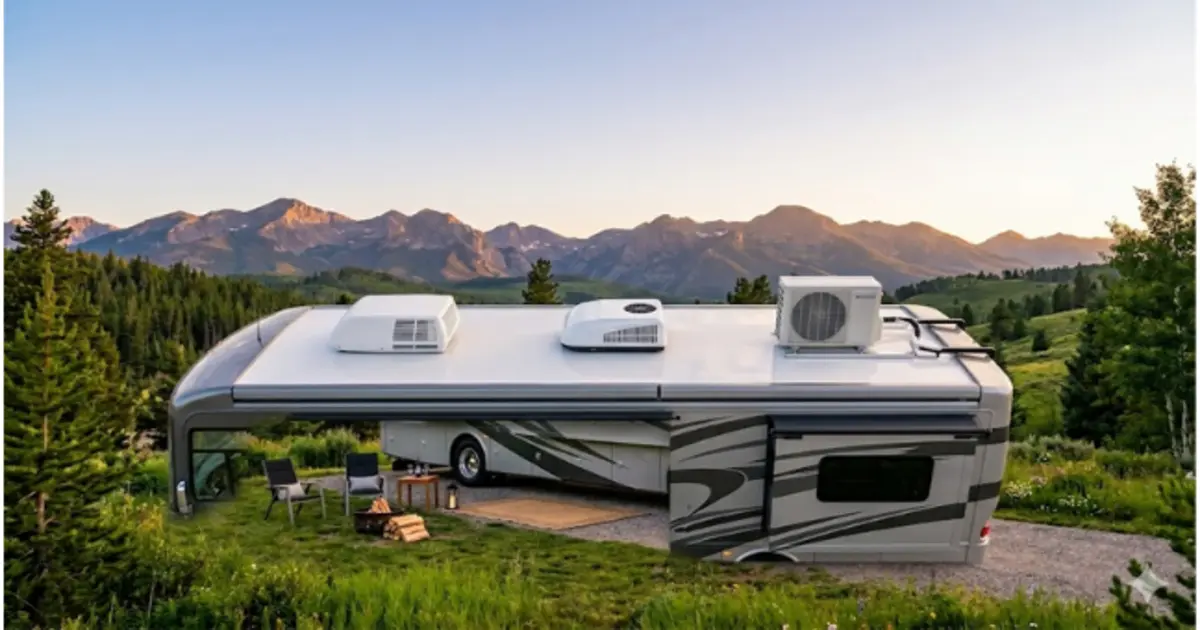
The 3 Types of RV Air Conditioners Explained
Before diving into rankings, you need to understand what you’re choosing between — because these three technologies serve very different use cases.
| Type | Power Source | Best For | Typical Cost |
|---|---|---|---|
| Rooftop (120V) | Shore power or generator | Campgrounds, hookups | $400 – $1,200 |
| 12V DC Rooftop | Battery bank + solar | Boondocking off-grid | $800 – $2,500 |
| Mini Split | 110V via inverter | Permanent setups, max efficiency | $1,500 – $4,000 |
RV air conditioning in 2026 divides into three distinct technologies: traditional 120V rooftop units (best for campgrounds with shore power), 12V DC rooftop units (purpose-built for solar-powered boondocking), and mini split systems (most energy-efficient, best for full-timers). Traditional 120V rooftops require 1,500–2,000 watts running and 3,000–4,500 watts at startup. True 12V DC units draw 16–29 amps (192–348 watts) in eco mode — up to 68% less power than standard units. Mini splits achieve 20–22 SEER efficiency ratings versus the 14 SEER typical of rooftop units, cutting cooling electricity costs by 35–40%.
Best Traditional Rooftop RV Air Conditioners
1. Dometic Brisk II — Best Overall Rooftop
The industry standard for a reason. The Dometic Brisk II delivers 13,500 BTU of reliable cooling, weighs just 78 lbs, and fits any standard 14″x14″ RV roof opening.
Specs:
– BTU: 13,500 cooling / 11,000 heating (heat pump version)
– Running watts: ~1,250W
– Startup watts: ~2,700W
– Noise: 52 dB
– Weight: 78 lbs
Best for: Full-hookup camping, Class A and Class C owners who primarily use campgrounds.
2. Coleman Mach 15 — Best High-BTU Option
At 15,000 BTU, the Coleman Mach 15 is the most powerful standard rooftop unit available. Ideal for large Class A motorhomes where a 13,500 BTU unit struggles in extreme heat.
Specs:
– BTU: 15,000 cooling
– Running watts: ~1,500W
– Noise: 56 dB
– Weight: 87 lbs
Best for: Large Class A motorhomes, hot climates (Arizona, Texas, Florida summers).
3. Furrion Chill 14,500 BTU — Best Heat Pump Value
Furrion’s Chill series offers a heat pump version that handles both cooling and heating down to 14°F — making it a strong all-season choice at a competitive price.
Specs:
– BTU: 14,500 cooling / 11,000 heating
– Running watts: ~1,350W
– Noise: 50 dB (quieter than most)
Best for: Four-season RVers who want one unit for both heating and cooling.
Best 12V DC RV Air Conditioners (Boondocking)
12V units are the game-changer for solar-powered RVers. They draw a fraction of the power of standard units — making off-grid air conditioning actually viable.
1. Dometic RTX 2000 — Best 12V Overall
Dometic’s flagship 12V unit. At 6,824 BTU and a minimum 16A draw in eco mode, it’s the most trusted 12V option on the market from the most recognized RV brand.
Specs:
– BTU: 6,824
– Power draw: 16A eco / 45A max (12V)
– Operating temp range: 41–126°F
– Runtime on 200Ah battery: ~6–8 hours
– Noise: 44 dB
Best for: Vans, Class B, and smaller Class C motorhomes with robust solar setups.
2. OutEquip Summit 2 — Most Efficient 12V
The Summit 2’s variable-speed compressor is the most power-efficient 12V unit available in 2026. In eco mode it draws just 16A while maintaining comfortable temperatures — making it the best choice for maximizing battery runtime.
Specs:
– BTU: 10,000
– Power draw: 16A eco / 35A max
– Noise: 40 dB (quietest 12V unit tested)
– Weight: 45 lbs
Best for: Serious boondockers with 400Ah+ LiFePO4 battery banks and 600W+ solar.
3. Treeligo 12V 10,000 BTU — Best Budget 12V
Strong performance at a lower price point. Treeligo’s frequency conversion technology keeps noise below 45 dB while delivering solid cooling in compact spaces.
Best for: Budget-conscious boondockers, campervan builds, and smaller RVs.
12V DC RV air conditioners in 2026 operate directly from a battery bank, bypassing the inverter losses (10–15%) that make running traditional 120V AC units from batteries impractical. The best 12V units — Dometic RTX 2000 and OutEquip Summit 2 — draw 16 amps in eco mode compared to 50+ amps for conventional rooftop units, representing a 68% reduction in power consumption. For solar-powered boondocking, a 12V unit paired with a 400Ah LiFePO4 battery bank and 600W solar array can provide 6–10 hours of cooling per day without running a generator. These units fit standard 14″x14″ roof openings and install in the same location as traditional rooftop ACs.
Best RV Mini Split Air Conditioners
Mini splits are the most efficient cooling option available — but they require more installation work and typically need an inverter.
1. MRCOOL DIY 18,000 BTU — Best Overall Mini Split
The MRCOOL DIY earns its name — it’s the only mini split with a pre-charged line set that doesn’t require an HVAC technician to install. At 22 SEER, it’s dramatically more efficient than any rooftop unit.
Specs:
– BTU: 18,000 cooling / heating
– SEER: 22
– Running watts: ~1,400W (much lower than equivalent BTU rooftop)
– Noise: 22 dB indoor (whisper-quiet)
Best for: Full-timers, large Class A owners, anyone who wants maximum efficiency and quiet operation.
2. Pioneer Diamante 9,000 BTU — Best for Smaller RVs
Pioneer’s Diamante series delivers 19 SEER efficiency in a compact package suited to Class B vans and smaller Class C motorhomes. Excellent heat pump performance down to 5°F.
Best for: Vans, smaller motorhomes, four-season use.
3. Senville LETO 12,000 BTU — Best Value Mini Split
Strong 19 SEER performance at a competitive price. The LETO requires professional line set charging but is otherwise straightforward to install.
Best for: Mid-size RVs where efficiency matters more than DIY installation.
Which Type Is Right for You?
| Your Situation | Best Choice |
|---|---|
| Mostly campgrounds / full hookups | Traditional rooftop (Dometic Brisk II) |
| Boondocking with solar setup | 12V DC (OutEquip Summit 2) |
| Full-timer wanting maximum efficiency | Mini split (MRCOOL DIY) |
| Large Class A in hot climates | Coleman Mach 15 or MRCOOL DIY |
| Van / Class B build | Dometic RTX 2000 (12V) |
| Four-season use | Furrion Chill (heat pump) or Pioneer Diamante |
Power Requirements at a Glance
Before choosing, make sure your power setup can handle it. Use our RV Energy Calculator to size your system.
| Unit Type | Running Watts | Startup Watts | Solar Needed |
|---|---|---|---|
| Standard 13,500 BTU rooftop | 1,250W | 2,700W | Not practical |
| Standard 15,000 BTU rooftop | 1,500W | 3,500W | Not practical |
| 12V DC (eco mode) | 192W | 420W | 400W+ solar viable |
| Mini split 9,000 BTU | 750W | 1,200W | 1,000W+ solar viable |
| Mini split 18,000 BTU | 1,400W | 2,200W | 1,500W+ solar viable |
For a deep dive on running AC off solar, read our guide: How to Run Your RV AC on Solar Power.
Frequently Asked Questions
What’s the best RV air conditioner for boondocking?
The OutEquip Summit 2 or Dometic RTX 2000 (both 12V DC) are the best choices for off-grid boondocking. They run directly from batteries at a fraction of the power of standard units.
Can I run my RV AC without shore power?
Yes — with the right setup. A 12V DC unit requires a 400Ah+ LiFePO4 battery bank and 600W+ solar. A standard 120V unit can run on a generator or a very large inverter/battery system.
How long does an RV AC last?
Most rooftop units last 8–12 years with proper maintenance. Mini splits can last 15–20 years. Annual coil cleaning and gasket inspection extend life significantly.
Is a mini split better than a rooftop AC for an RV?
Mini splits are more efficient (20–22 SEER vs. 14 SEER), quieter, and last longer — but cost more and require more installation work. For full-timers and efficiency-focused owners, they’re worth it.
Do I need a soft start for my RV AC?
If you run on solar or a smaller generator (3,000W or less), a soft start device (like the MicroAir EasyStart) reduces startup surge from 2,700W to around 600W — making solar-powered AC dramatically more feasible.
For tips on keeping your RV cool without burning through power, read How to Keep Your RV Cool in Summer Without AC. To understand exact power requirements, see How Many Watts Does an RV AC Use.

Published on June 9, 2026
Elena Brooks
Elena Brooks covers RV insurance for RVGeo, researching policy types, state requirements, and provider comparisons in depth before publishing. Her guides follow RVGeo's editorial standard of verifying every coverage detail, price, and policy term directly against insurer documentation rather than repeating marketing claims - so RV owners can compare real options, not sales pitches.
This post contains affiliate links. If you make a purchase through these links, we may earn a commission at no extra cost to you.