
Author
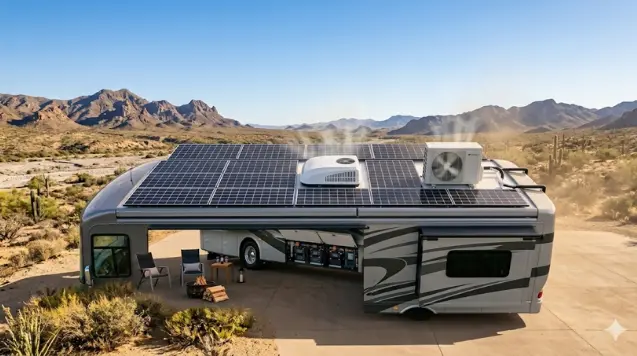
Running your RV air conditioner off solar is possible — but it’s one of the most power-hungry things you can do off-grid. Done right, you can stay cool while boondocking for days. Done wrong, you’ll drain your batteries in two hours.
Here’s exactly what it takes.
—
Can You Run RV AC on Solar?
Yes — but your solar setup needs to be sized specifically for it. A standard RV solar system (200W panels + 100Ah battery) cannot run an air conditioner. You need a purpose-built system.
Running a traditional 120V RV air conditioner on solar power requires a minimum battery bank of 700Ah (LiFePO4 recommended) and at least 1,500 watts of solar panels to sustain operation throughout a sunny day. The AC doesn’t draw power directly from panels — solar charges the battery bank, and the AC runs through a 3,000W+ inverter from stored battery energy. A 13,500 BTU rooftop unit draws 1,200–1,500 watts running and up to 4,500 watts at startup. Adding a soft start device (like MicroAir EasyStart) reduces startup surge to ~600W, making solar-powered operation viable. A 12V DC air conditioner is a more practical alternative, requiring only 400Ah of batteries and 600W of solar for similar cooling output.
—
The Math: What Your AC Actually Needs
Standard 13,500 BTU Rooftop AC
– Running watts: 1,200–1,500W
– Startup surge: 2,700–4,500W (without soft start)
– Daily use (8 hrs): ~10,000–12,000 Wh
What That Means for Your Solar System
| Component | Minimum | Recommended |
|—|—|—|
| Solar panels | 1,500W | 2,000W+ |
| Battery bank | 700Ah LiFePO4 | 1,000Ah LiFePO4 |
| Inverter | 3,000W | 3,500W pure sine wave |
| Soft start device | Strongly recommended | MicroAir EasyStart |
—
Step-by-Step: Setting Up Solar AC
Step 1: Add a Soft Start Device
The startup surge (2,700–4,500W) is the biggest obstacle to solar AC. A soft start device reduces this to ~600W — making the difference between possible and impossible for most solar setups.
Best option: MicroAir EasyStart 364 (~$300) — installs in 30 minutes, reduces startup from 4,500W to 600W.
Step 2: Size Your Battery Bank
For 8 hours of AC per day, you need ~10,000 Wh of energy. With a 50% depth of discharge on LiFePO4:
– Minimum: 700Ah at 24V = ~16,800 Wh usable
– Recommended: 1,000Ah at 24V = ~24,000 Wh usable
Avoid AGM batteries for AC loads — their limited discharge cycles make them uneconomical for this use.
Step 3: Size Your Solar Array
To recharge 10,000 Wh daily (assuming 5 peak sun hours):
– Minimum: 1,500W of panels
– Recommended: 2,000W for buffer on cloudy days
Use our RV Energy Calculator to size your exact system.
Step 4: Size Your Inverter
Your inverter must handle the AC’s running watts plus startup surge (even with soft start, ~1,500W surge remains):
– Minimum: 3,000W pure sine wave
– Recommended: 3,500W for headroom
Step 5: Consider a 12V DC Unit Instead
If building a new system, a 12V DC air conditioner (like the OutEquip Summit 2 or Dometic RTX 2000) is far more practical:
– Draws only 16–29A (192–348W) vs. 100A+ for standard units
– No inverter losses
– Works with a 400Ah battery + 600W solar system
—
Real-World Expectations
| Setup | What You Can Expect |
|—|—|
| 600W solar + 200Ah battery | No AC possible with standard unit |
| 1,500W solar + 700Ah LiFePO4 + soft start | ~4–6 hrs AC per sunny day |
| 2,000W solar + 1,000Ah LiFePO4 + soft start | ~8 hrs AC on sunny days |
| 600W solar + 400Ah LiFePO4 + 12V DC unit | ~6–8 hrs AC on sunny days |
—
The Smart Move: Combine Solar AC with Passive Cooling
Running AC all day even on a solar system is aggressive. Smart boondockers combine:
– Pre-cooling the RV before peak heat (run AC 7–10am)
– Reflective window covers to reduce heat gain
– MaxxAir fans for ventilation when it’s below 85°F outside
– AC during peak heat only (1–5pm)
This hybrid approach lets a 1,500W solar system keep a Class C comfortable all day. See our full guide: How to Keep Your RV Cool Without AC.
—
Frequently Asked Questions
How many solar panels do I need to run RV AC?
Minimum 1,500W for a standard 13,500 BTU unit. For a 12V DC unit, 600W is sufficient.
Can I run RV AC directly from solar panels?
No. Solar panels charge batteries, and the AC runs from batteries (via inverter for 120V units). There’s no direct connection.
What’s a soft start and do I need one?
A soft start device reduces your AC’s startup power surge from 4,500W to ~600W. It’s essential for solar-powered AC — without it, most inverters will shut off during startup.
Is it worth adding AC capability to an existing solar system?
Only if you already have 1,000W+ solar and 400Ah+ LiFePO4. Otherwise, upgrading costs more than the benefit — a 12V DC unit is a better path.
—
For the full RV power setup guide, read our RV Boondocking Power Setup and check How Many Watts Does an RV AC Use for detailed consumption numbers.
Realistic Runtime Expectations
Even with a properly sized system, plan for the AC to run intermittently rather than continuously — cycling on to bring the interior down to temperature, then off as the compressor cuts out, repeating throughout the day. On a fully sunny day with the recommended 700Ah/1,500W setup, most RVers can run a standard AC for 6-10 hours of cumulative runtime; cloudy days will draw down the battery bank faster than solar can replace it, so plan for generator backup or reduced AC use on multi-day cloudy stretches.
Common Mistakes When Sizing a Solar AC Setup
Underestimating startup surge. Sizing the inverter only for running watts, without margin for the 3,000-4,500W startup surge, is the most common reason a “correctly sized” system trips on AC startup.
Skipping the soft-start device. A soft-start add-on is inexpensive relative to the inverter and battery upgrade it can help you avoid, since it directly reduces the surge your system needs to handle.
Assuming panel wattage alone determines success. Panels only replenish the battery bank — undersizing the battery bank itself means the AC drains the batteries faster than solar can recharge them, regardless of panel wattage.
Frequently Asked Questions
Do I need a generator as backup even with a solar AC setup?
Most experienced boondockers keep a generator as backup for multi-day cloudy stretches or when running AC longer than the battery bank comfortably supports — solar alone rarely covers 100% of AC demand in all conditions.
Is a soft-start device worth adding?
Yes, for nearly any solar-powered AC setup — it meaningfully reduces the startup surge your inverter and battery bank need to handle, often making a smaller (and cheaper) inverter viable.

Published on June 11, 2026
Elena Brooks
Elena Brooks covers RV insurance for RVGeo, researching policy types, state requirements, and provider comparisons in depth before publishing. Her guides follow RVGeo's editorial standard of verifying every coverage detail, price, and policy term directly against insurer documentation rather than repeating marketing claims - so RV owners can compare real options, not sales pitches.
This post contains affiliate links. If you make a purchase through these links, we may earn a commission at no extra cost to you.