
Author
By Mohamed Najib
Founder of RVGeo & Certified Technical Inspector
Extended financing terms lower the monthly payment. That is the entire appeal, and it works — stretching a loan from 10 years to 15 can drop a payment by well over $100 a month. What the longer term does not change is how fast the RV itself wears out. The loan runs on a fixed amortization schedule. The rig runs on weather, road vibration, and sealant chemistry. Those two clocks do not tick at the same speed, and the gap between them is where owners get hurt.
Why 15-Year Financing Doesn’t Match Physical Longevity
A 15-year loan is a financial agreement. It is not a statement about how long the unit will last, and no lender has ever inspected the roof before writing one.
Amortization also front-loads interest. In the early years most of the payment services the debt rather than reducing the principal, so the balance falls slowly at exactly the time depreciation falls fastest. A travel trailer loses a large share of its value in the first two or three years. The loan does not care.
Physical Reality at 5–7 Years
The chassis is rarely the problem. The outer envelope is.
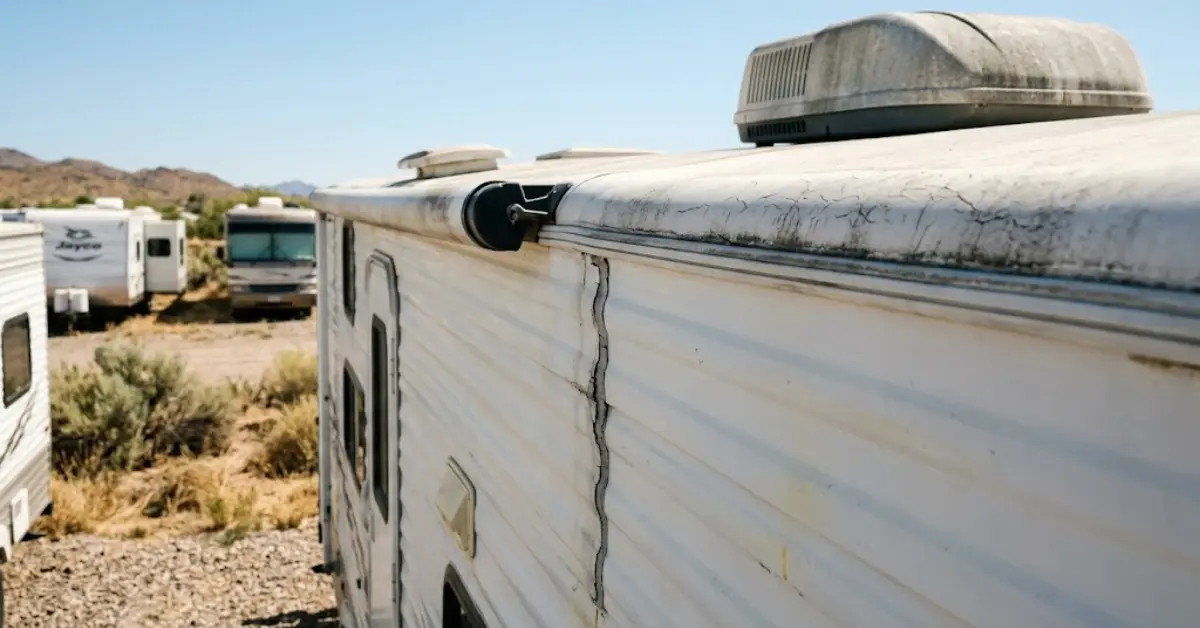
By year five to seven, the failures I find on inspection are consistent: roof lap sealant cracked or lifting at the edges, butyl tape hardened behind trim and no longer compressing, slide-out wiper seals worn flat on the leading edge, cargo door gaskets compressed and shedding, and window frames where the sealant bead has pulled away from the sidewall.
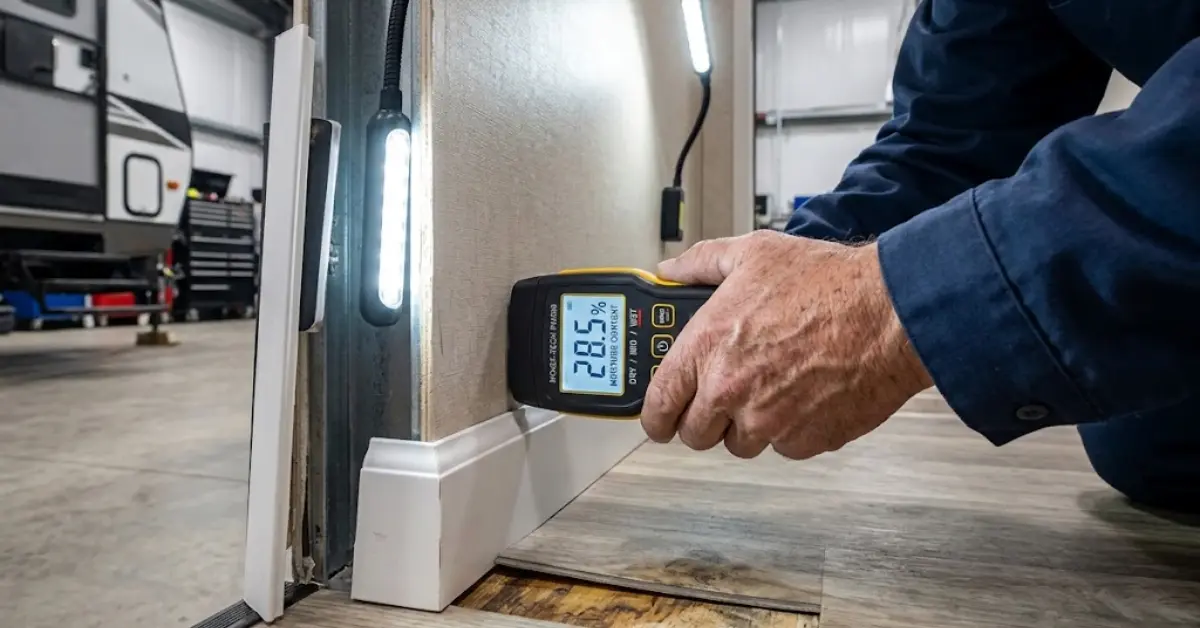
None of these are dramatic on the day they appear. All of them are moisture paths. Water that enters at a roof penetration does not stay at the roof — it tracks down the wall cavity and reaches the subfloor, where it does the expensive damage silently.
What Actually Lasts 15 Years
| Component | Survives 15 years? | Condition |
|---|---|---|
| Chassis & axles | Yes | With normal service and no accident damage |
| Framing & subfloor | Conditional | Only if kept genuinely dry — no exceptions |
| Roof membrane | Sometimes | Depends on material, storage, and UV exposure |
| Exterior seals | No | Inspect every 3–6 months, re-seal as needed |
| Tires | No | Age out around 6 years regardless of tread depth |
Read that table next to a 180-month payment schedule and the mismatch is obvious. Two line items are guaranteed to need replacement inside the loan term, and one of them — the subfloor — is conditional on maintenance you have to actually perform.
The Negative Equity Risk, With Real Arithmetic
Here is a worked example. The figures are illustrative, but the math is exact — substitute your own and the shape of the answer will not change.
Assumptions: $60,000 travel trailer, 10% down, $54,000 financed at 7.5% APR over 180 months. That gives a payment of roughly $501 per month.
After seven years of on-time payments you have paid in about $42,000. Your remaining balance is still roughly $36,000, because the early years went mostly to interest.
Now the other clock. A seven-year-old trailer in sound, dry condition typically retains something in the range of 40–50% of its original price. Call it $26,000. You are already about $10,000 underwater — uncomfortable, but survivable.
Then add water intrusion. A trailer with documented moisture in the subfloor does not sell at a small discount; it sells to a narrow pool of buyers who price in the repair. That same unit may be worth $14,000. Your gap is now $22,000, and you cannot sell your way out of it.
And this is not a gap insurance closes. Gradual water intrusion sits outside what most policies cover — the complete guide to RV insurance coverage and cost sets out where the line falls.
That is the trap. Not the interest rate — the timing.
How to Stay Ahead of It
Three things change the outcome, and none of them require refinancing.
Put money down. Every dollar of down payment is a dollar of equity you never have to earn back through amortization.
Treat sealant as scheduled maintenance, not repair. A tube of lap sealant and an hour on the roof twice a year is the cheapest insurance in RV ownership. The subfloor is the asset; the sealant is what protects it.
Keep records. A dated maintenance log with photographs is what separates “well maintained” from “seller says it was well maintained” at resale — and that distinction is worth real money.
Track your maintenance intervals with RV LIFE Pro. Start your RV LIFE Pro trial
Related reading:
- RV Insurance: The Complete Guide to Coverage & Cost
- Depreciation, Maintenance & Insurance: The Real Cost of Owning an RV
- RV Buying & Ownership Decisions That Save You Thousands
- New vs Used RV: The Real Long-Term Cost Comparison
- Reliability vs Purchase Price: What Really Matters When You Buy a Used RV
- Why Water Damage Destroys More Value Than an Accident

Published on August 17, 2026
Mike Dawson
Mike Dawson is RVGeo's lead editor, applying inspection-grade rigor to RV research - verifying manufacturer specs, testing components, and fact-checking pricing and claims before they're published. RVGeo's approach draws on a background in automotive technical inspection, applied specifically to RV electrical, power, and safety systems. Mike oversees RVGeo's foundational guides on power systems, DIY conversions, and van-life setup, with every recommendation checked against real specs and current pricing rather than assumptions.
This post contains affiliate links. If you make a purchase through these links, we may earn a commission at no extra cost to you.