
Author
Search “RV bridge stuck” on YouTube.
Go ahead. I’ll wait.
You’ll find hundreds of videos — Class A motorhomes wedged under historic railroad bridges, travel trailers with their A/C units ripped clean off, 5th wheels backing up in tears on narrow Pennsylvania country roads. Each one starts the same way: the driver trusted a GPS that had no idea how tall their rig was.
This guide covers exactly what to do instead. After three years full-timing and thousands of miles on unfamiliar roads, here’s how we’ve kept our 13’2″ motorhome out of every situation those YouTube videos document.
The fastest fix: RV LIFE Trip Wizard routes every mile based on your rig’s exact height, weight, and length. Set it up once — it protects you on every trip. Try it free for 7 days.
Why Google Maps Will Get You Into Trouble
Google Maps is a brilliant piece of software — for cars. For RVs, it has one fatal flaw: it doesn’t know you exist.
When you enter a destination, it plans the fastest route for a standard passenger vehicle. It doesn’t check bridge clearances. It doesn’t know you’re carrying propane. It has no idea your rig is 13 feet tall and 40 feet long. The result? It will confidently route you:
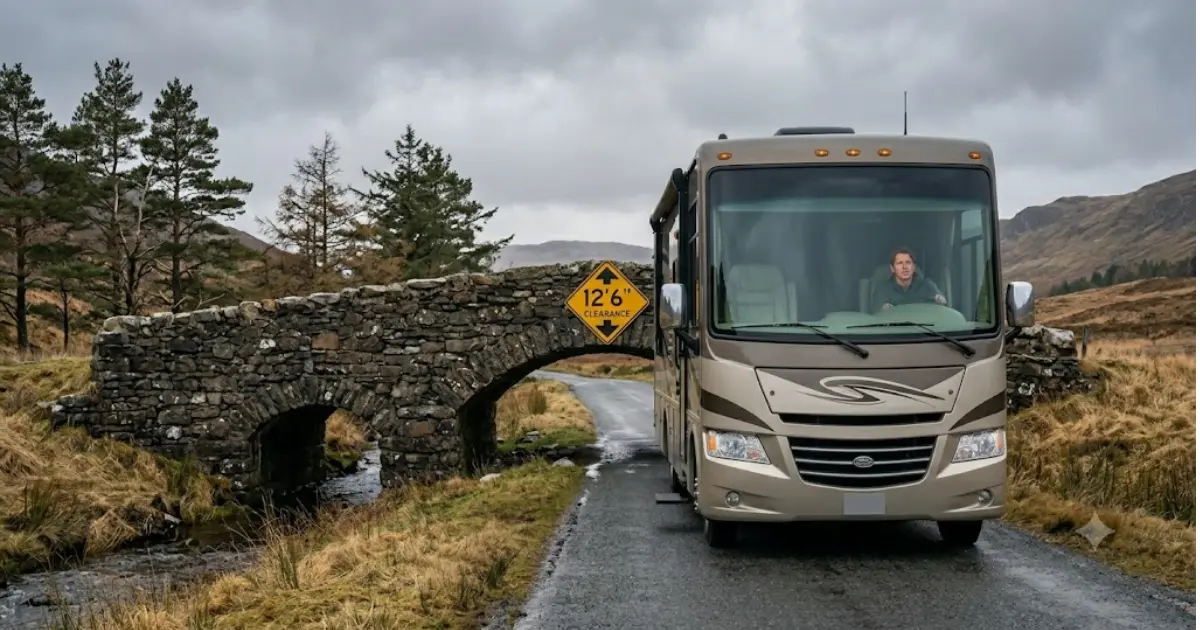
- Under a 12’6″ railroad bridge in a historic town
- Through a tunnel that bans propane
- Down a scenic parkway where RVs are legally prohibited
- Over a weight-restricted bridge your rig exceeds
The same applies to Waze, Apple Maps, and Roadtrippers. None of them have your vehicle profile.
Know Your Rig’s Exact Height — Right Now
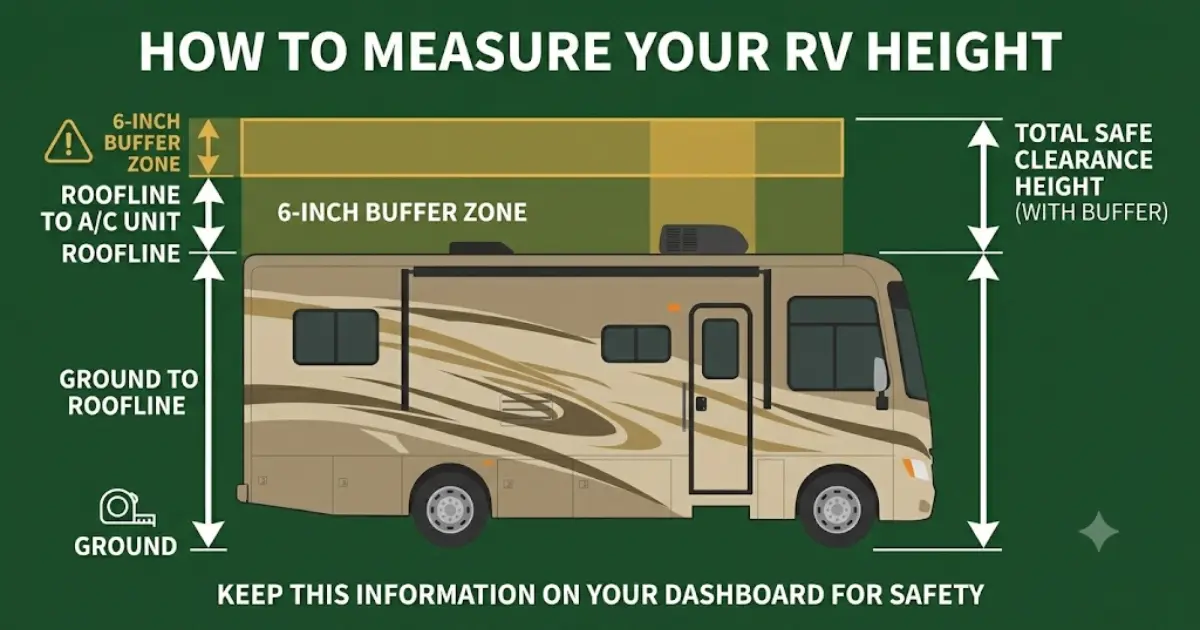
Before anything else: do you know your rig’s actual height? Not the manufacturer brochure number — the real, measured height from ground to the tallest point on your roof.
What to measure: Base roofline + air conditioning unit (adds 12–18 inches) + roof antennas + satellite dish + solar panels and mounting hardware.
Write the final number on tape and stick it on your dashboard.
The 6-inch rule: Subtract 6 inches from any posted clearance sign. Roads get repaved — repaving raises the surface. A sign that said 14’0″ may now be 13’7″ after two rounds of repaving. If your rig is 13’2″ and the sign says 13’6″, you’re not comfortable — you’re gambling.
Roads to Avoid in Any Large RV
Eastern Parkways
Parkways in New York, New Jersey, Connecticut, and Maryland were built in the 1920s–1940s for passenger cars. Many overpasses are at 11’0″ or less. The Taconic State Parkway, Merritt Parkway, and sections of the Garden State Parkway ban trucks and RVs outright. If your GPS routes you onto any of these, reroute immediately.
Propane-Restricted Tunnels
Most major US tunnels prohibit propane by law:
- Baltimore Harbor Tunnel (I-895)
- Hampton Roads Bridge-Tunnel (I-64 VA)
- Eisenhower / Johnson Tunnel (I-70 CO)
- Chesapeake Bay Bridge-Tunnel (requires escort)
Procedure: Turn off propane at the tank valve before approaching any tunnel.
Historic Town Centers
Small historic towns — especially in New England, Appalachia, and the rural South — often have 19th-century bridges with clearances designed for horse-drawn wagons. GPS apps love routing through these towns because they’re “faster.”
“No Trucks” Signs
When you see a “No Trucks” sign, it applies to you. RVs are legally classified as large vehicles in most states. The reason trucks are prohibited is usually a low bridge, a weight-restricted road, or a tight turning radius ahead.
The Right Solution: RV-Specific Route Planning
Here’s how to set up RV LIFE Trip Wizard in 10 minutes:
- Start your 7-day free trial at tripwizard.rvlife.com
- Navigate to Vehicle Profile
- Enter: total height, GVWR, total length, fuel type, propane on board yes/no
- Set your average driving speed
- Save profile
From this point forward, every route Trip Wizard generates is filtered for your specific rig. You never have to think about clearances again — the app thinks about them for you.
Try RV LIFE Trip Wizard free for 7 days →
Additional Tools Worth Knowing
- Low Clearance Map (lowclearancemap.com) — 27,000+ verified bridge clearances across the US. Free. Good secondary check on specific routes.
- Garmin RV GPS — dedicated units for RV routing. Reliable on-road navigation once your route is planned in Trip Wizard.
- iExit — shows truck stops with pull-through diesel lanes suitable for large rigs at upcoming interstate exits.
On the Road: Clearance Habits That Keep You Safe
- Watch for clearance signs early — 500 feet away gives you stopping room. 50 feet does not.
- Slow down approaching bridges — a bump at highway speed can reduce effective clearance by inches.
- When in doubt, walk it — 3 minutes to check beats days of repairs.
- Trust your mirrors, not just GPS — if something looks wrong, it probably is.
- Pre-download offline maps — cell service disappears in exactly the areas where historic low-clearance roads are most common.
Frequently Asked Questions
What happens if my RV hits a low bridge?
At minimum, roof equipment (A/C, antennas, satellite dish) is damaged or destroyed. In serious incidents, the roof structure itself is compromised. Prevention is the only good answer.
Is Trip Wizard guaranteed to avoid all low clearances?
No routing tool offers 100% guarantee — data has limits and road conditions change. Trip Wizard dramatically reduces risk, but maintain your own vigilance. The 6-inch rule applies regardless.
What should I do if my GPS routes me to a low clearance?
Stop immediately before you reach the clearance. Turn around if there’s room. Use Trip Wizard or Low Clearance Map to find an alternate route.
Are there states where low clearances are most common?
Yes — New York, New Jersey, Connecticut, Pennsylvania, and Maryland have the highest density of historic low-clearance bridges and restricted parkways.
Do weight restrictions apply to my RV?
Yes. If you’re over the posted weight limit on a bridge, you’re legally prohibited from crossing and liable for any damage. Know your GVWR and check bridge postings on rural routes.
Keep Reading
- RV LIFE Trip Wizard Review 2026 — the routing tool that solves this problem
- The Complete Guide to Planning an RV Trip in 2026 — full planning process
- Best RV Trip Planner Apps — every routing option compared
Disclosure: This article contains affiliate links. If you subscribe to RV LIFE Trip Wizard through our link, we earn a commission at no extra cost to you. We only recommend tools we use and trust.

Published on July 18, 2026
Mike Dawson
Mike Dawson is RVGeo's lead editor, applying inspection-grade rigor to RV research - verifying manufacturer specs, testing components, and fact-checking pricing and claims before they're published. RVGeo's approach draws on a background in automotive technical inspection, applied specifically to RV electrical, power, and safety systems. Mike oversees RVGeo's foundational guides on power systems, DIY conversions, and van-life setup, with every recommendation checked against real specs and current pricing rather than assumptions.
This post contains affiliate links. If you make a purchase through these links, we may earn a commission at no extra cost to you.