
Author

When you’re boondocking on BLM land, in national forests, or deep in the desert, your water supply is whatever you can carry or find — and what you find in natural sources needs proper treatment before it’s safe to drink. Boondocking water filtration is one of the most important (and most overlooked) skills for off-grid RV living. This guide covers every filtration method, what each removes, and how to build a reliable multi-stage system that works far from civilization.
Why boondocking water filtration is different from campground filtration
At a full-hookup campground, you’re connecting to municipal or well water that’s already treated. Standard RV inline filters (sediment + carbon) are enough to improve taste and remove chlorine. But when you’re boondocking, you may be filling from:
- Dispersed camping water spigots (quality varies, often untested)
- Natural streams, rivers, or lakes (contain bacteria, protozoa, and sediment)
- Unmonitored rural wells or springs
- Water you’ve stored in tanks for days or weeks
Each of these sources has different contamination risks. A single inline carbon filter is not sufficient for any of them. A proper boondocking water system uses multiple stages to address multiple threat types.
The four contamination categories to address
1. Sediment and particulates
Dirt, rust, sand, and suspended particles. These are the most visible contaminants and the easiest to filter. A sediment pre-filter (1–5 micron) is the first stage of any filtration system and protects downstream filters from clogging prematurely. Change it regularly — a clogged pre-filter kills your water pressure.
2. Biological contaminants (bacteria and protozoa)
Giardia, Cryptosporidium, E. coli, Salmonella — found in any natural water source that has contact with wildlife or human activity. These are the contaminants that cause serious illness. To remove them you need either:
- Ceramic filter or hollow fiber membrane (0.1–0.2 micron) — physically blocks bacteria and protozoa. Reliable, long-lasting, no chemicals needed.
- UV purification (SteriPen, inline UV systems) — destroys the DNA of bacteria, viruses, and protozoa without adding taste or chemicals. Requires clear water (pre-filter first).
- Chemical treatment (chlorine tablets, iodine) — works but adds taste and isn’t ideal for daily drinking water use.
3. Chemical contaminants (heavy metals, pesticides, VOCs)
Agricultural runoff, mining areas, old pipes, and industrial zones can leach chemicals into water sources. Activated carbon filters (GAC or carbon block) address chlorine, chloramines, VOCs, pesticides, and many industrial chemicals. They do NOT remove bacteria, viruses, or heavy metals on their own. For heavy metals (lead, arsenic, mercury), you need KDF media or a dedicated heavy metal reduction cartridge.
4. Viruses
Less common in North American backcountry water than in developing countries, but present near populated areas and livestock operations. Standard ceramic and hollow fiber filters do NOT remove viruses (they’re too small, 0.02–0.3 microns). To address viruses you need UV treatment or a nanofiltration/reverse osmosis membrane. For most US boondocking destinations, virus removal is a secondary concern — but it matters if you’re near agricultural areas or using water from populated recreation sites.
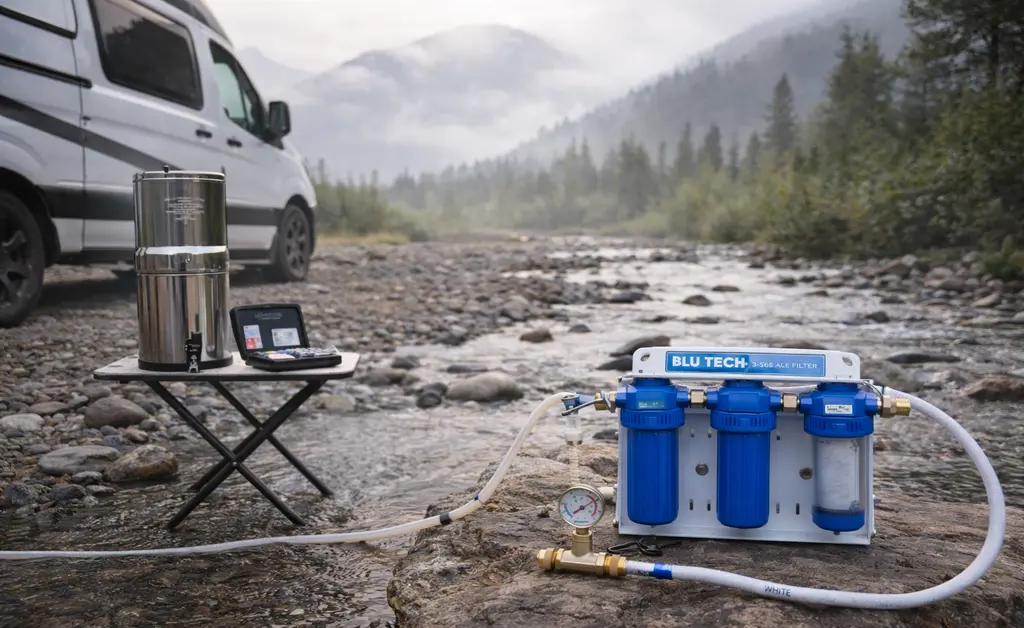
Building a multi-stage boondocking water filtration system
Stage 1: Sediment pre-filter (5 micron)
Install a whole-RV sediment filter on the incoming water line. This catches particles before they reach your pump, faucets, and downstream filters. Canister-style filters (like Camco’s EVO or the RV Water Filter Store systems) screw in-line between your hose and RV inlet. Replace every 3 months or when flow drops noticeably.
Stage 2: Carbon block filter (0.5–1 micron)
A high-quality carbon block filter (Berkey, Clearsource, or Waterdrop inline) removes chlorine, chloramines, VOCs, bad taste, and odor. Carbon block also provides some sediment reduction at the sub-micron level. This is the stage that makes water taste good. For boondocking, a 0.5 micron carbon block also begins to mechanically reduce Cryptosporidium (which is 4–6 microns) and Giardia (8–15 microns).
Stage 3: Biological treatment (ceramic or UV)
For natural water sources, add a dedicated biological barrier:
- Countertop gravity filter (Berkey): The most popular choice among boondockers. Black Berkey elements filter at 0.2 micron, removing bacteria, protozoa, most viruses, and many chemicals. No electricity needed. A 2-element Big Berkey handles a couple comfortably; a 4-element Royal Berkey suits families. Expensive upfront ($300–$500) but element lifespan is 3,000+ gallons each.
- Inline UV purifier: Systems like the VIQUA or Sterilight install in your water line and irradiate water before it reaches your faucets. Effective against all biological threats. Requires electricity (12V models available for RVs) and only works on clear water — sediment pre-filter is mandatory first.
- Squeeze or pump filter (Sawyer, MSR): Portable backpacking-style filters work for emergency or small-batch water treatment from natural sources when your main system isn’t available.
Stage 4 (optional): Reverse osmosis for drinking water
Under-sink RO systems (like the iSpring RCC7 or Waterdrop G3) produce the purest drinking water possible — removing virtually everything including viruses, heavy metals, nitrates, and fluoride. The trade-off: they waste 3–4 gallons for every 1 gallon produced, which is a significant concern when you’re conserving tank water. Most boondockers use RO only for drinking and cooking water, not for the whole-rig supply.
Treating water from natural sources (streams, rivers, springs)
Collecting water from natural sources for RV use requires extra steps beyond your inline filtration system:
- Pre-settle: Let collected water sit in a bucket for 30 minutes so heavy sediment falls out before pumping through your system.
- Pre-filter with a coarse cloth or bandana to remove large debris before running through your filtration system.
- Always treat for biological contaminants — even crystal-clear mountain streams can carry Giardia from upstream wildlife. Clear water does not mean safe water.
- Test if uncertain: Portable water test kits (WaterSafe, SureSafe) provide basic screening for coliform bacteria, nitrates, and pH in minutes. More comprehensive mail-in tests (National Testing Laboratories, Tap Score) are worth doing if you’re using an unfamiliar water source repeatedly.
Water conservation practices for boondockers
Filtration gets you safe water — conservation stretches how long it lasts:
- Low-flow faucet aerators and showerheads — reduce flow from 2.5 GPM to 0.5–1 GPM with zero noticeable difference in comfort. Simple $5–$10 swap.
- Navy showers — wet, turn off, soap, rinse. Uses 2–3 gallons instead of 20+.
- Hand sanitizer at the door — reduces hand-washing water use significantly when coming in from outside.
- Foot pump faucet — old-school but extremely effective for on-demand low-flow dispensing when cooking or washing dishes.
- Track your usage: A flowmeter on your inlet line shows exactly how much water you’re using per day. Most full-time boondockers target under 5 gallons/person/day.
Frequently asked questions about boondocking water filtration
Is a Berkey filter enough for boondocking?
For drinking and cooking water: yes, a Berkey is one of the most comprehensive point-of-use filters available and handles most boondocking water sources reliably. For whole-rig water (showers, washing dishes), pair it with a good inline sediment + carbon filter on the main line. Berkey for drinking, inline filtration for everything else.
Can I drink water directly from a mountain stream?
Not safely without treatment. Clear, fast-moving mountain streams still carry Giardia and Cryptosporidium from wildlife upstream. Always treat water from natural sources with a filter rated to 0.2 micron or smaller, or use UV treatment after pre-filtering.
How long can water sit in an RV fresh tank?
Untreated water: 1–2 weeks maximum before bacterial growth becomes a concern, especially in warm weather. To extend storage: add a small amount of unscented household bleach (1/4 tsp per 15 gallons), or use a silver-ion tank treatment product. Drain and sanitize your fresh tank at least twice per year — a musty smell means bacteria.
A solid boondocking water filtration system is a one-time investment that pays off in safety, taste, and peace of mind every single day off-grid. Start with a quality sediment + carbon inline filter, add a Berkey or UV system for biological treatment, and your water quality will exceed what most people drink at home — even when you’re camped in the middle of nowhere.

Published on January 29, 2026
Emma STONNE
This post contains affiliate links. If you make a purchase through these links, we may earn a commission at no extra cost to you.