
Author
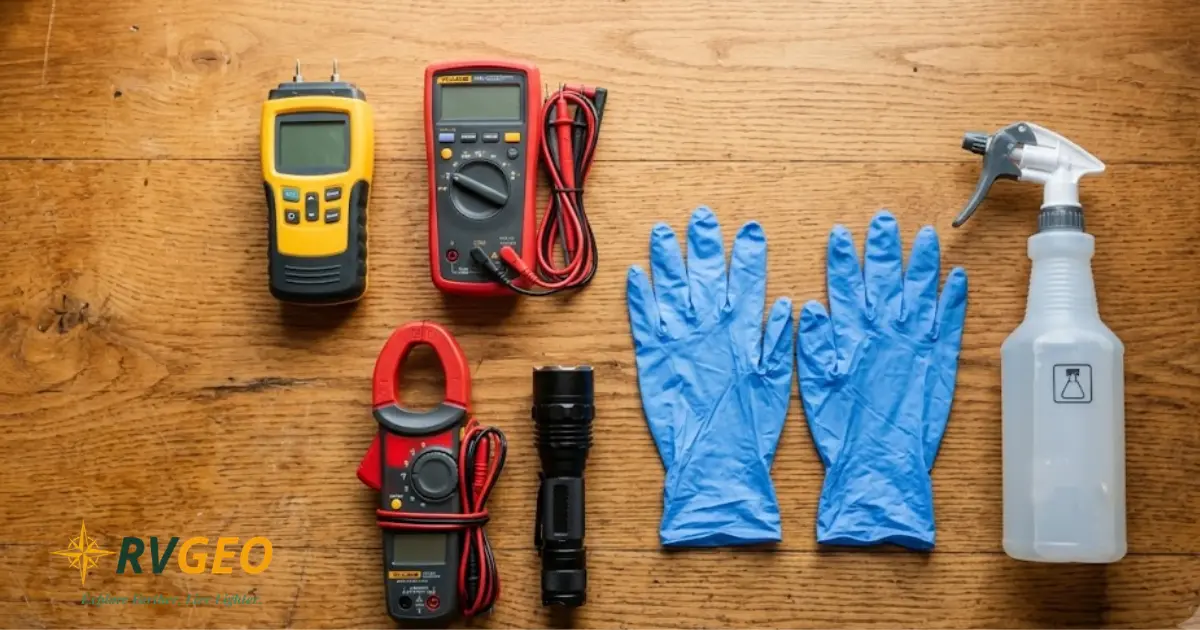
After 19 years inspecting vehicles, I can tell you the gap between guessing and knowing when you buy a used RV comes down to a handful of inexpensive tools. Together they cost less than a single surprise repair — and they turn a seller’s “it runs great” into something you can actually verify.
Here’s exactly what I reach for to check a used RV before any money changes hands: what each tool does, how it works, and which model is worth buying.
As an Amazon Associate, RVGeo earns from qualifying purchases — at no extra cost to you.
1. Moisture Meter — the Most Important Tool You’ll Own
Water is the number-one killer of RV value, and it hides. A moisture meter is the only way to catch it before it shows on the surface.
How it works: a pin-type meter drives a tiny current between two metal pins — the more water in the material, the better it conducts, so the resistance drops and the reading climbs. A pinless (capacitive) meter emits a high-frequency field to read moisture below the surface without leaving holes. Know the numbers: under 12–15% is dry, over 20% means active water retention, and over 28–30% means the wood is already rotting.
What to buy: a combination pin/pinless meter gives you both quick surface scans and confirmed pin readings.
Pick: Extech MO55 (pin/pinless) — the combination meter home inspectors trust.
2. Multimeter — Your Electrical Baseline
Before you trust any “new battery” or “just rewired” claim, verify it.
How it works: two leads read the potential difference (voltage) across a circuit, or confirm continuity — whether a fuse or wire is actually passing current.
What to buy: auto-ranging, AC/DC, from a name you can trust.
Pick: Klein Tools MM400 — auto-ranging, durable, does everything a buyer needs.
3. DC Clamp Meter — Read Current Without Cutting a Wire
The coach electrical system is where previous owners improvise. A clamp meter shows you what’s really flowing.
How it works: a Hall-effect sensor built into the jaw reads the magnetic field around a wire, so you measure amps without breaking the circuit — perfect for spotting a parasitic draw or checking what the charger actually delivers. Make sure it reads DC, not just AC.
Pick: KAIWEETS AC/DC Clamp Meter — DC-capable and great value.
4. Battery Load Tester — the Battery’s Real Health
A battery can read a healthy 12.7V at rest and still be finished the moment you put a load on it. A resting voltage tells you almost nothing.
How it works: a load tester sends a frequency impulse across the terminals to calculate the battery’s internal resistance and cranking capacity, then compares it to the factory rating. That’s how you catch a sulfated battery a seller swears is “good.”
Pick: ANCEL BST200 — pocket-sized, 100–1100 CCA, reads state of health.
5. LP Leak-Detector Spray — Gas Safety in Seconds
The propane system isn’t a bargaining chip — it’s life-safety. Never skip it.
How it works: the foaming liquid bubbles up anywhere gas escapes — spray it on every connection, hose, and regulator. (Pros also use a gas manometer that pressurizes the line; a dropping needle confirms a leak.) Choose a non-corrosive, gas-line-safe formula.
Pick: Gasoila Leak Detector Spray — non-corrosive and safe for gas lines.
Two Optional Upgrades
- Thermal camera — hidden water reads as a cold patch on the screen, so you can scan a whole wall at a glance.
- Water pressure gauge (PSI) — confirms the plumbing holds pressure without a hidden leak.
Neither is essential, but both make a hard-to-reach problem obvious.
How to Use Them Together
Work in order of what costs you the most: the moisture meter first (structure is the one thing you can’t fix), then the multimeter, clamp meter, and battery tester for the electrical system, then the leak spray for gas. It takes fifteen minutes and can save you five figures.
Bottom Line
These tools cost less than one surprise RV repair. Bring them to every used-RV viewing — and follow the full pre-purchase RV inspection checklist so you know exactly where to use each one. It all ties back to the same truth: the decisions that save you thousands are the ones you make before you sign.

Published on July 23, 2026
Mike Dawson
Mike Dawson is RVGeo's lead editor, applying inspection-grade rigor to RV research - verifying manufacturer specs, testing components, and fact-checking pricing and claims before they're published. RVGeo's approach draws on a background in automotive technical inspection, applied specifically to RV electrical, power, and safety systems. Mike oversees RVGeo's foundational guides on power systems, DIY conversions, and van-life setup, with every recommendation checked against real specs and current pricing rather than assumptions.
This post contains affiliate links. If you make a purchase through these links, we may earn a commission at no extra cost to you.