
Author
RV Electrical Safety Guide: Fuses, Breakers & Grounding Explained
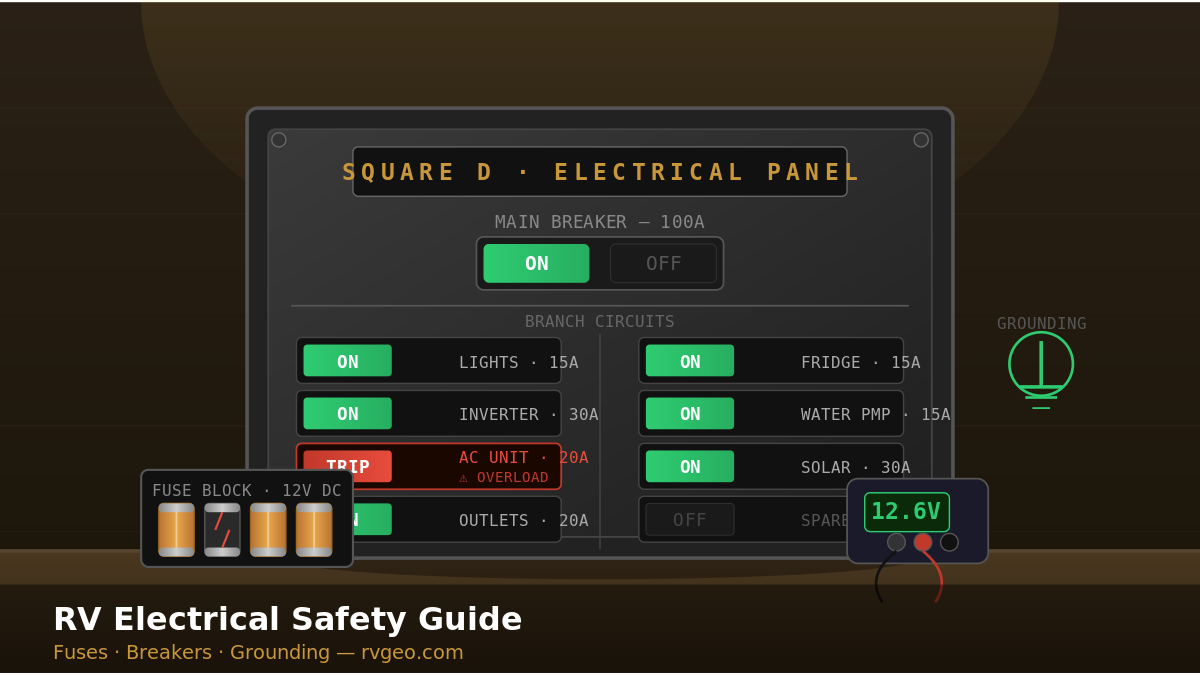
Electrical problems are the leading cause of RV fires. Most of them are preventable with proper fusing, correct wire sizing, and a solid grounding system. This guide covers everything you need to know to wire your RV safely — whether you’re doing a full build or auditing an existing system.
The 3 Pillars of RV Electrical Safety
- Fusing: Every positive wire must be fused as close to the power source as possible
- Wire sizing: Every wire must be rated for the current it carries plus a safety margin
- Grounding: Every component must have a clean, low-resistance path back to the battery negative
All three must be correct. A properly fused circuit with undersized wire is still a fire hazard. A correctly sized wire with a bad ground connection causes voltage drop, overheating, and component failure.
Understanding Your RV’s Two Electrical Systems
12V DC System
Powers lights, water pump, refrigerator (12V), furnace blower, slideout motors, and most built-in RV components. Runs directly from your battery bank. Uses fuses and circuit breakers rated in amps at 12V.
120V AC System
Powers outlets, microwave, air conditioner, and appliances — identical to household current. Comes from shore power, generator, or inverter. Uses standard residential breakers (15A, 20A, 30A, 50A).
Critical rule: Never mix DC and AC wiring in the same conduit or junction box. Keep the two systems physically separated throughout the rig.
Fusing: The Most Important Safety Rule
A fuse protects the wire, not the device. Its job is to melt before the wire overheats and starts a fire. This means:
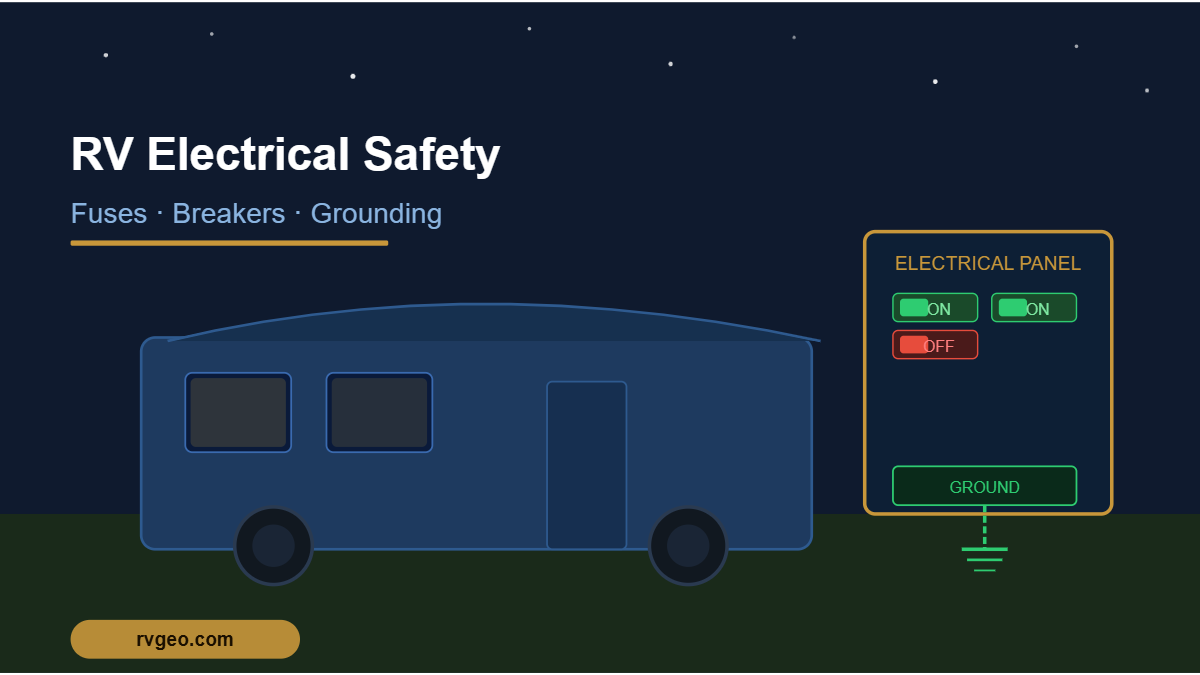
- The fuse rating must match the wire’s ampacity, not the device’s draw
- The fuse must be installed within 7 inches of the positive terminal (ABYC standard)
- Every branch circuit needs its own fuse at the source
Common Fuse Types in RVs
| Fuse Type | Where Used | Rating Range |
|---|---|---|
| ANL / Mega fuse | Main battery disconnect, inverter | 100–400A |
| MIDI fuse | Mid-run protection, DC-DC chargers | 30–100A |
| ATC/ATO blade | Individual circuits in fuse block | 1–40A |
| Class T fuse | Lithium battery main fuse | 100–400A |
Main Battery Fuse Sizing
- 100Ah lithium battery: 200A ANL or Class T fuse
- 200Ah lithium battery: 300A ANL or Class T fuse
- Inverter (2,000W): 200A fuse on inverter positive wire
- Inverter (3,000W): 300A fuse on inverter positive wire
Wire Sizing Chart for RV DC Systems
| Wire Gauge (AWG) | Max Amps (12V, under 10ft) | Common Use |
|---|---|---|
| 16 AWG | 13A | LED lights, USB chargers |
| 14 AWG | 18A | Water pump, small fans |
| 12 AWG | 25A | Fridge, furnace blower |
| 10 AWG | 35A | Solar charge controller output |
| 8 AWG | 50A | DC-DC charger, large loads |
| 4 AWG | 100A | Inverter (under 1,500W) |
| 2 AWG | 130A | Inverter (2,000W), battery interconnects |
| 1/0 AWG | 175A | Large inverter (3,000W+) |
| 4/0 AWG | 300A | Main battery cables, large lithium banks |
Key rule: Always increase wire gauge for longer runs. Every extra 10 feet of wire doubles the effective resistance. Use a voltage drop calculator for runs over 10 feet.
Grounding: The Most Overlooked Safety Issue
A bad ground causes more mysterious RV electrical problems than any other single issue — flickering lights, devices resetting, inverter faults, and battery monitors reading incorrectly. Here’s how to ground correctly:
DC Grounding Rules
- All negative wires should run to a central negative bus bar, not daisy-chained from device to device
- The negative bus bar connects to the battery negative with a single large wire (same gauge as positive)
- Ground the chassis at one point from the negative bus bar — use a dedicated ground lug bolted to bare metal (not painted surface)
- Solar panels must be grounded — connect the panel frames to the chassis ground
AC Grounding Rules
- The AC ground wire (green or bare copper) must connect to the chassis
- Never connect AC neutral to ground inside the RV — this is done at the shore power pedestal
- Install a surge protector at the shore power inlet — it protects against miswired pedestals which are surprisingly common at campgrounds
One more reason grounding matters more than ever: under the 2026 NEC, new RVs will ship with a factory-installed Grounding Monitor Interrupter (GMI) that physically blocks shore power whenever a pedestal ground is faulty. Our guide to the new 2026/27 RV electrical rules explains the GMI requirement and how to retrofit similar protection on an older rig.
Shore Power Safety
Campground pedestals are frequently miswired, corroded, or delivering incorrect voltage. Protect your RV with:
- Surge Protector: Protects against voltage spikes and miswired pedestals. Progressive Industries and Hughes Autoformers make the most trusted units. Non-negotiable for full-timers.
- EMS (Electrical Management System): More advanced than a surge protector — also monitors voltage and disconnects if it drops below safe levels (low voltage is more common than surges and damages AC compressors and converters silently over time).
- Polarity checker: A $5 outlet tester confirms correct wiring before you plug in. Use it every time at an unfamiliar campground.
Inverter Safety Checklist
- Install within 3 feet of battery bank — minimize cable length
- Fuse the positive cable at the battery, not at the inverter
- Use pure sine wave for AC appliances with motors (AC unit, fridge compressor, microwave)
- Never install in an enclosed space without ventilation — inverters generate significant heat
- Install a battery disconnect switch between battery and inverter for emergency shutoff
RV Electrical Inspection Checklist
Run through this checklist annually or before purchasing a used RV:
- All positive wires fused within 7 inches of source
- No undersized wires (check for warm wires under load — warm = too small)
- Battery terminals clean, tight, and free of corrosion
- Shore power cord and plug not cracked or discolored
- Surge protector or EMS installed and functional
- Inverter properly fused and ventilated
- Chassis ground connections clean and tight
- GFCI outlets in bathroom and kitchen functional
- Smoke and CO detector installed and tested
Frequently Asked Questions
What gauge wire should I use for my inverter?
It depends on inverter size and cable length. A 2,000W inverter at 12V draws ~167A peak. Use 2/0 AWG for runs under 4 feet, 4/0 AWG for runs up to 8 feet. Always match the negative cable gauge to the positive.
Can I use automotive wire in my RV?
Automotive wire (GXL, TXL) works for DC circuits but is not rated for 120V AC. For AC wiring, use UL-listed building wire (THHN/THWN) or marine-grade wire. Never use standard lamp cord for any RV wiring.
How do I find an electrical short in my RV?
Remove all fuses and reinsert one at a time with a multimeter set to current mode in series with the circuit. The circuit that shows current draw with no loads connected has a short. Systematically trace the wire from fuse to each device in that circuit.
See Also
- Best RV Inverter Charger in 2026: Tested & Ranked
- How to Size Your RV Battery Bank: Step-by-Step Guide
- RV Power System Setup: Complete Guide for Vans and RVs
- RV Solar vs Generator for Boondocking

Published on May 27, 2026
Mike Dawson
Mike Dawson is RVGeo's lead editor, applying inspection-grade rigor to RV research - verifying manufacturer specs, testing components, and fact-checking pricing and claims before they're published. RVGeo's approach draws on a background in automotive technical inspection, applied specifically to RV electrical, power, and safety systems. Mike oversees RVGeo's foundational guides on power systems, DIY conversions, and van-life setup, with every recommendation checked against real specs and current pricing rather than assumptions.
This post contains affiliate links. If you make a purchase through these links, we may earn a commission at no extra cost to you.