
Author
RV Solar vs Generator for Boondocking: Real Cost & Performance Compared
Every serious boondocker eventually faces this decision: go solar, run a generator, or do both? The debate is older than lithium batteries, and the answer genuinely depends on how you camp. What changed in the last five years is that solar costs dropped dramatically while generator fuel costs rose — shifting the math significantly in solar’s favor.
This comparison covers the real numbers: upfront cost, fuel and maintenance over 5 years, noise, reliability, weather dependency, and the specific scenarios where each power source wins.
Quick Comparison: Solar vs Generator for RV Boondocking
| Factor | Solar | Generator |
|---|---|---|
| Upfront cost | $800–$3,000+ | $400–$3,000 |
| Fuel cost | $0 (sun is free) | $3–8/day (gasoline/propane) |
| Noise | Silent | 60–70 dB |
| Maintenance | Near zero | Oil changes, spark plugs, filters |
| Weather dependency | Yes (clouds reduce output) | None |
| Campground restrictions | None | Many restrict generator hours |
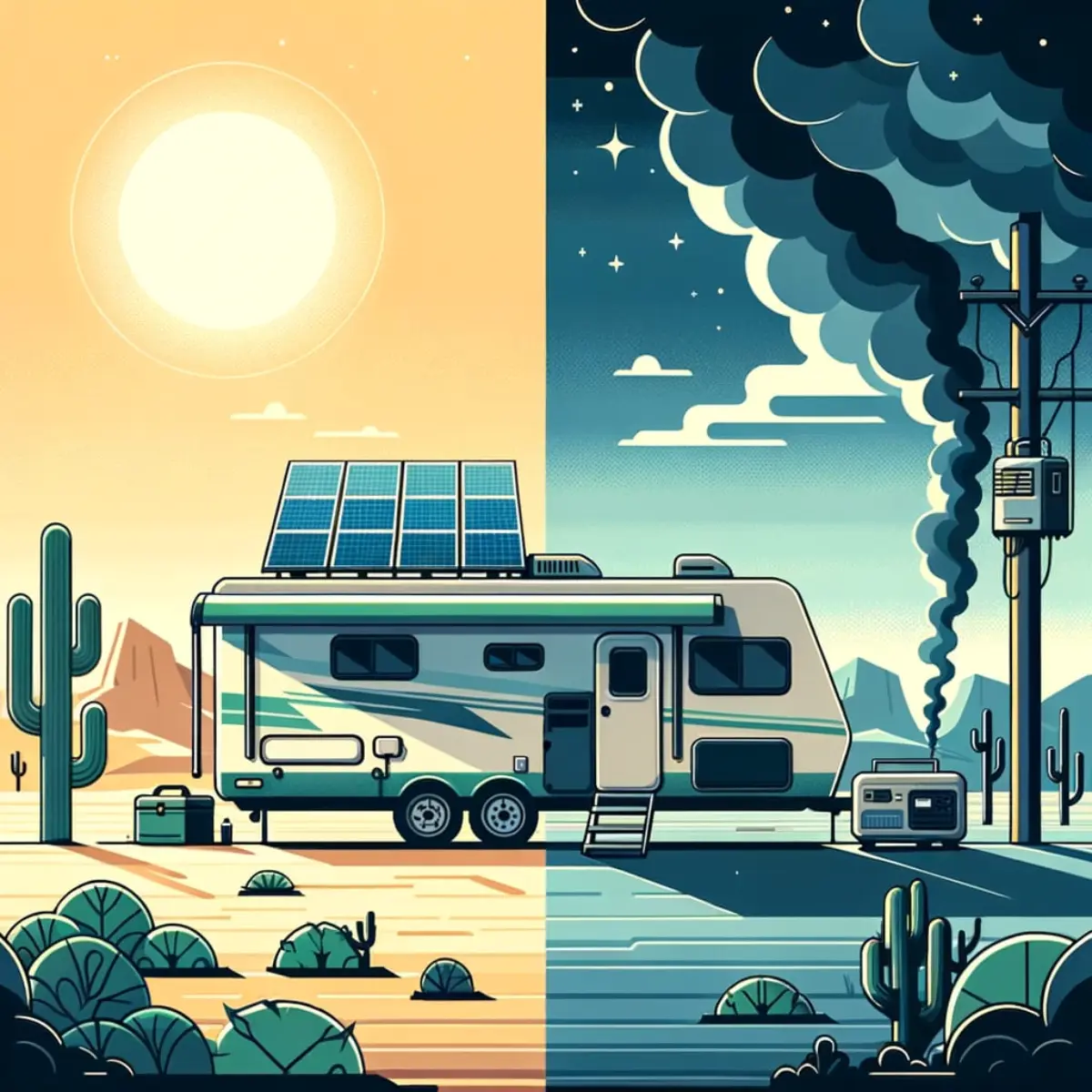
| 5-year total cost | $1,000–$3,500 | $3,500–$8,000 |
| Continuous high-draw ability | Limited by battery | Unlimited while running |
| Night use | Yes (battery) | Noisy at 2am — not recommended |
The Real Cost Over 5 Years
Solar Cost Analysis
A solid entry-level boondocking solar setup:
- 400W of roof panels: ~$600
- 30A MPPT charge controller: ~$150
- Installation hardware/wiring: ~$200
- Total upfront: ~$950
Ongoing costs: virtually zero. No fuel, no oil changes. Panels last 25+ years. Controller lasts 10–15 years. 5-year total: ~$1,000 (upfront + minor maintenance).
Generator Cost Analysis
A reliable 2,000W inverter generator (Honda EU2200i or equivalent):
- Purchase: ~$1,100
- Fuel: 0.5–1 gallon/hour at 50% load × ~2 hours/day × 365 days = ~365 gallons/year
- Fuel at $3.50/gallon: ~$1,275/year
- Annual maintenance (oil, filters, plugs): ~$50/year
- 5-year total: ~$7,700
Even a $3,000 solar system with a quality LiFePO4 battery bank breaks even with a generator in under 2 years of full-time boondocking use.
Solar: The Real Advantages
Silence
Solar produces zero noise. You can wake up at 5am to bird calls, not engine noise. This isn’t a minor comfort issue — it’s the defining quality-of-life difference for full-time or extended boondockers. Many public lands and campgrounds have strict generator quiet hours (typically 8pm–8am). Solar has no restrictions.
No Fuel Logistics
Carrying, storing, and sourcing gasoline while remote camping is a genuine hassle. Solar eliminates the fuel run, the storage can, and the fuel stabilizer for winter storage.
Passive Recharging
Solar recharges your batteries while you sleep, hike, or explore. A generator requires you to be present, running an engine, in a place where that’s acceptable.
Low Maintenance
A solar system installed correctly requires no routine maintenance. Occasionally clean the panels, check connections annually. That’s it.
Generator: The Real Advantages
Weather Independence
On cloudy, rainy, or heavily shaded days, your solar output drops to 10–30% of rated capacity. A generator doesn’t care about weather. For boondockers in the Pacific Northwest or camping under forest canopy, consistent solar output isn’t guaranteed.
High-Draw Appliances
Running an RV air conditioner requires 1,500–3,500W continuously — far beyond what most portable solar setups can sustain through a battery bank. A generator handles AC, electric cooking, and high-draw tools directly.
Instant Recharge
A 2,000W generator can recharge a 200 Ah LiFePO4 battery bank in about 2 hours. Solar with 400W of panels takes 4–6 hours of good sun. When you’ve had a run of cloudy days and need power fast, a generator recovers your bank quickly.
Lower Barrier to Entry
A $400 inverter generator and an extension cord gets you started without any installation. Solar requires wiring, mounting, and charge controller configuration.
The Hybrid Approach: Why Most Full-Timers Use Both
The most practical boondocking power strategy combines solar as the primary source with a generator as the emergency backup:
- Solar handles 90–95% of your power needs during normal camping
- Generator runs 1–2 hours every 3–5 days during extended cloudy periods to top up batteries
- Generator powers high-draw needs like charging a second vehicle battery or running a power tool
This hybrid approach gives you the silence and fuel savings of solar with the weather reliability of a generator — without the daily fuel cost and noise of generator-only operation.
What About Portable Power Stations?
For campers who don’t want to install roof panels, a large portable power station (1,500–2,000 Wh) paired with portable solar panels offers a middle ground. You get solar benefits without installation, plus the station can be charged via shore power or a vehicle’s 12V socket.
The limitation is capacity — portable setups rarely match a properly sized roof-mounted system for extended boondocking. See our best portable power station for RV guide for the top options.
Which Is Right for Your Boondocking Style?
Choose solar if:
- You boondock in sunny climates (Southwest USA, desert, open plains)
- You stay at one site for 3+ days at a time
- Silence and stealth camping matter to you
- You’re planning a full RV solar system installation anyway
Choose a generator if:
- You camp primarily in shaded or cloudy environments
- You run an air conditioner regularly
- You need occasional high-draw power (power tools, welding)
- You move campsites daily and can’t rely on consistent solar angles
Choose both if:
- You full-time or extended boondock (7+ days)
- You want redundancy and weather resilience
- Your electrical demands include both steady low-draw and occasional high-draw appliances
For a complete guide to building a full off-grid power system, see our RV Boondocking Power Setup guide and the RV Gear & Power Complete Guide.
Frequently Asked Questions
How many solar panels do I need to eliminate generator use?
For a typical boondocking load of 1,500–2,000 Wh/day, you need 400–600W of solar panels in a sunny climate. In partially cloudy conditions, 600–800W provides better reliability. Pair this with a 200–300 Ah LiFePO4 battery bank.
What’s the quietest RV generator?
Honda EU2200i and Yamaha EF2000iSv2 are the benchmark for quiet operation at 48–57 dB at 25% load. Most campers find anything below 60 dB acceptable. Above 65 dB becomes disruptive to neighbors.
Can solar run an RV air conditioner?
Directly from panels, no — the power demand is too high and inconsistent. With a large LiFePO4 bank (400+ Ah) and 800W+ of solar, you can run a small 13,500 BTU AC for 1–2 hours in the afternoon and recharge overnight. It requires a purpose-designed system.
Is solar worth it for weekend camping only?
For 2–3 camping days per month, the math is less compelling. A 400W system costs ~$950 and saves maybe $20–$40/month in generator fuel — breakeven is 2–4 years. It’s still worth it for the silence and convenience, but the financial case is weaker than for full-timers.
Key Takeaways
- 5-year total cost: solar ~$1,000–$3,500 vs generator ~$7,700 for regular boondockers
- Solar wins on silence, fuel cost, and passive recharging in sunny climates
- Generator wins on weather reliability, high-draw capability, and lower setup barrier
- The best answer for extended boondocking is both — solar primary, generator backup
- Use the Free RV Power Calculator to size your solar and battery system before deciding
For the complete picture of off-grid RV power, read the RV Gear & Power Complete Guide.
Total Cost of Ownership: The 5-Year Math
Upfront costs favor the generator. Long-term costs favor solar. Here is what the numbers look like over five years for a typical boondocker camping 60 days per year:
Generator scenario (Honda EU2200i + 2 hours/day of runtime):
- Generator cost: $1,200
- Fuel: 0.9 gallons per hour x 2 hours x 60 days x 5 years = 540 gallons x $4 = $2,160
- Oil changes and maintenance: ~$200 over 5 years
- 5-year total: approximately $3,560
Solar scenario (400W system + 200Ah LiFePO4):
- 400W solar panels: $400-600
- MPPT charge controller: $150-250
- 200Ah LiFePO4 battery: $500-700
- Wiring and installation: $200-400
- Maintenance over 5 years: near zero
- 5-year total: approximately $1,250-1,950
Solar breaks even versus generator at approximately 18-30 months of regular boondocking use. After that, every camping day is essentially free energy. The generator continues costing fuel money indefinitely.
Noise, Stealth, and Campsite Etiquette
One factor the numbers do not capture: generator noise changes the camping experience. Even the quietest inverter generators (Honda EU2200i at 48-57 dB) are audible at 50 feet. Many dispersed camping areas and some state parks prohibit generator use during quiet hours (typically 10pm to 8am). Generator noise is the single most common source of conflict at campsites.
Solar is completely silent. For stealth camping on public land, solar is the only viable primary power source. A running generator announces your presence; solar does not.
Frequently Asked Questions
How many solar panels do I need to eliminate generator use?
For a typical boondocking load of 1,500-2,000 Wh per day, you need 400-600W of solar in a sunny climate paired with a 200-300Ah LiFePO4 bank. In partially cloudy conditions, 600-800W provides better reliability. This setup eliminates generator use for 90-95% of camping days.
What is the quietest RV generator available?
Honda EU2200i and Yamaha EF2000iSv2 are the benchmark for quiet operation at 48-57 dB at 25% load. Most campers find anything below 60 dB acceptable for daytime use. Above 65 dB becomes disruptive at neighboring campsites.
Can solar run an RV air conditioner?
Not directly from panels during operation. With a large LiFePO4 bank (400Ah+) and 800W+ of solar, you can run a 13,500 BTU AC for 1-2 hours in the afternoon using stored battery power, then recharge overnight. It requires a purpose-designed high-capacity system and is expensive to set up.
Is solar worth it for weekend-only camping?
For 2-3 camping days per month, the financial case is weaker. A 400W system costs roughly $1,000-1,500 installed and saves $20-40 per month in generator fuel — breakeven is 2-4 years. However, the silence, convenience, and zero maintenance often make it worthwhile even for occasional campers who value the experience over pure cost optimization.
Using a solar generator on a jobsite? The sizing math is different from RV use — construction tools have higher surge multipliers and simultaneous load patterns. The free Jobsite Solar Generator Calculator handles the full calculation: continuous output, peak surge, battery, and solar array size based on your actual tools.
See also: Best RV Inverter Charger in 2026: Tested & Ranked

Published on May 4, 2026
Mike Dawson
Mike Dawson is RVGeo's lead editor, applying inspection-grade rigor to RV research - verifying manufacturer specs, testing components, and fact-checking pricing and claims before they're published. RVGeo's approach draws on a background in automotive technical inspection, applied specifically to RV electrical, power, and safety systems. Mike oversees RVGeo's foundational guides on power systems, DIY conversions, and van-life setup, with every recommendation checked against real specs and current pricing rather than assumptions.
This post contains affiliate links. If you make a purchase through these links, we may earn a commission at no extra cost to you.