
Author
Best MPPT Charge Controller for RV in 2026 (Ranked by Size & Budget)
Your MPPT charge controller is the brain of your solar system — it converts panel output into the right voltage and current to charge your battery safely and efficiently. A good controller extracts 20–30% more energy from your panels than a cheap PWM unit. This guide ranks the best MPPT controllers for RV use across every system size.
MPPT vs PWM: Why It Matters
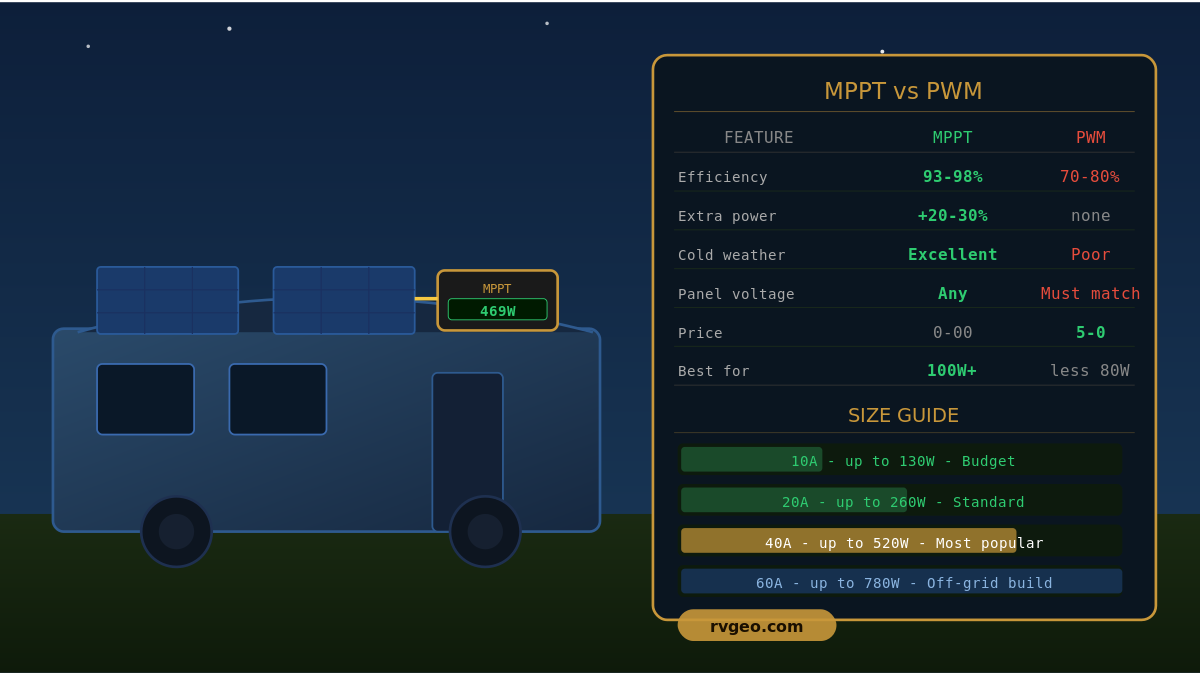
PWM (Pulse Width Modulation) controllers are cheap but wasteful — they simply connect the panels to the battery and waste any voltage above the battery’s charging voltage as heat. MPPT (Maximum Power Point Tracking) controllers continuously find the optimal operating point on the panel’s power curve and convert excess voltage into usable current.
In practice: a 200W panel on a PWM controller might deliver 130–150W to a 12V battery. The same panel on an MPPT controller delivers 180–195W. That’s 25–30% more power from the same panels — enough to justify the price difference in the first season of use.
Top MPPT Charge Controllers at a Glance
| Controller | Max Amps | Max PV Input | Bluetooth | Price | Best For |
|---|---|---|---|---|---|
| Victron SmartSolar 100/30 | 30A | 100V / 400W | Yes | ~$130 | Small systems, Victron ecosystem |
| Renogy Wanderer 30A MPPT | 30A | 100V / 400W | Optional | ~$80 | Budget 30A |
| Victron SmartSolar 100/50 | 50A | 100V / 700W | Yes | ~$200 | Mid-size systems |
| Epever Tracer 4210AN | 40A | 150V / 520W | No (add-on) | ~$100 | Best value 40A |
| Victron SmartSolar 150/70 | 70A | 150V / 1,000W | Yes | ~$380 | Large systems 800W+ |
| Renogy DCC50S | 50A | 50V / 200W solar | No | ~$180 | Combined DC-DC + MPPT |
How to Choose the Right Controller Size
Controller size (in amps) determines how much current it can pass to your battery. Here’s how to calculate what you need:
Formula: Total panel watts ÷ battery voltage × 1.25 safety factor = minimum controller amps
- 400W panels ÷ 12V × 1.25 = 41.7A minimum → use a 40A or 50A controller
- 600W panels ÷ 12V × 1.25 = 62.5A minimum → use a 60A or 70A controller
- 800W panels ÷ 12V × 1.25 = 83.3A minimum → use an 80A or 100A controller
Always size up rather than down — running a controller at its maximum rating continuously causes overheating and reduces lifespan.
1. Victron SmartSolar 100/30 — Best for Small Systems
Overview
The Victron SmartSolar 100/30 is the most recommended MPPT controller for RV builds under 400W. It’s not the cheapest 30A controller on the market, but Victron’s build quality, the VictronConnect app integration, and the reliability record across thousands of installations justify the price premium. If you ever expand your system, adding a second Victron component is seamless.
Key Specs
- Max charge current: 30A
- Max PV voltage: 100V open circuit
- Max PV power (12V battery): 400W
- Battery compatibility: LiFePO4, AGM, Gel, Flooded, custom profiles
- Bluetooth: Built-in — VictronConnect app for iOS and Android
- Display: No built-in display (monitor via app)
- Warranty: 5 years
What RVers Like
- VictronConnect app shows live solar production, battery state, historical data
- Custom battery profiles — set exact charge voltages for any battery chemistry
- Integrates with Victron GX devices for whole-system monitoring
- Extremely reliable — runs for years without issues in full-time rigs
Downsides
- No built-in display — requires phone to see data
- More expensive than Renogy or Epever equivalents
Verdict: Best MPPT controller for 200–400W systems. Worth the premium over budget alternatives.
2. Epever Tracer 4210AN — Best Value 40A Controller
Overview
The Epever Tracer series is the most popular MPPT controller in the budget-to-mid range globally. The 4210AN delivers 40A of charging current, supports up to 150V panel input (allowing series panel wiring), and includes a proper LCD display showing all key metrics without needing a phone. For RVers who want solid performance without paying Victron prices, Epever is the go-to choice.
Key Specs
- Max charge current: 40A
- Max PV voltage: 150V open circuit
- Max PV power (12V): 520W
- Battery compatibility: LiFePO4 (custom profile), AGM, Gel, Flooded
- Display: Built-in LCD — shows voltage, current, power, temperature
- Bluetooth: Optional add-on module (~$15)
- Warranty: 1 year (replace every 5–7 years in practice)
What RVers Like
- Built-in display — no phone needed to monitor
- 150V input allows wiring panels in series for long cable runs
- RS485 port for data logging and monitoring integration
- Excellent value — ~$100 for 40A is hard to beat
Downsides
- Lithium profile requires manual configuration (not plug-and-play like Victron)
- Bluetooth is an add-on, not built-in
- Build quality is functional but not premium
Verdict: Best budget MPPT controller for 400–600W systems. Reliable and feature-rich for the price.
3. Victron SmartSolar 100/50 — Best Mid-Size Controller
Overview
The SmartSolar 100/50 is the sweet spot in Victron’s lineup — 50A of output handles up to 700W of solar panels on a 12V system, covering most RV roof configurations. The built-in Bluetooth and full app integration make it the easiest controller to configure and monitor. For systems between 400W and 700W, this is the controller most experienced RVers recommend.
Key Specs
- Max charge current: 50A
- Max PV voltage: 100V
- Max PV power (12V): 700W
- Bluetooth: Built-in
- Warranty: 5 years
Verdict: The default recommendation for 400–700W systems. Pair with 3–4 Renogy or Rich Solar 200W panels for a complete, well-matched system.
4. Victron SmartSolar 150/70 — Best for Large Systems
Overview
For RVs with 800W or more of solar — typically large Class A motorhomes or builds designed to run AC off solar — the SmartSolar 150/70 handles the load. The 150V input allows more flexible panel wiring configurations, and 70A of output can keep a 400Ah battery bank charging aggressively during peak sun hours.
Key Specs
- Max charge current: 70A
- Max PV voltage: 150V
- Max PV power (12V): 1,000W
- Bluetooth: Built-in
- Warranty: 5 years
Verdict: Required for 800W+ systems. Overkill for anything smaller — save money and go with the 100/50 instead.
MPPT Controller Setup for Lithium Batteries
If you’ve upgraded to LiFePO4, update your controller settings:
- Set battery type to LiFePO4 (or custom if LiFePO4 isn’t listed)
- Absorption voltage: 14.2–14.4V
- Float voltage: 13.5V (or disable float — lithium doesn’t need it)
- Low voltage disconnect: 11.5V
- Equalization: Disable completely — never equalize lithium batteries
Incorrect settings can undercharge your lithium battery (leaving it at 80%) or, in rare cases with very aggressive voltages, trigger the BMS protection. See our Lithium vs AGM guide for full chemistry details.
Final Rankings
- Victron SmartSolar 100/50 — Best overall for most RV systems (400–700W)
- Epever Tracer 4210AN — Best value for budget-conscious 400–600W builds
- Victron SmartSolar 100/30 — Best for small systems under 400W
- Victron SmartSolar 150/70 — Best for large systems 800W+
- Renogy Wanderer 30A MPPT — Best entry-level for first-time solar installs
Frequently Asked Questions
Can I connect more panels than my controller is rated for?
Yes — the controller will simply limit output to its rated amperage. You won’t damage it, but you’ll lose some production during peak hours. It’s better to size correctly, but oversizing panels slightly (up to 130% of controller rating) is a common and acceptable practice.
Do I need one controller per panel?
No — one controller handles all your panels. Wire panels in series or parallel (or both) and connect the combined output to a single controller. Multiple controllers are only used in very large systems or when panels face different directions.
What’s the difference between 12V and 24V systems?
A 24V system allows smaller wire gauges and longer cable runs for the same power. Most RVs run 12V. If you’re building from scratch with 400Ah+ of batteries, 24V may be worth considering — but converting an existing 12V RV is rarely practical.
See Also
- RV Solar Panel Sizing Guide: How Many Panels Do You Really Need?
- Choosing the Best Charge Controller for Your RV Solar System
- How to Size Your RV Battery Bank: Step-by-Step Guide
- 7 Common RV Solar Setup Mistakes That Kill Your Off-Grid Power
- RV Power System Setup: Complete Guide for Vans and RVs

Published on May 25, 2026
Mike Dawson
Mike Dawson is RVGeo's lead editor, applying inspection-grade rigor to RV research - verifying manufacturer specs, testing components, and fact-checking pricing and claims before they're published. RVGeo's approach draws on a background in automotive technical inspection, applied specifically to RV electrical, power, and safety systems. Mike oversees RVGeo's foundational guides on power systems, DIY conversions, and van-life setup, with every recommendation checked against real specs and current pricing rather than assumptions.
This post contains affiliate links. If you make a purchase through these links, we may earn a commission at no extra cost to you.