
Author

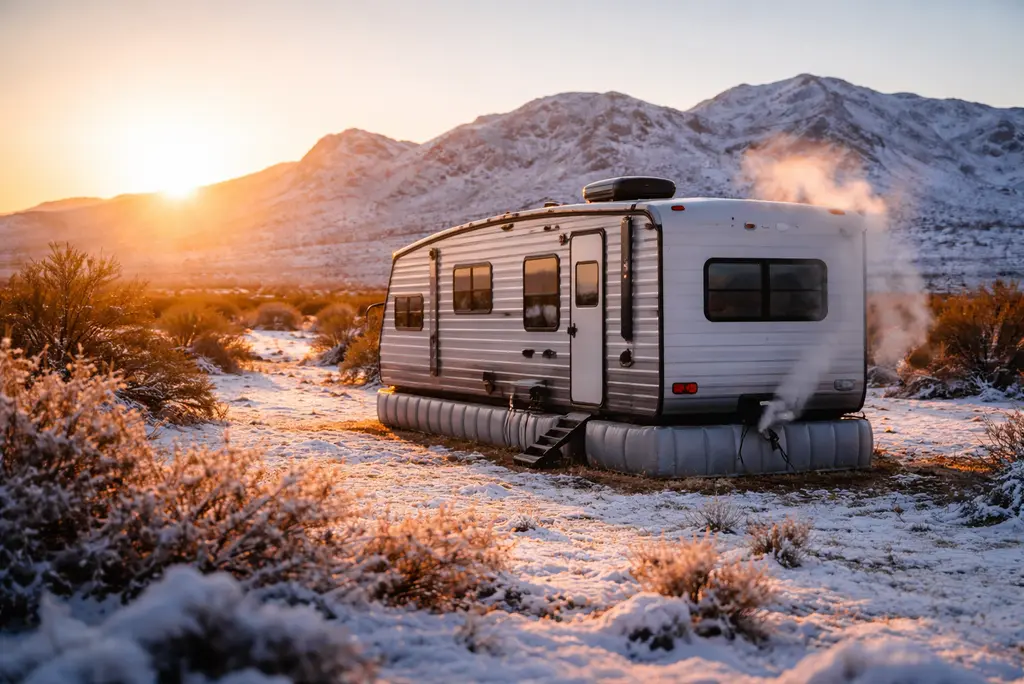
Winter boondocking — camping off-grid in freezing temperatures without hookups — is one of the most rewarding (and misunderstood) ways to RV. Done right, it gives you free or near-free camping in stunning desert and mountain landscapes while your peers pay $800+/month for RV park spots. Done wrong, it means frozen pipes, dead batteries, and a cold, miserable night. This guide covers everything you need to stay warm, safe, and self-sufficient through a real winter on the road.
Why winter boondocking is worth it
The financial case alone is compelling: Quartzsite’s Long-Term Visitor Area (LTVA) pass costs $180 for 7 months — less than $1/day. Compare that to RV parks in snowbird destinations charging $800–$1,200/month from November through March. BLM land across Arizona, New Mexico, and coastal Texas adds thousands more acres of free camping. Beyond cost, winter boondocking gives you genuine solitude, dark skies, and connection with a community of full-timers who actually live this lifestyle year-round.
Understanding winter temperature zones for RVers
Zone 1: Mild winter (20°F–45°F nights) — beginner-friendly
This covers the Arizona desert, southern New Mexico, and coastal Texas — the most popular winter boondocking destinations. Factory RV insulation handles these temps with modest upgrades. A stock travel trailer can maintain 65°F inside using 1.5–2 gallons of propane per night. Key additions: Reflectix window insulation (~$0.50/sq ft, blocks 20–30% of heat loss), door weather stripping ($15–20), and a heated water hose (Camco’s 25-ft model, $90, draws just 48W) to prevent hose freezing below 32°F. Battery performance stays at 85–90% in this range — both AGM and lithium work reliably.
Zone 2: Cold winter (0°F–20°F nights) — intermediate
This covers higher desert elevations, the Texas Hill Country in deep winter, and parts of the Southwest. RV insulation starts showing its limits. Priority upgrades: skirting to enclose the undercarriage (keeps the belly 20–30°F warmer than outside air), foam board insulation on window interiors, and a secondary heating source. AGM batteries drop to 60–70% capacity in this range and stop accepting charge below 32°F — lithium (LiFePO4) with internal heating is strongly recommended. Pipe freeze prevention becomes critical: heat tape on exposed lines, cabinet doors open under sinks, and trickling faucets on the coldest nights.
Zone 3: Extreme winter (below 0°F) — advanced only
Four-season RVs or heavily modified rigs only. Most standard RVs are not designed for sustained sub-zero camping without extensive modification. If you’re pushing into this zone, you need: full-length skirting with insulated base, spray foam insulation in underbelly cavities, a diesel heater as primary heat (not propane, which loses pressure in extreme cold), and a lithium battery system with self-heating capability.
Heating options compared: what actually works off-grid
Propane furnace (built-in)
Every RV has one. Reliable and fast, but propane furnaces are notoriously inefficient — they exhaust a lot of heat outdoors through the duct system. Expect 1–3 gallons/night depending on outside temps and how often the furnace cycles. The blower motor also draws significant 12V power (3–8A), which adds up overnight. Best used as a backup or for quick warm-ups, not as your primary boondocking heat source.
Diesel heater (Webasto, Espar, or Chinese clones)
The gold standard for off-grid winter heating. A diesel parking heater (like the Webasto Air Top 2000 STC or the budget-friendly Vevor/Hcalory units) burns diesel or kerosene, draws only 10–30W of electricity after startup, and produces clean, consistent heat. A 2kW unit uses roughly 0.1–0.2 liters/hour of fuel — far more efficient than propane. The main investment is upfront cost ($150 for Chinese units, $1,000–$2,500 for name brands) and installation. For serious winter boondockers, it pays for itself quickly in fuel savings.
Propane catalytic heater (Mr. Heater Buddy)
Flameless, silent, and very efficient — catalytic heaters produce radiant heat with no blower motor draw. The Mr. Heater Big Buddy is popular for supplemental heating in mild to moderate cold. Important safety note: catalytic heaters consume oxygen and produce water vapor. Use only in well-ventilated spaces and always have a CO detector. Not suitable for sleeping in a sealed RV without a cracked vent.
Electric space heater (shore power or large inverter)
Only viable with hookups or a very large lithium + solar system. A 1,500W space heater running 8 hours overnight = 12kWh. Even 400Ah of lithium (about 5.1kWh usable) can’t sustain that. Electric heat off-grid is a common mistake that drains batteries by midnight.
Protecting your water system in freezing temps
- Heated water hose: Essential below 32°F. Camco, Pirit, and Valterra make reliable options (25–50 ft). Run it continuously when temps drop — it draws 5–9W, not a meaningful battery drain.
- Disconnect from external water when parked: Fill your fresh tank and use the pump. Eliminates the freeze risk entirely.
- Heat tape on vulnerable pipes: Focus on the underbelly, exposed sections near exterior walls, and the water pump area. Self-regulating heat tape adjusts output to temperature.
- Open cabinet doors: Under sinks especially — this lets heated interior air reach the pipes behind the cabinet walls.
- Know your tank heater pads: Many RVs include electric tank heater pads for fresh, gray, and black tanks. Confirm yours work before winter and that they’re switched on.
- Trickle the faucets: On nights below 15°F, a slow trickle (just enough to see movement) keeps water moving and prevents freeze-ups.
Power management for winter boondocking
Winter boondocking is harder on your power system than summer because: solar input is reduced (shorter days, lower sun angle), heating draws more power, and cold temperatures reduce battery capacity. Your power strategy needs to account for all three.
- Lithium batteries are the winter upgrade that matters most. AGM batteries lose 30–40% capacity at 0°F and stop accepting charge in freezing temps. LiFePO4 with self-heating maintains near-full capacity down to -4°F and charges at partial capacity to -22°F.
- Tilt your solar panels in winter. Panels mounted flat on an RV roof lose 30–50% efficiency in winter compared to tilted mounts aimed at the lower winter sun. Adjustable tilt mounts are the single best solar upgrade for full-time winter boondockers.
- Generator for top-up: A small generator (Honda EU2200i, ~$1,100) run for 2 hours midday can fully recover your batteries on extended cloudy periods.
- LED lighting everywhere: Incandescent bulbs are a significant overnight drain. Full LED conversion saves 80% on lighting power.
Best locations for winter boondocking in the US
- Quartzsite, Arizona (LTVA): The most famous winter boondocking destination. $180/season for 7 months on BLM land. Massive community of full-timers, vendor markets, and year-round mild temps (nights 28–45°F, days 55–70°F).
- Anza-Borrego Desert, California: Free 30-day BLM camping near the state park. Stunning desert scenery, slightly warmer than Quartzsite at night.
- Elephant Butte, New Mexico: Less crowded alternative with good solar and mild winters. Free BLM camping around the lake area.
- Big Bend area, Texas: Remote, spectacular, and very free. Lower elevation zones stay above freezing most nights through winter.
- Yuma, Arizona area: Even warmer than Quartzsite. Good option for those not yet ready for freezing nights at all.
Winter boondocking essentials checklist
- ✅ Diesel or catalytic heater as primary heat source
- ✅ Reflectix window insulation cut to size
- ✅ RV skirting (foam board DIY or commercial system)
- ✅ Heated water hose (25–50 ft)
- ✅ Heat tape on exposed underbelly pipes
- ✅ Lithium battery bank with self-heating
- ✅ Tilting solar panel mounts
- ✅ CO and propane detector (test monthly)
- ✅ Extra propane tanks (at least 40 lbs on hand)
- ✅ Generator + extra fuel for cloudy stretches
- ✅ Thermal underwear and quality sleeping bag as backup
- ✅ Hand warmers for emergency battery warm-up
Frequently asked questions about winter boondocking
Can a regular RV handle winter boondocking?
Yes — in mild winter zones (Zone 1, nights above 20°F). With Reflectix, weather stripping, a supplemental heater, and a heated water hose, most standard RVs handle Quartzsite-style winters comfortably. For sustained sub-freezing temps, additional upgrades are needed.
How much propane does winter boondocking use?
Using only the built-in furnace in mild conditions (nights around 35°F): roughly 1.5–2 gallons per night. In colder conditions (nights around 20°F): 2–4 gallons/night. Switching to a diesel heater reduces heating fuel costs by 50–70% and eliminates the propane dependency entirely.
How do you stay warm at night while boondocking?
Layered approach: a diesel or catalytic heater keeps the interior above 60°F, thermal curtains or Reflectix block window cold, and a quality sleeping bag (rated to 20°F) gives you insurance if heating fails overnight. Never sleep in a sealed RV with an open-flame heater without ventilation and a working CO detector.
Winter boondocking rewards the prepared. With the right heating system, insulation upgrades, and a well-sized power setup, you can camp for free or nearly free all winter — in places that are genuinely beautiful, genuinely peaceful, and genuinely off the beaten path. The desert in January is something most RVers never experience. You won’t regret being one of the ones who does.

Published on February 16, 2026
Emma STONNE
This post contains affiliate links. If you make a purchase through these links, we may earn a commission at no extra cost to you.