
Author
Mini splits deliver 20–22 SEER efficiency compared to 14 SEER for standard rooftop ACs — that’s a 35–40% reduction in cooling electricity costs. They’re also dramatically quieter (22 dB vs. 52 dB), and they last significantly longer.
But they cost more upfront, require more installation work, and need an inverter. Here’s everything you need to know to decide if a mini split makes sense for your RV.
Mini Split vs. Rooftop AC: Key Differences
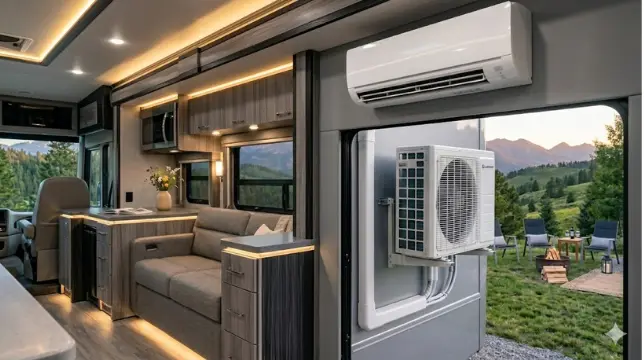
RV mini split systems differ from standard rooftop ACs in three fundamental ways: efficiency, noise, and installation. Mini splits achieve 19–22 SEER energy efficiency ratings versus 14 SEER typical of rooftop units, reducing cooling electricity consumption by 35–40%. Indoor noise levels of 22–30 dB (whisper-quiet) compare to 50–56 dB for rooftop units. Mini splits use two components — an outdoor condenser mounted on the RV frame or exterior wall, and a quiet indoor wall cassette — connected by refrigerant lines. They require a 110–240V power source through an inverter for off-grid use. Installation is more complex than rooftop replacement but the long-term efficiency gain makes them the preferred choice for full-time RVers and owners who prioritize performance.
| Feature | Mini Split | Standard Rooftop |
|---|---|---|
| SEER efficiency | 19–22 | 12–14 |
| Indoor noise | 22–30 dB | 50–56 dB |
| BTU range | 9,000–24,000 | 11,000–15,000 |
| Heat pump capability | Yes (all models) | Some models only |
| Installation complexity | Moderate–complex | Simple drop-in |
| Unit cost | $800–$2,500 | $400–$1,200 |
| Lifespan | 15–20 years | 8–12 years |
Best RV Mini Splits of 2026
1. MRCOOL DIY 18,000 BTU — Best Overall
The only mini split you can install without an HVAC technician. MRCOOL’s pre-charged line set is a genuine game-changer — no special tools, no refrigerant certification required.
Specs:
– BTU: 18,000 cooling + heating
– SEER: 22 (best in class)
– Running watts: ~1,400W
– Noise (indoor): 22 dB
– Heat pump: Yes, effective to 5°F
– DIY install: Yes
Why it wins: The combination of 22 SEER efficiency, DIY installation, and 18,000 BTU output makes this the go-to choice for larger Class A and Class C motorhomes.
Best for: Full-timers, large Class A owners, anyone who wants maximum efficiency with DIY installation.
2. Pioneer Diamante Series 9,000 BTU — Best for Smaller RVs
Pioneer’s Diamante delivers 19 SEER in a compact, lightweight package. Strong heat pump performance down to 5°F makes it a genuine four-season solution.
Specs:
– BTU: 9,000 cooling + heating
– SEER: 19
– Running watts: ~750W
– Noise (indoor): 26 dB
– Heat pump: Yes, effective to 5°F
– Weight: Compact (indoor unit ~18 lbs)
Best for: Vans, Class B motorhomes, smaller Class C builds where the MRCOOL’s 18,000 BTU would be overkill.
3. Senville LETO 12,000 BTU — Best Value
Solid 19 SEER performance at a competitive price point. The LETO requires professional line set charging (unlike the MRCOOL) but otherwise installs straightforwardly.
Specs:
– BTU: 12,000 cooling + heating
– SEER: 19
– Running watts: ~1,000W
– Noise (indoor): 30 dB
– Heat pump: Yes
Best for: Mid-size Class C owners who want efficiency gains at a lower upfront cost and don’t mind hiring an HVAC tech for the line set.
4. Gree Vireo+ 12,000 BTU — Best Efficiency Option
Gree’s Vireo+ pushes SEER ratings above 20 in the 12,000 BTU range — rare at this price point. Requires professional installation.
Best for: Efficiency-focused owners who want top-tier SEER without paying MRCOOL pricing.
Is a Mini Split Worth It for Your RV?
The Efficiency Case
On a 600W solar system running an AC 6 hours/day:
| AC Type | Daily Consumption | Weekly Consumption | Feasible on 600W Solar? |
|---|---|---|---|
| 13,500 BTU rooftop | ~8,100 Wh | 56,700 Wh | No |
| 9,000 BTU mini split | ~4,500 Wh | 31,500 Wh | Marginal |
| 12,000 BTU mini split | ~6,000 Wh | 42,000 Wh | With 800W+ solar |
| 18,000 BTU mini split | ~8,400 Wh | 58,800 Wh | Needs 1,200W+ solar |
The Noise Case
At 22–30 dB, mini splits are genuinely whisper-quiet. Many full-timers report better sleep quality after switching from a 52 dB rooftop unit.
The Cost Case
| Mini Split | Rooftop Replacement | |
|---|---|---|
| Unit cost | $800–$2,500 | $400–$1,200 |
| Installation | $200–$600 DIY / $500–$1,500 professional | $100–$300 |
| Annual energy savings | $150–$400 | — |
| Payback period | 3–5 years | — |
For full-timers using AC daily, the payback period is real. For weekend campers, a standard rooftop makes more financial sense.
Installation Overview
Mini split installation in an RV involves:
- Mounting the outdoor condenser — typically on the rear bumper, tongue jack area, or custom bracket on the RV frame
- Running refrigerant lines through the RV wall (typically 3/4″ hole)
- Mounting the indoor cassette on a wall or ceiling
- Connecting to power via your RV’s inverter or shore power
MRCOOL DIY eliminates the refrigerant charging step — the line set comes pre-charged and snaps together.
All other brands require an HVAC technician for line set charging (~$100–$300).
Frequently Asked Questions
Can a mini split run off solar?
Yes — more effectively than a standard rooftop due to lower wattage requirements. A 9,000 BTU Pioneer Diamante needs ~750W running vs. 1,200W+ for a 13,500 BTU rooftop.
Do RV mini splits work as heat pumps in winter?
Yes — all models listed here include heat pump capability effective to 5°F. This makes them excellent four-season climate control solutions, replacing both AC and propane heating in mild-to-moderate winter conditions.
How loud are mini splits vs. rooftop ACs?
Dramatically quieter. Mini split indoor units run at 22–30 dB (comparable to a library). Rooftop ACs run at 50–56 dB (similar to a normal conversation).
Does a mini split need a dedicated circuit?
Yes — most 12,000–18,000 BTU units need a dedicated 20A or 30A 110/240V circuit.
For full AC type comparisons, read Best RV Air Conditioners 2026. To understand power requirements, see How Many Watts Does an RV AC Use.

Published on June 12, 2026
Elena Brooks
Elena Brooks covers RV insurance for RVGeo, researching policy types, state requirements, and provider comparisons in depth before publishing. Her guides follow RVGeo's editorial standard of verifying every coverage detail, price, and policy term directly against insurer documentation rather than repeating marketing claims - so RV owners can compare real options, not sales pitches.
This post contains affiliate links. If you make a purchase through these links, we may earn a commission at no extra cost to you.