
Author
By Mohamed Najib
Founder of RVGeo & Certified Technical Inspector
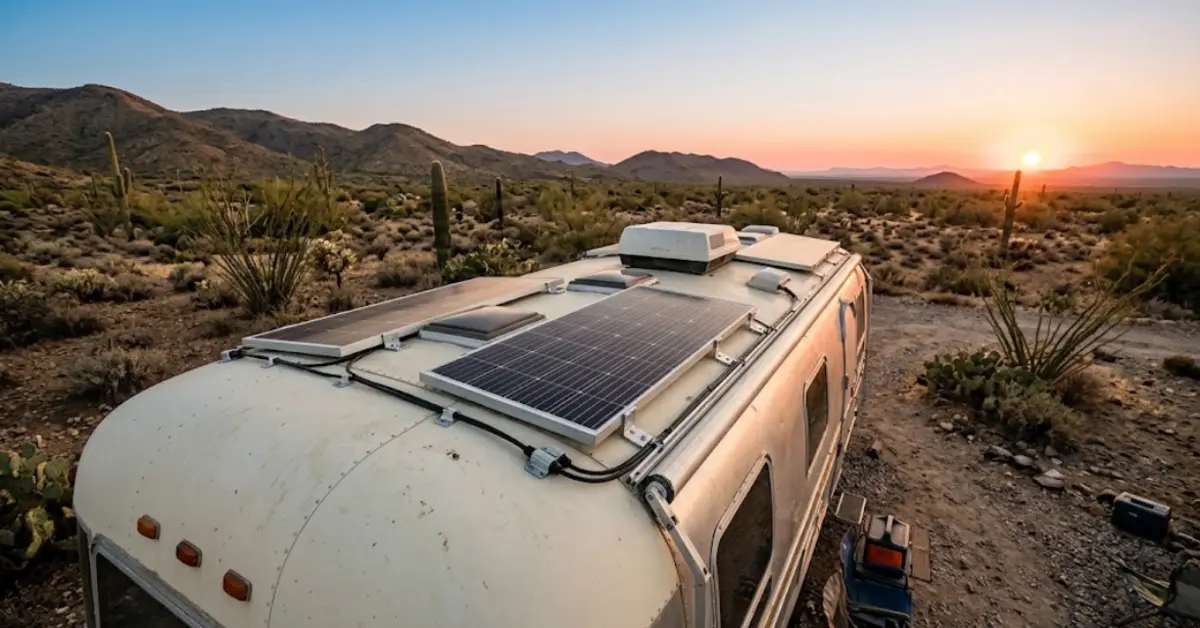
Boondocking has changed what used-RV buyers look for. A decade ago, a shopper walking a lot cared about layout, mileage, and whether the awning worked. Today a growing share of them open the battery compartment first. Rigs with a documented lithium and solar system sell faster and hold their asking price better than equivalent units on factory lead-acid.
But there is a hard limit on that premium, and most sellers discover it too late: electrical upgrades do not protect against structural failure. A pristine solar array bolted to a leaking roof destroys value faster than the batteries build it.
Why Off-Grid Capability Reshapes Resale
Traditional 12V lead-acid does not hurt you in the campground market. A buyer who plugs into shore power every night has no reason to pay extra for lithium, and factory-standard is exactly what they expect. The trade-offs behind that choice are covered in our lithium vs AGM battery comparison.
The shift is in who else is shopping. Boondocking buyers search actively for LiFePO4 and rooftop solar, and they are comparing your rig against the cost of doing the conversion themselves. That is the real benchmark. If your system is clean, correctly sized, and documented, you are selling them months of work and a five-figure parts order they no longer have to place. If it looks improvised, you are selling them a rewiring project.
If you are still deciding what to install rather than what to sell, start with the complete guide to RV batteries, inverters and off-grid systems — sizing the system correctly is what makes it documentable later.
What the Market Actually Pays
| System | Effect on resale | Why |
|---|---|---|
| Clean factory 12V lead-acid | Neutral | Meets expectations for shore-power buyers |
| Documented LiFePO4 + solar | Holds asking price | Buyer avoids the conversion cost and the labour |
| Undocumented DIY install | Discount applied | Unknown quality reads as unknown risk |
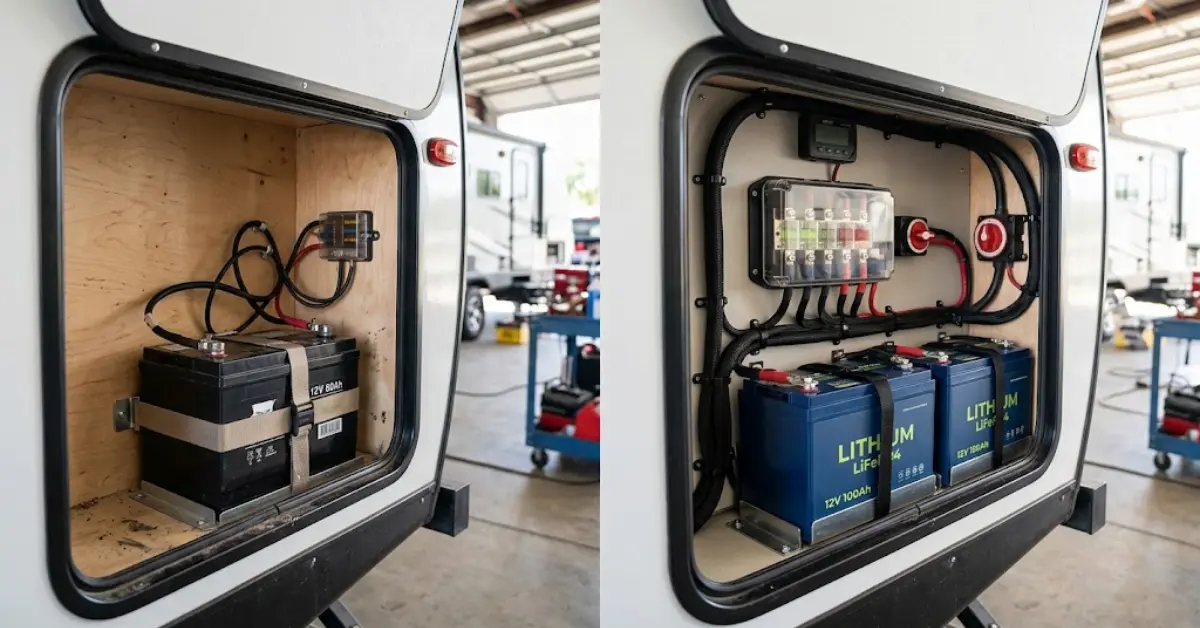
Notice that the third row is not penalised for being DIY. It is penalised for being unverifiable. A careful owner-install with paperwork behind it competes perfectly well with a shop install. A professional install with no paperwork does not.
What “Documented” Actually Means
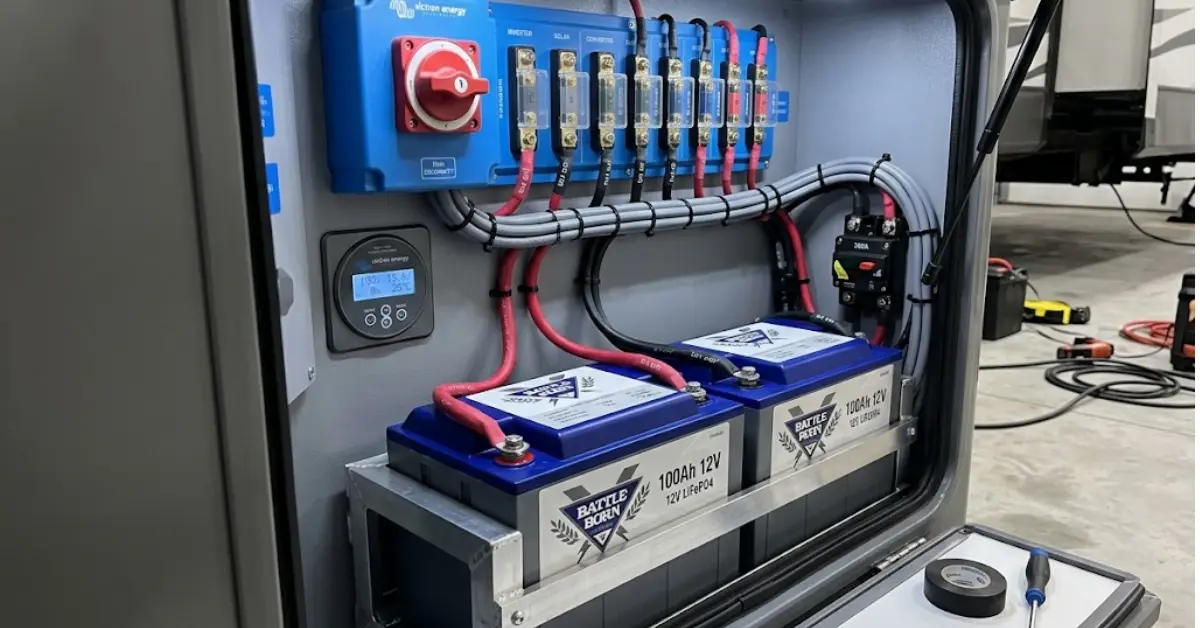
This is the part sellers underestimate, and it costs them real money. Documentation is not a receipt in a drawer. Assembled properly, it is a folder a buyer can read in five minutes:
- Component list with specifications — battery chemistry and capacity, charge controller model and rating, inverter continuous and surge output, panel wattage and configuration
- A wiring diagram, even hand-drawn, showing runs, wire gauge, and where the disconnects are
- Fuse and breaker schedule — every protected circuit with its rating
- Installation photos taken before the panels went back on, which is the only way anyone can ever see the work behind the walls
- Invoices, and the installer’s name if it was not you
A buyer holding that folder stops negotiating on risk and starts negotiating on price. That is the whole point.
Seals First, Upgrades Second
Here is the sequencing error I see most often. An owner spends a season and a serious budget on lithium, an inverter, and a roof full of panels — while the lap sealant around the existing roof penetrations is already cracked.
Every panel mount is a new hole in the roof. Adding penetrations to an envelope that is already failing does not just fail to add value; it accelerates the moisture path that destroys the subfloor. And a buyer who finds soft flooring will not pay for your electrical system at all. They will price the repair, and the solar becomes salvage.
The order is not negotiable. Verify the roof membrane, all existing penetrations, vents, slide-out seals, and window frames are genuinely watertight first. Then upgrade. An ordinary 12V rig with a perfect envelope outsells a solar-equipped rig with a wet floor every single time.
Plan your off-grid routes and boondocking stops with RV LIFE Pro. Explore RV LIFE Pro tools for off-grid camping
Related reading:
- RV Gear & Power: The Complete Guide
- How to Size Your RV Battery Bank
- How Much Does a DIY Camper Van Electrical Build Really Cost?
- DIY Van Electrical: Build Safety Checklist
- Best LiFePO4 RV Batteries
- Best RV Solar Panels
- The Pre-Purchase RV Inspection Checklist

Published on August 19, 2026
Mike Dawson
Mike Dawson is RVGeo's lead editor, applying inspection-grade rigor to RV research - verifying manufacturer specs, testing components, and fact-checking pricing and claims before they're published. RVGeo's approach draws on a background in automotive technical inspection, applied specifically to RV electrical, power, and safety systems. Mike oversees RVGeo's foundational guides on power systems, DIY conversions, and van-life setup, with every recommendation checked against real specs and current pricing rather than assumptions.
This post contains affiliate links. If you make a purchase through these links, we may earn a commission at no extra cost to you.