
Author
Plenty of guides show you how to build a camper van electrical system. Almost none show you how to check whether the one you built — or the one someone else built and you’re now buying — is actually safe. That’s the gap this guide fills. It’s written from the inspection side, not the installation side: the questions a trained eye asks about a finished system, not another walkthrough of how to wire a panel.
Electrical faults are a documented cause of fires in converted vans — small errors like an undersized wire paired with an oversized fuse, or a poorly crimped joint, can generate enough heat to melt insulation and ignite nearby material. None of that shows up on a parts list. It only shows up when someone actually checks the finished system.
Why “How to Build It” Isn’t the Same Question as “Is It Safe”
Most van electrical content — and there’s a lot of it, some of it genuinely excellent — walks through the build: size the battery, size the panels, size the inverter, wire it up. That sequence matters, and it’s covered well elsewhere. What almost none of it does is take a step back afterward and ask, with no assumptions about who built it or how confident they were: does this system actually meet the standard it should?
That distinction matters most in two situations: right after you finish your own build, before you trust it on the road — and when you’re buying a van someone else converted, where you have no idea what corners were cut.
What Actually Gets Checked, Beyond the Spec Sheet
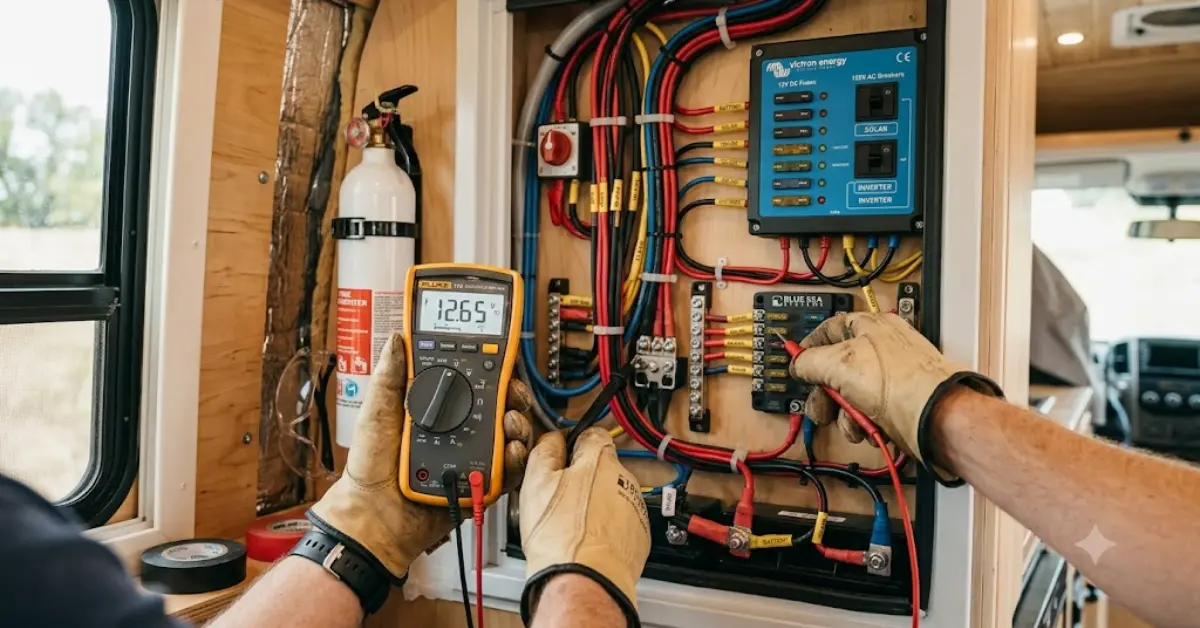
A correctly sized battery and a correctly sized inverter can still be one bad connection away from a real problem. The checks below are the ones that don’t show up when you’re comparing product specs — they only show up when someone inspects the finished install.
Wire Gauge Matched to Actual Current Draw
Undersized wire is the single most common issue in DIY builds, and it’s invisible unless you check current draw against gauge for every run, not just the main battery cable. A wire that’s fine for a 10-amp accessory circuit can overheat if it’s also carrying a 30-amp load someone added later.
Fusing at Every Major Connection
Every conductor coming off the battery needs a fuse sized to protect that specific wire — not just one fuse at the main output. Missing fuses at secondary connections is one of the most frequently cited gaps in real-world van electrical failures.
Inverter Type Matched to What It’s Actually Powering
A modified sine wave inverter is cheaper, and it will damage sensitive electronics over time — laptops, CPAP machines, some battery chargers — even though it “works” in the sense that things turn on. This is a check a spec sheet won’t flag, because the inverter is doing exactly what its own rating says. Whether it’s the right type for what’s plugged into it is a separate question.
Ground Connections, Not Just Positive Runs
Loose or corroded grounds are easy to miss because the system often still works, intermittently, right up until it doesn’t. A visual check under load — not just a continuity test at rest — is what actually catches this.
Whether the System Was Copied or Actually Sized
A build that copies someone else’s parts list without recalculating for your own daily load is a common way to end up either overpaying for capacity you don’t use, or running short on a system that “should” be enough on paper. This is a planning check, not a wiring check, and it belongs in the same review.
If You’re Building It Yourself: The Order That Prevents Most of These Problems
The checks above catch problems after the fact. The build order below is what prevents most of them from happening in the first place — run your energy audit before buying a battery, size the battery before the solar array, size the solar array before the inverter, and only wire everything once every component is sized to the one before it, not to a parts list you found online.
- Energy audit calculator — run this before buying anything
- Battery bank sizing and lithium vs AGM comparison
- Solar panel sizing
- Inverter sizing and charge controller type
- Wiring and fusing standards, plus the updated 2026/27 rules on GMI and lithium
Two More Pieces of This Cluster
Frequently Asked Questions
Can I inspect my own DIY electrical build myself?
You can check most of the items above yourself with a multimeter and a visual inspection under load. The value of an outside check is that it’s done without the confidence bias of having built the system yourself — it’s easy to assume a connection is fine because you remember making it carefully.
What’s the most dangerous mistake in a DIY van electrical build?
Undersized wire paired with a fuse that doesn’t match it — the fuse is supposed to protect the wire, and if it’s sized to the load instead of the wire gauge, it won’t trip before the wire overheats.
Is a modified sine wave inverter actually unsafe?
It’s not unsafe in the sense of causing a fire on its own, but it can degrade or damage electronics not designed for it over time. Whether that’s an acceptable tradeoff depends entirely on what you’re planning to plug into it.
Should I have a used camper van’s electrical system inspected before buying?
Yes, for the same reason you’d have any vehicle system inspected before buying — a system that “works” during a test walk-through can still have wiring or fusing issues that only show up under sustained load or after months of vibration.
Sources
- RVGeo — RV Power Usage Calculator
- RVGeo — Lithium vs AGM RV Battery
- RVGeo — RV Battery Bank Sizing Guide
- RVGeo — RV Solar Panel Sizing Guide
- RVGeo — RV Inverter Sizing Guide
- RVGeo — MPPT vs PWM Solar Charge Controller
- RVGeo — RV Electrical Safety Guide
- RVGeo — New 2026/27 RV Electrical Rules

Published on August 5, 2026
Michael Carter
Michael Carter covers RV solar, batteries, and power systems for RVGeo, focusing on component specs, wiring safety, and system sizing. His guides break down solar arrays, charge controllers, inverters, and battery banks using manufacturer documentation and verified pricing, with an emphasis on the electrical safety fundamentals that matter most in a moving vehicle.
This post contains affiliate links. If you make a purchase through these links, we may earn a commission at no extra cost to you.