

Author
Best RV Solar Panels in 2026: Renogy vs Rich Solar vs Newpowa (Ranked & Reviewed)
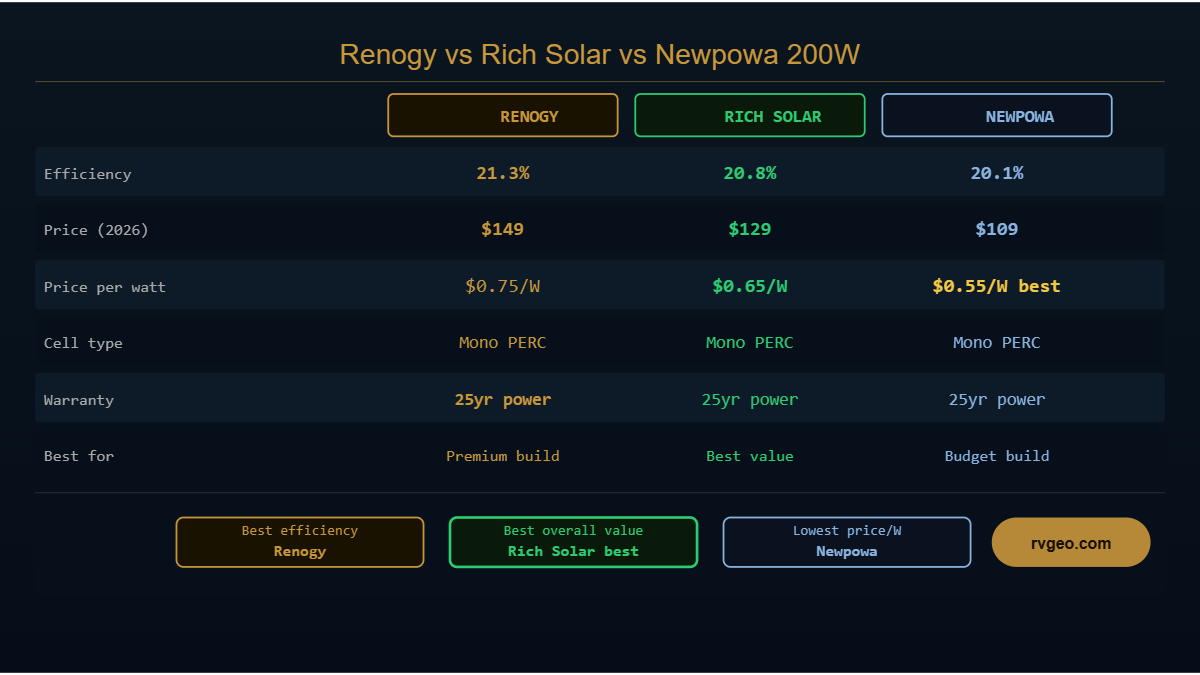
Choosing solar panels for your RV comes down to three things: efficiency, durability, and price per watt. In 2026, the market has matured — budget brands have closed the gap on premium ones, and you no longer need to spend $300 per panel to get reliable performance. This guide ranks the best RV solar panels across every budget and use case.
Top RV Solar Panels at a Glance
| Panel | Wattage | Efficiency | Type | Price/Watt | Best For |
|---|---|---|---|---|---|
| Renogy 200W Mono | 200W | 21.3% | Rigid mono | ~$0.90/W | Best overall value |
| Rich Solar 200W | 200W | 22.1% | Rigid mono | ~$0.95/W | Best efficiency |
| Newpowa 200W | 200W | 20.8% | Rigid mono | ~$0.80/W | Best budget rigid |
| BougeRV 200W Flexible | 200W | 23.0% | Flexible mono | ~$1.10/W | Best flexible panel |
| Renogy 100W Suitcase | 100W | 21% | Portable foldable | ~$1.20/W | Best portable option |
Rigid vs Flexible vs Portable: Which Type Do You Need?
- Rigid panels — Most common for permanent RV roof installs. Heavier but more durable, better heat dissipation, lowest cost per watt. Best for travel trailers and Class A/C motorhomes.
- Flexible panels — Lightweight, can curve slightly to fit rounded roofs. Ideal for vans, pop-up campers, and curved surfaces. Slightly more expensive and shorter lifespan than rigid.
- Portable/foldable — No permanent installation. Set up at camp, angle toward sun for maximum output. Best for occasional campers or as a supplement to a fixed system.
1. Renogy 200W Monocrystalline — Best Overall
Overview
Renogy is the most trusted brand in the North American RV solar market, and the 200W monocrystalline panel is their flagship product for good reason. It delivers consistent output, comes with a 25-year power warranty, and the price per watt is hard to beat for a panel of this quality. If you’re installing 4–6 panels on a travel trailer or motorhome, Renogy 200W is the default recommendation.
Key Specs
- Max power: 200W
- Efficiency: 21.3%
- Open circuit voltage (Voc): 24.3V
- Short circuit current (Isc): 8.86A
- Dimensions: 58.7 × 26.8 × 1.4 inches
- Weight: 16.5 lbs (7.5 kg)
- Frame: Anodized aluminum — corrosion resistant
- Warranty: 25-year power output, 5-year material warranty
What RVers Like
- Pre-drilled holes make roof mounting straightforward
- IP67 junction box — fully waterproof in rain and washing
- Consistent with Renogy charge controllers and wiring accessories — easy ecosystem
- Strong resale market if you upgrade later
Downsides
- Slightly heavier than some competitors
- Not the highest efficiency — Rich Solar edges it out by ~0.8%
Verdict: The safe, reliable choice for most RV solar installs. Proven track record across hundreds of thousands of rigs.
2. Rich Solar 200W — Best Efficiency
Overview
Rich Solar panels consistently measure above their rated wattage in independent tests — a rare quality in the budget solar market. The 200W panel often produces 210–215W in ideal conditions. For roof-limited builds where every square foot counts, Rich Solar’s higher efficiency means more watts from the same space.
Key Specs
- Max power: 200W (typically over-performs)
- Efficiency: 22.1% — highest in this comparison
- Voc: 24.7V
- Weight: 15.9 lbs
- Warranty: 25-year power output
What RVers Like
- Consistently over-performs rated wattage in real-world testing
- Slightly lighter than Renogy equivalent
- Good customer support for a mid-tier brand
Downsides
- ~5–10% more expensive than Renogy per watt
- Smaller brand ecosystem — fewer compatible accessories
Verdict: Choose Rich Solar if your roof space is limited and you need maximum watts per square foot. The efficiency premium is worth it in space-constrained builds.
3. Newpowa 200W — Best Budget Rigid Panel
Overview
Newpowa is consistently the lowest price-per-watt option among quality RV solar panels. The 200W panel comes in around $0.80/W — about 10% cheaper than Renogy — with only a small efficiency trade-off. For large systems where you’re buying 6–8 panels, the savings add up to $100–200 without meaningful performance loss.
Key Specs
- Max power: 200W
- Efficiency: 20.8%
- Weight: 17.2 lbs
- Warranty: 25-year power output
Downsides
- Slightly lower efficiency than Renogy and Rich Solar
- Heavier frame
- Smaller community and fewer reviews to draw from
Verdict: Best for budget-focused builds or large systems where you’re buying 6+ panels and want to minimize cost.
4. BougeRV 200W Flexible — Best Flexible Panel
Overview
BougeRV’s flexible panels use CIGS (copper indium gallium selenide) technology that achieves 23% efficiency — higher than most rigid monocrystalline panels. They’re 70% lighter than rigid equivalents and can flex up to 30 degrees for curved surfaces. The trade-off is cost and long-term durability compared to glass-faced rigid panels.
Key Specs
- Max power: 200W
- Efficiency: 23.0%
- Weight: 4.9 lbs — extremely light
- Flexibility: Up to 30° arc
- Warranty: 5-year product warranty
What RVers Like
- Ideal for van conversions and curved RV roofs
- Lightweight — won’t affect vehicle payload significantly
- Highest efficiency per square inch of any panel in this list
Downsides
- Shorter lifespan than rigid glass panels (10–15 years vs 25+)
- Heat builds up underneath (no air gap) — reduces efficiency in hot climates
- Higher price per watt
Verdict: Best for vans and curved roofs where rigid panels won’t work. For flat roofs, rigid panels are the better long-term investment.
5. Renogy 100W Suitcase — Best Portable Panel
Overview
The Renogy 100W suitcase panel folds in half, includes a built-in kickstand, and connects directly to your charge controller or battery with included cables. No installation required — set it up in 2 minutes at camp, angle it toward the sun, and collect free power. Perfect for occasional campers or as a supplement to a fixed roof system.
Key Specs
- Max power: 100W
- Folded dimensions: 27 × 20 × 2.8 inches
- Weight: 26.5 lbs with case
- Included: 10A PWM controller, cables, alligator clips
Downsides
- 100W only — needs to supplement a larger system for meaningful power
- PWM controller included is basic — upgrade to MPPT for better performance
- Heavier than comparable wattage in rigid panels
Verdict: Best for weekend campers without a permanent solar setup, or as a portable supplement for cloudy days when your roof system underproduces.
How Many Solar Panels Do You Need?
The answer depends on your daily energy consumption. Use our RV Solar Panel Sizing Guide for a full calculation, but here are common configurations:
- 200–400W (1–2 panels): Phones, laptop, LED lights, 12V fridge — basic van life
- 600–800W (3–4 panels): All of the above + water pump, larger fridge, TV — comfortable full-timing without AC
- 1,000–1,200W (5–6 panels): All loads + 2–4 hours of AC per day in summer
- 1,600W+ (8+ panels): All-day AC use, large motorhome with heavy loads
Wiring: Series vs Parallel
How you wire your panels affects your charge controller requirements:
- Series wiring: Voltages add up (e.g., 4 × 24V panels = 96V). Use with a higher-voltage MPPT controller. Better for long wire runs.
- Parallel wiring: Currents add up (e.g., 4 × 9A panels = 36A). Stays at 24V. Better in partial shade conditions.
- Series-parallel combination: Most large systems use a mix for optimal balance of voltage and current.
Final Rankings
- Renogy 200W — Best overall. Proven, affordable, great ecosystem.
- Rich Solar 200W — Best efficiency for space-limited roofs.
- BougeRV 200W Flexible — Best for vans and curved surfaces.
- Newpowa 200W — Best budget pick for large systems.
- Renogy 100W Suitcase — Best portable option for occasional campers.
Frequently Asked Questions
How long do RV solar panels last?
Quality rigid monocrystalline panels degrade about 0.5% per year and carry 25-year power warranties. After 25 years, a 200W panel still produces around 175W. Flexible panels have shorter lifespans of 10–15 years due to laminate degradation.
Can I mix different brands of solar panels?
Yes, but match wattage and voltage as closely as possible within each series or parallel string. Mismatched panels in series limit output to the weakest panel’s specs.
Do solar panels work on cloudy days?
Yes, but at reduced output — typically 10–25% of rated capacity on overcast days. Plan your battery bank to cover 2–3 days of cloudy weather without recharging.
See Also
- RV Solar Panel Sizing Guide: How Many Panels Do You Really Need?
- Choosing the Best Charge Controller for Your RV Solar System
- 7 Common RV Solar Setup Mistakes That Kill Your Off-Grid Power
- How to Size Your RV Battery Bank: Step-by-Step Guide
- RV Power System Setup: Complete Guide for Vans and RVs

Published on May 20, 2026
Mike Dawson
Mike Dawson is RVGeo's lead editor, applying inspection-grade rigor to RV research - verifying manufacturer specs, testing components, and fact-checking pricing and claims before they're published. RVGeo's approach draws on a background in automotive technical inspection, applied specifically to RV electrical, power, and safety systems. Mike oversees RVGeo's foundational guides on power systems, DIY conversions, and van-life setup, with every recommendation checked against real specs and current pricing rather than assumptions.
This post contains affiliate links. If you make a purchase through these links, we may earn a commission at no extra cost to you.