
Author

If you rely on solar power while RVing, weather is your biggest variable. A system that performs flawlessly on a sunny July afternoon in Arizona can underperform by 60% on a cloudy November morning in Oregon. Understanding how different weather conditions affect solar output helps you plan smarter and avoid dead batteries in inconvenient locations.
How Solar Panels Actually Generate Power
RV solar panels convert sunlight into DC electricity through photovoltaic (PV) cells. Output is measured in watts and depends on two factors: the intensity of light hitting the panel (irradiance) and the panel’s efficiency at converting that light. Standard panels are rated at peak output under ideal laboratory conditions — 1,000 W/m² of sunlight at 25°C (77°F). Real-world conditions almost never match these numbers.
Clouds and Overcast Skies
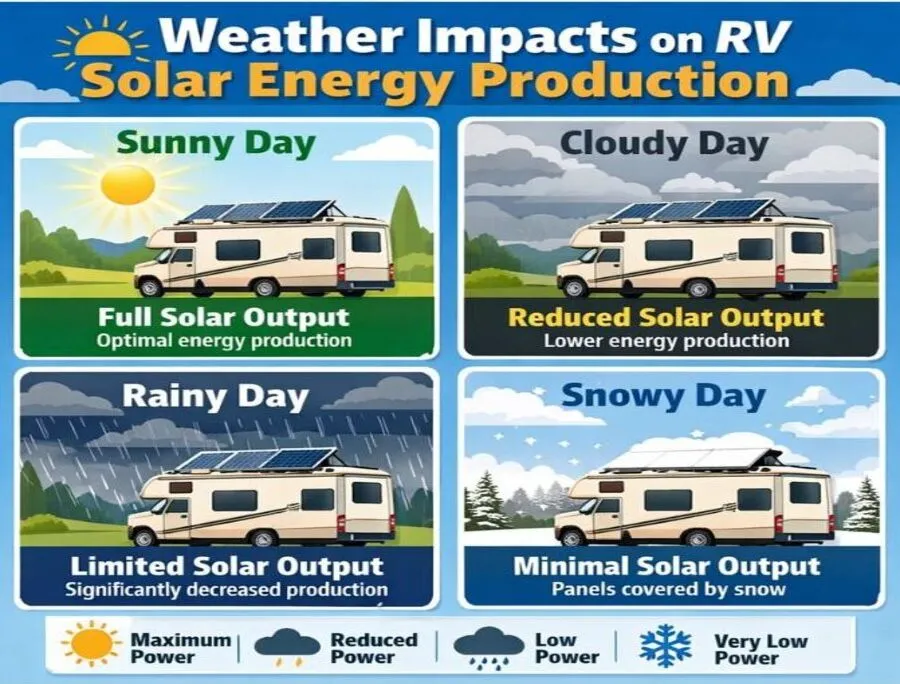
Clouds are the most common weather challenge for RV solar users. Thin cloud cover typically reduces output by 10–25%. Heavy overcast conditions can cut production by 70–90%. However, not all cloud cover is equal:
- Thin cirrus clouds: minor reduction, sometimes even a slight boost from light diffusion
- Cumulus clouds: output drops when the cloud passes directly over the sun
- Thick stratus or storm clouds: production near zero
The practical implication: in consistently overcast regions like the Pacific Northwest, size your battery bank for 2–3 days of autonomy rather than 1 day.
Rain and Humidity
Rain itself doesn’t damage solar panels — modern panels are rated for wet conditions. What rain does do is block sunlight. During active rainfall, expect output to drop 80–90%. On the positive side, rain cleans dust and pollen off your panels, which can restore 5–15% of output lost to surface buildup. After a rainy day, your panels often perform better than before the storm.
High humidity without rain also reduces efficiency slightly — water vapor scatters and absorbs some incoming light. In tropical or coastal environments, factor in a 5–10% ongoing efficiency reduction compared to dry desert conditions.
Temperature: The Counterintuitive Factor
Most RVers assume hot weather means better solar production. It doesn’t. Solar panels are semiconductors, and heat actually reduces their efficiency. Most panels lose approximately 0.3–0.5% of output for every degree Celsius above 25°C (77°F).
On a 40°C (104°F) summer day, your panels may be running at a surface temperature of 60–70°C — meaning 10–20% less output than their rated capacity. Cold, clear winter days can actually produce more power per hour of sun than hot summer days, assuming you have enough sunlight hours.
This is why desert RVers who park in full sun during summer sometimes see disappointing numbers despite clear skies — the panels are thermally throttled.
Snow and Ice
Snow on panels blocks production almost entirely. Even a light dusting reduces output significantly. The good news: panels generate a small amount of heat during operation, and their smooth glass surface helps snow slide off once temperatures rise slightly. Most RVers in snowy regions either brush panels off manually or tilt them at a steeper angle to encourage shedding.
Ice is less common on panels due to their dark surface absorbing heat, but freezing rain (glaze ice) can be an issue. Never pour hot water on frozen panels — thermal shock can crack the glass. Let them warm naturally or use lukewarm water.
Wind
Wind doesn’t directly affect solar output, but it impacts your system indirectly. High winds create structural stress on roof-mounted panels — particularly tilt mounts. Before severe weather, lower any tilted panels flat to reduce wind loading. Wind also affects how quickly your RV’s interior cools, which changes your power consumption for heating or cooling.
Seasonal Sun Angle
Beyond weather, the angle of the sun changes with the seasons. In winter, the sun tracks lower across the sky, meaning panels receive light at a less efficient angle. At 45° north latitude (roughly the Oregon/Idaho border), winter solar irradiance is about 40% of summer levels even on clear days — just due to the sun’s path.
Tilting panels toward the sun compensates partially. A panel tilted to match latitude angle captures significantly more energy than a flat-mounted panel in winter months.
Practical Tips for Weather-Adaptive Solar Management
- Check weather forecasts before unhooking from shore power — if 3 cloudy days are coming, top up your batteries first
- Use a battery monitor (Victron BMV series is popular) to track real-time state of charge
- Clean panels regularly — especially in dusty desert or pollen-heavy environments; dirty panels lose 15–25% output
- Tilt panels toward the sun in winter and when parked for multiple days
- Reduce loads on low-production days — skip running the microwave or hair dryer; prioritize lighting and phone charging
- Consider a small generator as backup for extended overcast periods — a 2,000W inverter generator can fully recharge a 200Ah lithium bank in 2–3 hours
How Much Battery Do You Need as a Weather Buffer?
A common recommendation for full-time RVers or boondockers in variable climates:
- Sunny climates (Southwest US): 1.5× your daily consumption in battery capacity
- Mixed climates (Mountain West, Southeast): 2× daily consumption
- Overcast climates (Pacific Northwest, Northeast): 3× daily consumption, plus a backup charging source
For a typical RV drawing 50–75Ah per day, this means 100–225Ah of usable lithium capacity depending on where you travel.
Final Thoughts
Weather variability is the reality of off-grid RV living. The RVers who manage it best aren’t those with the biggest solar arrays — they’re the ones who understand their system’s real-world behavior and adjust consumption and positioning accordingly. A 400W panel system with good batteries and smart habits will outperform a 600W system used without attention to conditions.
Plan for your worst-case weather scenario, not your best. That mindset is what keeps the lights on when clouds roll in for a week.