Author

Choosing the right inverter for your RV solar system
When setting up a solar system for your RV, selecting the right inverter is crucial for ensuring efficient energy conversion and optimal performance. Inverters play a vital role in transforming the direct current (DC) generated by your solar panels into the alternating current (AC) needed to power most RV appliances. This article will guide you through understanding different types of inverters, their pros and cons, and how to match them with your energy needs.
Understanding inverter types
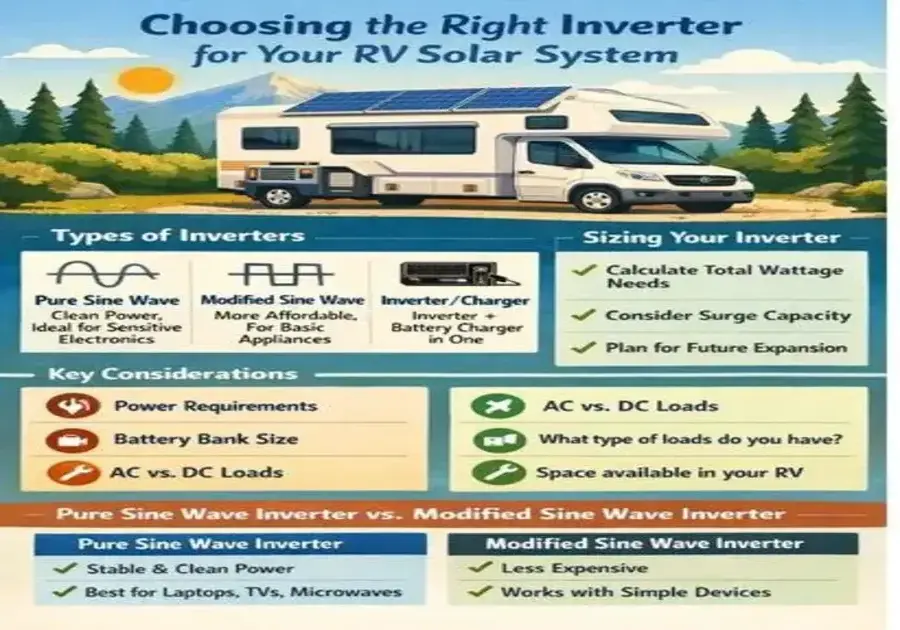
Inverters come in various types, each suited to different applications and energy requirements. The main types are:
Pure sine wave inverters
Pure sine wave inverters produce a smooth and consistent AC waveform, making them ideal for sensitive electronics and appliances that require stable power. These inverters are typically more expensive but offer better efficiency and reliability, especially for modern electronics like laptops, televisions, and microwaves.
Modified sine wave inverters
Modified sine wave inverters provide a stepped, less smooth waveform, which can be sufficient for simple appliances and devices that do not require exact power quality. They are more affordable but may cause issues with some electronics, such as increased heat production or noise in audio equipment.
Inverter/chargers
Inverter/chargers combine the functionalities of an inverter and a battery charger. They can convert DC to AC and also charge your RV’s battery bank when connected to shore power. This dual functionality is convenient for RVers who frequently switch between off-grid and on-grid setups.
Matching inverter capacity with your energy needs
Selecting the right inverter capacity is essential to meet your energy consumption needs. Consider the following factors when determining the appropriate inverter size:
Calculate your total wattage
Determine the total wattage of all appliances and devices you plan to run simultaneously. This includes lights, kitchen appliances, entertainment systems, and any other electronics. Add an additional 20% as a safety margin to account for any unexpected power surges or additional devices.
Consider the inverter’s efficiency
Inverter efficiency refers to the percentage of DC power that is successfully converted to AC power. Most inverters have an efficiency rate between 85% and 95%. Opt for a higher efficiency inverter to minimize energy loss and maximize battery life.
Pros and cons of different inverters
Each inverter type has its advantages and disadvantages, which should be considered based on your specific needs and budget.
Pros and cons of pure sine wave inverters
Pros:
- Compatible with all appliances and electronics
- Efficient power conversion
- Stable and reliable power output
- Higher cost compared to other types
- Cost-effective solution
- Sufficient for basic appliances
- May cause issues with sensitive electronics
- Less efficient power conversion
- Convenient dual functionality
- Easy transition between power sources
- Generally more expensive
Cons:
Pros and cons of modified sine wave inverters
Pros:
Cons:
Pros and cons of inverter/chargers
Pros:
Cons:
Importance of inverter compatibility and installation
Ensuring that your inverter is compatible with your RV’s electrical system is crucial for optimal performance. Consult with a professional or refer to the RV manufacturer’s guidelines to match the inverter with your system’s voltage and capacity requirements.
Proper installation is also vital to prevent common issues such as overheating or inefficient power conversion. For detailed troubleshooting of inverter issues, refer to our main article on RV solar energy troubleshooting: common issues and fixes.
Integrating with other solar components
Your inverter should work seamlessly with other components of your RV solar system, such as solar panels and batteries. Regular maintenance of these components is essential for system longevity and efficiency. Discover more about maintaining your solar panels in our guide on how to clean and maintain RV solar panels for optimal performance.
of article
Choosing the right inverter for your RV solar setup requires understanding your energy needs, evaluating different inverter types, and ensuring compatibility with your existing system. By doing so, you can enjoy a reliable and efficient solar power experience during your off-grid adventures.