
Author
How to Size Your RV Battery Bank: Step-by-Step Calculator Guide
The single most common RV electrical mistake is buying batteries before doing the math. You end up either underpowered — dead batteries by midnight — or overpaying for capacity you’ll never use. Sizing your battery bank correctly takes about 20 minutes and saves you hundreds of dollars.
This guide walks you through the exact process: calculate your daily energy needs, choose your battery type, factor in depth of discharge, and arrive at a specific amp-hour number you can shop with confidence.
→ Use the Free RV Power Calculator — plug in your appliances and get your battery bank size in 2 minutes.
What Is a Battery Bank and Why Does Sizing Matter?
An RV battery bank is the collection of batteries wired together to store electrical energy for use when you’re not connected to shore power. It powers your 12V lights, water pump, furnace fan, and — through an inverter — your AC appliances like a laptop, TV, or CPAP.
Size it too small and you’ll run out of power before morning. Size it too large and you’ve overspent on batteries you can’t fully charge with your existing solar or alternator setup. The goal is matching your bank to your actual consumption and recharge capacity.
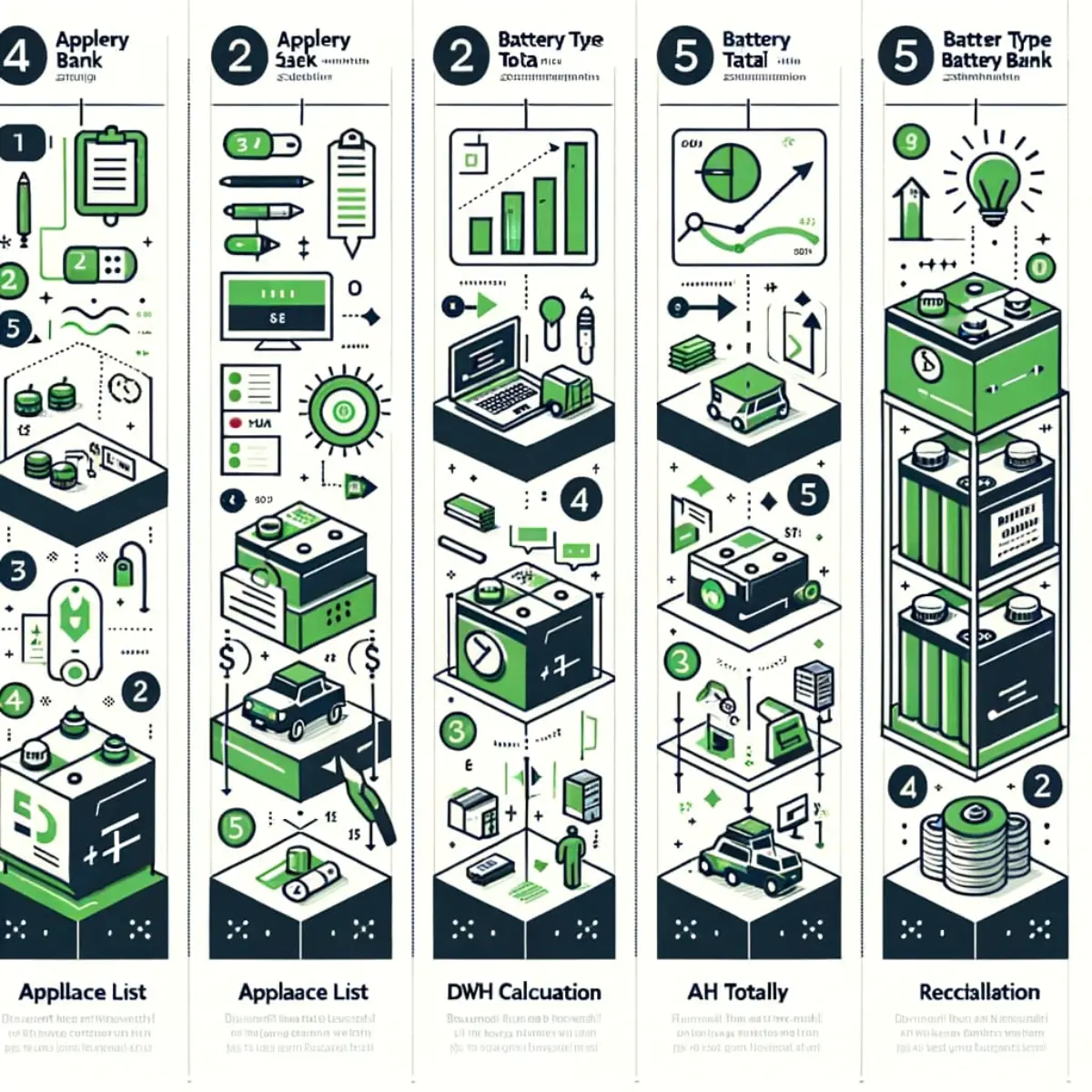
Step 1: List Every Electrical Load in Your RV
Start with a complete inventory of what you run and for how long. Focus on overnight use when shore power isn’t available.
| Appliance | Watts | Hours/Day | Daily Wh |
|---|---|---|---|
| 12V Compressor fridge | 50W avg | 24h | 1,200 Wh |
| CPAP (no humidifier) | 30W | 8h | 240 Wh |
| LED lighting (4 lights) | 20W | 5h | 100 Wh |
| Phone + tablet charging | 30W | 3h | 90 Wh |
| Laptop | 60W | 3h | 180 Wh |
| Water pump (intermittent) | 60W | 0.5h | 30 Wh |
| Total | 1,840 Wh |
This example shows a realistic boondocking load of 1,840 watt-hours per day. Your number will be different — use the calculator linked above to build your own list.
Pro tip: Check the label or spec sheet for actual wattage. Manufacturers often list maximum draw, not average. Compressor fridges especially vary — 50W average is typical, but they cycle on and off.
Step 2: Add a Safety Buffer
Never size your bank to exactly your daily consumption. You need margin for:
- Cloudy days with less solar recharge
- Cold weather (batteries lose 20–30% capacity below 0°C)
- Unexpected loads (guests, extra cooking, weather changes)
- Battery aging (capacity decreases over time)
Standard rule: multiply your daily consumption × 1.25 to 1.5 for your total bank capacity.
Our example: 1,840 Wh × 1.3 = 2,392 Wh minimum bank
Step 3: Apply Depth of Discharge Limits
Here’s where most guides go wrong: you cannot use 100% of your battery’s rated capacity without damaging it.
| Battery Type | Max Recommended DoD | Usable % |
|---|---|---|
| Lead-acid (flooded) | 50% | 50% |
| AGM | 50% | 50% |
| LiFePO4 | 80% | 80% |
This means a 100 Ah AGM battery only gives you 50 Ah of usable capacity. A 100 Ah LiFePO4 gives you 80 Ah usable.
The formula:
“
Required Ah = Daily Wh ÷ Battery Voltage ÷ Usable %
For our 2,392 Wh example at 12V:
- AGM: 2,392 ÷ 12 ÷ 0.50 = 399 Ah total (e.g., 4 × 100 Ah AGM)
- LiFePO4: 2,392 ÷ 12 ÷ 0.80 = 249 Ah total (e.g., 2 × 100 Ah LiFePO4 + 1 × 50 Ah, or 1 × 300 Ah)
This is why LiFePO4 wins on a capacity-for-capacity basis: you need far fewer batteries to deliver the same usable energy.
Step 4: Choose Your Battery Chemistry
For detailed specs and real-world performance differences, see our full guide on lithium vs AGM RV batteries. Here’s the short version:
Choose AGM if:
- Budget is the primary constraint (AGM costs ~$150–200 per 100 Ah vs $300–500 for LiFePO4)
- You camp primarily with shore power access
- You’re replacing an existing AGM system and not ready for a full upgrade
Choose LiFePO4 if:
- You boondock regularly (more than 2–3 nights per month)
- You want to maximize usable capacity per kilogram
- You plan to run solar — LiFePO4 accepts faster charge rates
- Long-term cost efficiency matters (LiFePO4 lasts 5–10× longer)
For most boondockers, LiFePO4 is the correct answer despite the higher upfront cost. The math works out in your favor within 2–3 years.
Step 5: Verify Your Recharge Capacity Matches
A common mistake: sizing a 400 Ah LiFePO4 bank but only having 200W of solar. At 200W, you generate roughly 800–1,000 Wh on a good sun day — not enough to recharge a bank you’re drawing 1,800 Wh from overnight.
Rule of thumb for solar:
- 1 Ah of LiFePO4 capacity needs roughly 10–15W of solar to recharge in a day
- 200 Ah bank → 200 × 12 = 2,400 Wh → needs ~300–400W of solar for full daily recharge
If your solar is undersized, either add panels, add an alternator charging system, or reduce your bank to what you can realistically recharge. A bank you can’t fill is just dead weight.
Step 6: Wire Your Bank Correctly
Battery bank wiring affects performance and safety:
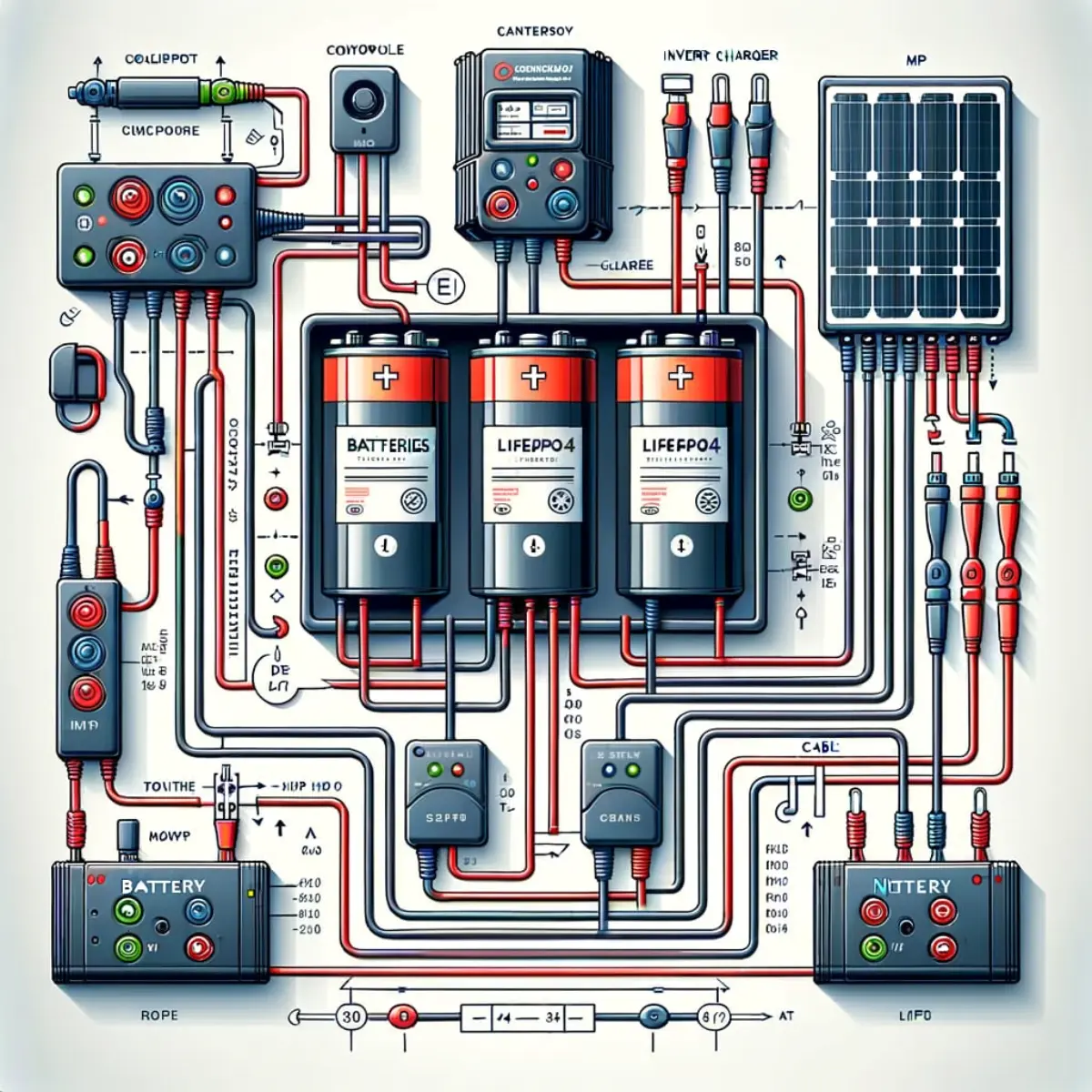 MPPT charge controller and inverter charger” />
- Series wiring increases voltage (12V + 12V = 24V) — used for 24V or 48V systems
- Parallel wiring increases capacity (100 Ah + 100 Ah = 200 Ah at 12V) — most common for RV banks
- Series-parallel combines both for high-capacity, higher-voltage systems
For a standard 12V RV system with multiple 12V batteries, parallel wiring is correct. Use equal-length cables from each battery to a busbar — unequal lengths cause uneven charging and premature failure.
Real-World Example: Sizing for a 5-Day Boondocking Trip
Setup: Class C motorhome, 2 adults, no generator use
Daily loads:
- Compressor fridge: 1,200 Wh
- CPAP × 2: 480 Wh
- LED lights + fan: 150 Wh
- Devices: 120 Wh
- Total: 1,950 Wh/day
With 5 days of autonomy and 300W solar (1,200 Wh harvest/day on average):
- Net daily draw: 1,950 − 1,200 = 750 Wh
- 5-day cumulative draw: 750 × 5 = 3,750 Wh
LiFePO4 bank needed: 3,750 ÷ 12 ÷ 0.80 = 391 Ah → round up to 400 Ah LiFePO4
That’s two 200 Ah LiFePO4 batteries in parallel, or four 100 Ah units.
Free Tool: Skip the Math
If this feels like a lot of calculation, use the Free RV Power Calculator. Enter your appliances, usage hours, and number of days without shore power — it outputs your recommended battery bank size, solar panel wattage, and inverter size automatically.
Frequently Asked Questions
How many 100 Ah batteries do I need for boondocking?
It depends on your load. A typical couple using a fridge + CPAP + devices drawing ~1,800 Wh/day needs at least 200 Ah LiFePO4 (usable: 160 Ah = 1,920 Wh) for one night’s autonomy, or 400 Ah for 2–3 nights without recharging.
Can I mix old and new batteries in a bank?
No. Mixing batteries of different ages, capacities, or chemistries causes the weaker cells to drag down the stronger ones. Always use matched batteries — same brand, capacity, chemistry, and ideally the same age.
What voltage should my RV battery bank be?
Most RVs run 12V systems. Some larger rigs use 24V for efficiency over long wire runs. Unless you’re building a new system from scratch, match your existing system voltage.
How long does a 200 Ah LiFePO4 battery last?
At 1,800 Wh/day consumption: 200 Ah × 12V × 0.80 DoD = 1,920 Wh usable — just over one night. With 300W of solar adding ~1,000–1,200 Wh/day, you can run indefinitely in good sun conditions.
Key Takeaways
- Start with your daily watt-hour total — every other number flows from this
- Apply depth of discharge limits — 50% for AGM, 80% for LiFePO4
- LiFePO4 requires 37% less total capacity than AGM for the same usable energy
- Match your solar harvest to your daily draw — an oversized bank with undersized solar is a problem
- Use the Free RV Power Calculator to get your exact numbers
For a complete overview of RV battery types, inverters, and off-grid systems, see the RV Gear & Power Complete Guide.
For RV battery banks, Renogy lithium batteries offer the best cycle life and weight savings.
Renogy Lithium Batteries → |
Renogy AGM (budget option) →
Affiliate links — we earn a small commission at no extra cost to you.
Related Articles
- Lithium vs AGM RV Battery: Which Is Right for Your Setup?
- Battle Born vs Renogy Lithium Battery: Which RV Battery Is Worth It?
- Best LiFePO4 RV Batteries: Top Picks for Reliable Power
- How Long Can You Boondock on RV Batteries?
- How Long Will Your RV Battery Last?
- RV Energy Monitoring: What to Track and What Actually Matters
- RV Power System Setup: Complete Guide for Vans and RVs

Published on May 2, 2026
Mike Dawson
Mike Dawson is RVGeo's lead editor, applying inspection-grade rigor to RV research - verifying manufacturer specs, testing components, and fact-checking pricing and claims before they're published. RVGeo's approach draws on a background in automotive technical inspection, applied specifically to RV electrical, power, and safety systems. Mike oversees RVGeo's foundational guides on power systems, DIY conversions, and van-life setup, with every recommendation checked against real specs and current pricing rather than assumptions.
This post contains affiliate links. If you make a purchase through these links, we may earn a commission at no extra cost to you.