

Author
RV Gear & Power: The Complete Guide to Batteries, Inverters & Off-Grid Systems (2026)
Most RV power problems are not gear problems. They are planning problems.
You buy a battery. Then solar panels. Then an inverter. Then you spend three weekends trying to figure out why the system does not perform the way you expected. The gear was fine. The plan was not.
This guide gives you the framework first. The gear decisions come after. Whether you are building your first off-grid system or upgrading an existing setup, every section here is designed to help you make smarter choices — and avoid the expensive mistakes that most RV owners only learn about after the fact.
What this guide covers:
Let’s start with the foundation.
🔋 Free RV Power Calculator
Not sure how much battery, solar or inverter you need? Run the numbers in 2 minutes.
→ Use the Free RV Power Calculator
Why Most RV Power Systems Fail Before They Start
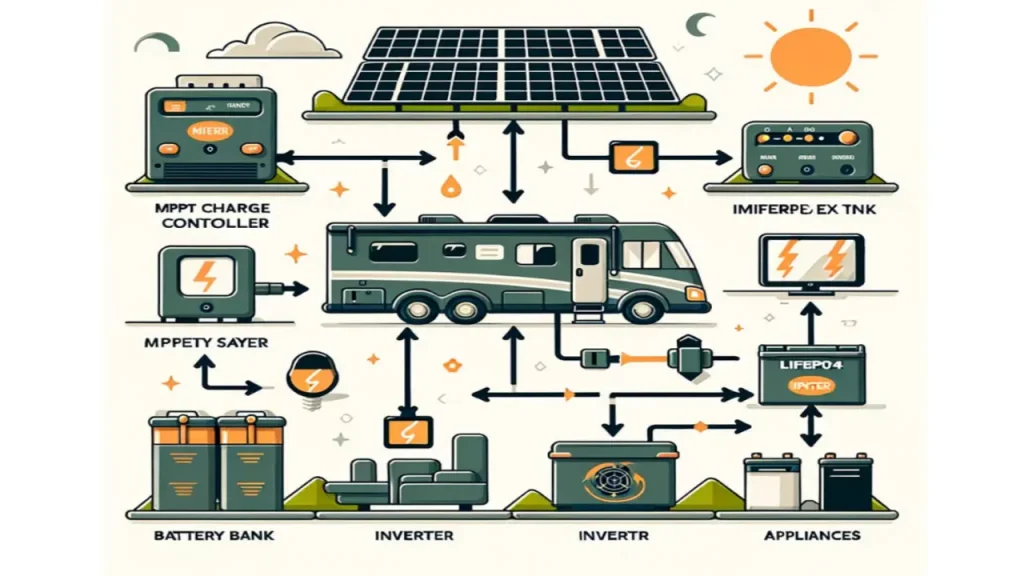
An RV power system fails when its components are sized independently rather than as a system. The most common mistake is purchasing batteries, solar panels, and an inverter separately — each one “good enough” on its own — without calculating whether they work together efficiently. A 200Ah battery bank paired with a 100W solar panel and a 2000W inverter creates an unbalanced system: the inverter can drain the battery in under two hours, while the solar panel takes two days to recharge it. Correct RV power planning starts with a daily energy audit — calculating total watt-hours consumed per 24 hours — before selecting any components. This single step eliminates the most costly sizing errors.
The 3 Components Every RV Power System Needs
A functional off-grid RV power system has three core elements:
1. Storage — Your battery bank. Holds the energy you generate or pull from shore power.
2. Generation — Solar panels, a generator, or shore power hookup. Replenishes your battery bank.
3. Conversion — An inverter or inverter-charger. Converts DC battery power to AC for your appliances.
Remove or undersize any one of these three and the whole system underperforms. Most problems trace back to one of them being skipped in the planning phase.
The Planning Mistake 80% of RV Owners Make
Buying gear before calculating daily energy consumption. It sounds obvious. It is still the most common error.
Before you look at a single product listing, spend 30 minutes listing every electrical device you run, how many watts it draws, and how many hours per day you use it. Add them up. That number — your daily watt-hours — drives every sizing decision that follows.
If you want to skip the math, use the Free RV Power Calculator to get a quick estimate of your actual energy needs before you buy anything.
RV Batteries: The Foundation of Your Power System
Your battery bank is the single most important component in your RV power system. Get this right, and everything else becomes easier to size.
LiFePO4 vs AGM: What Actually Matters
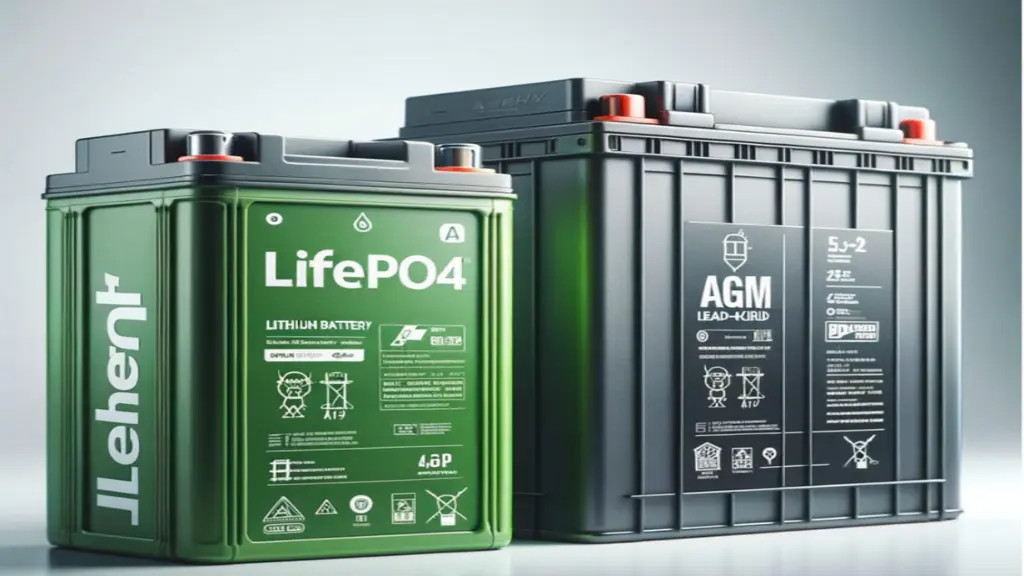
The debate between lithium iron phosphate (LiFePO4) and AGM batteries comes down to four practical factors: usable capacity, weight, lifespan, and upfront cost.
| | LiFePO4 | AGM |
|—|—|—|
| Usable capacity | 80–100% | 50% |
| Weight (100Ah) | ~13 kg | ~28 kg |
| Cycle life | 3,000–6,000 | 300–500 |
| Upfront cost | Higher | Lower |
| Break-even | 2–3 years | — |
The usable capacity difference is the key number. A 200Ah LiFePO4 battery gives you 160–200Ah of actual power. A 200Ah AGM gives you 100Ah before you risk damaging it. To get the same usable capacity, you need twice as many AGM batteries — at which point the price advantage disappears.
For serious boondocking or full-time van life, LiFePO4 is the clear choice. For occasional weekend trips with shore power hookups, AGM still works fine. Read the full lithium vs AGM RV battery comparison for a detailed side-by-side breakdown.
How to Size Your RV Battery Bank
Once you have your daily watt-hours (Wh), the battery sizing formula is straightforward:
Step 1: Convert to amp-hours
`Daily Wh ÷ System voltage (usually 12V) = Daily Ah`
Example: 960Wh ÷ 12V = 80Ah per day
Step 2: Multiply by days of autonomy
`Daily Ah × Days without charging = Base capacity`
Example: 80Ah × 2 days = 160Ah
Step 3: Add a 20% safety buffer
`Base capacity × 1.2 = Minimum battery bank size`
Example: 160Ah × 1.2 = 192Ah minimum
For LiFePO4, this is your actual bank size. For AGM, double it to account for the 50% usable capacity limit.
The RV battery bank sizing guide walks through this calculation step by step with a real-world example.
What a BMS Does and Why You Need One
A Battery Management System (BMS) is the electronic brain inside a LiFePO4 battery pack. It monitors cell voltage, temperature, and current — and cuts the circuit if any parameter goes out of range.
A quality BMS protects against:
When comparing LiFePO4 batteries, the quality of the BMS matters as much as the cell chemistry. Cheap cells with a solid BMS outperform premium cells with a poorly designed one. Look for batteries with Bluetooth monitoring — it lets you check your state of charge, charge/discharge rate, and cell temperature directly from your phone.
The best LiFePO4 batteries for RV boondocking covers the top-rated options with BMS quality as a core evaluation criterion.
RV Solar Panels: Charging While You Drive or Park
Solar is the cleanest, cheapest-per-kWh source of energy for RV use — once the upfront equipment is paid for. The key is sizing it correctly for your battery bank, not for a “nice to have” number.
How Many Watts Do You Actually Need?
A common rule of thumb: your solar array should be able to recharge your battery bank in 5–6 peak sun hours.
Formula:
`Battery bank Ah × System voltage ÷ Peak sun hours = Solar wattage`
Example: 200Ah × 12V ÷ 5 hours = 480W of solar panels
This is a starting point. In cloudy climates, northern latitudes, or heavily shaded campsites, you will want 25–30% more capacity. In the American Southwest, peak sun hours average 5.5–6.5 per day, making solar highly effective for most of the year.
RV solar panel sizing depends on three variables: daily energy consumption in watt-hours, available peak sun hours at the camping location, and charge controller efficiency. The standard calculation divides total daily watt-hours by the product of peak sun hours and system efficiency (typically 0.75 for MPPT controllers). For a system consuming 960 watt-hours per day with 5 peak sun hours, the minimum solar array size is 960 ÷ (5 × 0.75) = 256 watts. Most RV owners add a 25-30% buffer for cloudy days and partial shading, bringing a practical minimum to around 320-400 watts for a moderate-consumption system. Fixed roof panels provide continuous charging while parked or driving; portable panels offer flexibility at the cost of per-watt efficiency.
MPPT vs PWM Charge Controllers: Which One?
Your charge controller sits between the solar panels and the battery bank. It prevents overcharging and optimizes power transfer.
PWM (Pulse Width Modulation):
MPPT (Maximum Power Point Tracking):
For most RV systems in 2026, MPPT is the right choice. The efficiency gains pay for the price difference in under two seasons of regular use. See the full MPPT vs PWM solar charge controller comparison for specific product recommendations.
Roof-Mounted vs Portable Solar Panels
Roof-mounted panels:
Portable panels:
Many RVers run both — a fixed roof array for base charging, with portable panels available for extended stays at low-sun sites.
RV Inverters & Converters: Running AC Appliances Off-Grid
Your battery stores DC power. Your appliances run on AC power. An inverter bridges that gap.
Pure Sine Wave vs Modified Sine Wave
This is one decision you should get right the first time, because the wrong choice can damage sensitive electronics.
Pure sine wave inverters produce a smooth, clean AC waveform identical to grid power. Every modern appliance — laptops, TVs, CPAP machines, variable speed motors, LED dimmers — runs correctly on pure sine wave power.
Modified sine wave inverters produce a stepped, blocky approximation of AC power. They are cheaper, but they cause problems with:
The cost difference between modified and pure sine wave inverters has shrunk significantly in 2026. For any system running modern appliances, pure sine wave is the only sensible choice. The operating efficiency difference (90–95% vs 70–80%) also means lower battery drain over time.
How to Size Your RV Inverter
Your inverter must handle the peak wattage of everything you run simultaneously — not just the average.
Step 1: List your highest-draw appliances
Step 2: Identify what you might run at the same time
If you run a microwave (1000W) and charge a laptop (65W) while the refrigerator cycles (150W), your peak draw is ~1215W.
Step 3: Add 20–25% headroom for startup surges
`1215W × 1.25 = ~1519W` → A 2000W inverter gives comfortable headroom.
For most RVers: a 2000W inverter covers all common appliances. Add an air conditioner and you need 3000W+. The detailed RV inverter sizing guide includes a full wattage reference table.
Inverter-Charger Combos: When They Make Sense
An inverter-charger combines an inverter with a battery charger in a single unit. When you plug into shore power, it charges your batteries and passes through AC power to your appliances. When you disconnect, it automatically switches to inverter mode.
This automatic transfer makes inverter-chargers the standard choice for:
Top inverter-charger brands in 2026 include Victron MultiPlus, Renogy, and Xantrex. See the best RV inverter charger guide for tested recommendations at each price point.
For a clear explanation of how inverters and converters differ, the RV power converter vs inverter explainer covers the practical distinctions without the jargon.
Boondocking Power: Staying Off-Grid for Days
Boondocking — camping without electrical hookups — is where your power system gets its real test. Here is what actually determines how long you can stay out.
RV boondocking duration depends on three measurable variables: battery bank capacity in usable amp-hours, daily energy consumption in amp-hours, and the rate of solar or generator recharging. A 200Ah LiFePO4 battery bank (160Ah usable at 80% depth of discharge) paired with a 400W solar array in a location receiving 5 peak sun hours generates approximately 133Ah per day at 95% MPPT efficiency. For an RV consuming 80Ah daily, this system runs indefinitely in good sunlight. In cloudy conditions reducing solar output by 70%, the system becomes a net draw of 13Ah per day, depleting the 160Ah bank in approximately 12 days without supplemental charging. This makes battery bank sizing for cloudy-day autonomy — not just average conditions — the critical calculation for extended boondocking.
Solar + Battery + Generator: The Smart Combination
Most experienced boondockers use all three power sources — not because solar is unreliable, but because weather is unpredictable.
The practical approach:
A small 2000–3000W generator running 1.5 hours per day uses roughly 1.5 liters of fuel — significantly cheaper than oversizing your solar array to cover worst-case weather scenarios.
The RV solar vs generator comparison breaks down the real cost difference over 5 years, including fuel, maintenance, and equipment.
How Long Can You Actually Stay Off-Grid?
With a well-sized system:
| System Size | Daily Use | Sunny Days | Cloudy Days |
|—|—|—|—|
| 100Ah LiFePO4 + 200W solar | 60Ah/day | Indefinite | 1–2 days |
| 200Ah LiFePO4 + 400W solar | 80Ah/day | Indefinite | 4–5 days |
| 400Ah LiFePO4 + 600W solar | 120Ah/day | Indefinite | 7–10 days |
“Indefinite” assumes sufficient daily sun (4+ peak hours). In deep shade or heavy overcast for multiple consecutive days, even large systems need supplemental charging.
Use the Free RV Power Calculator to model your specific setup and see exactly how many days of autonomy your system provides under different conditions.
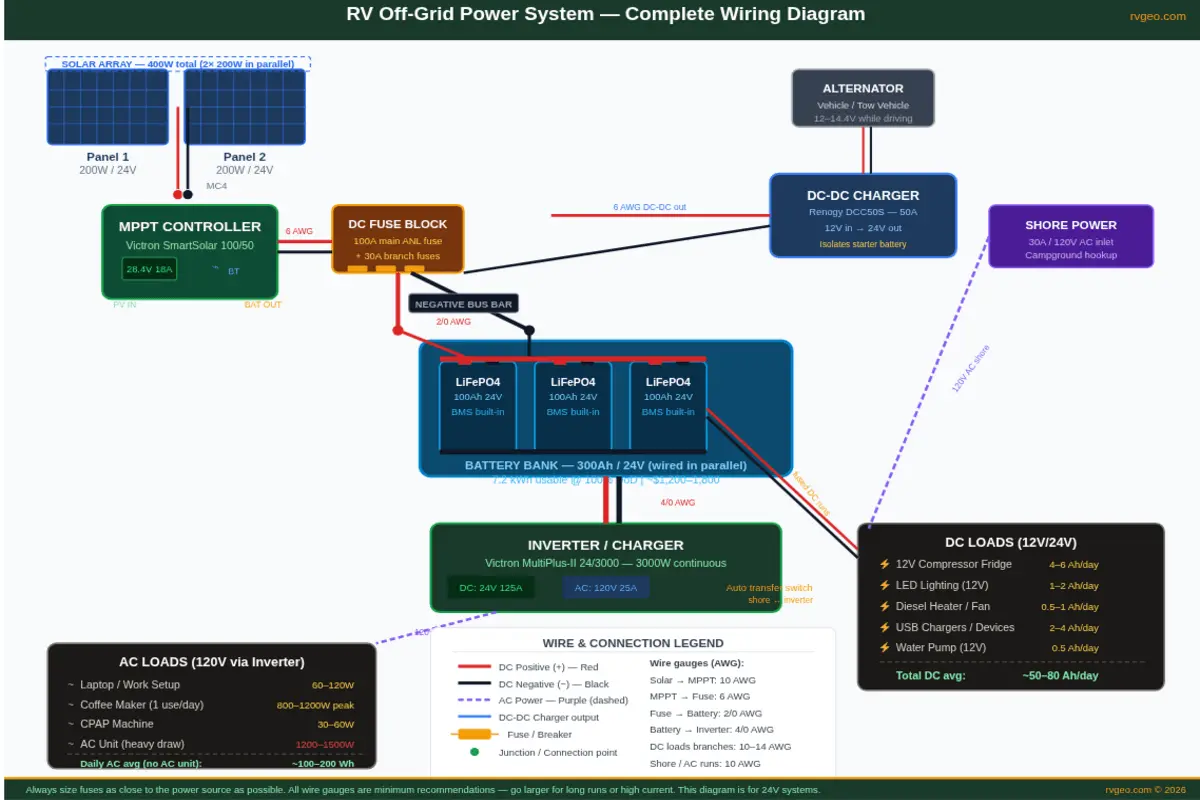
For a deeper walkthrough of building a complete boondocking-ready system, the RV boondocking power setup guide covers the exact components and wiring sequence.
Portable Power Stations as a Backup Option
Portable power stations — large battery packs with built-in inverters, like the EcoFlow Delta Pro or Jackery Explorer 2000 — have become a practical supplement for RV power.
They are not a replacement for a proper battery + solar system for serious off-grid use, but they excel as:
The best portable power stations for RV camping covers the top-rated options for 2026, including wattage, capacity, and recharge time.
RV Battery Charging Methods Compared
Your battery bank can be charged from three sources. Most RV setups use all three depending on availability.
Shore Power
When you plug into a campsite electrical hookup (30A or 50A service), your converter or inverter-charger automatically charges your batteries from grid AC power.
Solar Charging
The most common primary charging method for boondockers. Silent, fuel-free, and automatic once the system is installed.
Alternator / DC-DC Charging
When you drive, your vehicle alternator can charge your house batteries through a DC-DC charger (also called a B2B charger). This is standard equipment on most modern van conversions.
For a full breakdown of all three methods — including which charges lithium correctly and which can damage it — see the RV battery charging methods guide.
Best RV Power Gear in 2026: Quick Reference
You do not need the most expensive equipment. You need the right equipment, correctly sized. Here are the categories worth investing in:
Best LiFePO4 Batteries
Full rankings and testing notes: best LiFePO4 batteries for RV boondocking
Best RV Inverter Chargers
Full rankings: best RV inverter charger 2026
Best Portable Power Stations
Full rankings: best portable power stations for RV 2026
Free Tools & Resources
Free RV Power Calculator
Before you buy anything, use the free RV Power Calculator to estimate your actual daily energy consumption and see what size battery bank and solar array you need.
→ Use the Free RV Power Calculator — instantly, no signup required
The Smart Method for Mobile Power — $59
The ebook that goes deeper than this guide. It gives you a structured decision framework for sizing and selecting every component in your RV power system — before you spend money on the wrong setup.
→ Get The Smart Method for Mobile Power — $59
*”Build Your RV Power System With More Clarity, Fewer Mistakes, and Better Decisions.”*
Frequently Asked Questions
What is the best battery for RV off-grid use?
LiFePO4 (lithium iron phosphate) batteries are the best choice for off-grid RV use in 2026. They offer 80–100% usable capacity vs 50% for AGM, last 3,000–6,000 cycles vs 300–500 for AGM, and weigh 50% less. The higher upfront cost typically pays back within 2–3 years for regular users.
How many solar panels do I need for my RV?
Calculate your daily watt-hour consumption, divide by your average peak sun hours, then divide by 0.75 (MPPT efficiency). For a system using 960Wh/day in a location with 5 peak sun hours: 960 ÷ (5 × 0.75) = 256W minimum. Add 25–30% buffer for cloudy days, bringing a practical minimum to 320–400W.
What size inverter do I need for RV use?
Add up the wattage of all appliances you might run simultaneously, then multiply by 1.25 for startup surge headroom. For most RVers running a microwave, laptop, and lighting concurrently, a 2000W pure sine wave inverter is sufficient. Running an air conditioner requires 3000W+.
Do I need a generator if I have solar panels?
Not always, but it is a practical backup. Solar handles 80–90% of charging needs under normal conditions. A small generator running 1–2 hours on consecutive cloudy days prevents battery depletion without requiring you to oversize your solar array for worst-case weather.
What is the difference between an inverter and a converter in an RV?
A converter charges your 12V batteries from 120V shore power (AC to DC). An inverter does the opposite — it converts DC battery power to 120V AC for your appliances. An inverter-charger does both in one unit, automatically switching between modes depending on whether shore power is available.
How long can I boondock on a 200Ah LiFePO4 battery bank?
With 160Ah of usable capacity and a daily consumption of 80Ah, you have 2 full days of autonomy without any charging. Pair with 400W of solar (generating ~133Ah on a sunny day) and you can boondock indefinitely under normal sunlight conditions.
🔋 Free RV Power Calculator
Not sure how much battery, solar or inverter you need? Run the numbers in 2 minutes.
→ Use the Free RV Power Calculator
Key Takeaways
Complete Resource Library — RV Gear & Power
Every article below goes deeper into a specific component or decision covered in this guide. Use these as your next step once you know which part of your system to focus on.
Solar Panels & Controllers
- RV Solar Panel Sizing Guide: How Many Panels Do You Really Need?
- MPPT vs PWM Solar Charge Controller: Which Does Your RV Need?
- 7 Common RV Solar Setup Mistakes That Kill Your Off-Grid Power
- RV Solar Panel Maintenance: Complete Seasonal Checklist (2026)
- How to Run RV Air Conditioning Off Solar Power
Batteries
- How to Size Your RV Battery Bank: Step-by-Step Calculator Guide
- Lithium vs AGM RV Battery: Which Is Right for Your Setup?
- Best LiFePO4 Batteries for RV Boondocking in 2026
- Why Your RV Battery Drops Faster Than Expected
- RV Battery Charging Methods: Solar, Shore Power & Alternator Explained
- Best RV Batteries for Cold Weather: AGM vs Lithium Tested (2026)
- DC-DC Battery to Battery Charger for RV: What It Is and the Best Options
Inverters & Converters
- How to Size an Inverter for Your RV: Wattage Guide & Calculator
- Best RV Inverter Charger in 2026: Tested & Ranked
- RV Power Converter vs Inverter: Key Differences Every Owner Should Know
- Common Inverter Problems in RV Solar Systems and How to Solve Them
Power Planning & Off-Grid Setup
- RV Power Usage Calculator Guide: Estimate Your Daily Energy Needs
- RV Boondocking Power Setup: How to Stay Off-Grid for 7+ Days
- RV Solar vs Generator for Boondocking: Real Cost & Performance Compared
- Best RV Generators in 2026: Honda vs Champion vs Westinghouse
- Best Portable Power Station for RV Camping in 2026
- Best 12V Compressor Fridge for RV Camping in 2026
- New 2026/27 RV Electrical Rules Explained: GMI & Lithium Standards
- Starlink Roam Plans in 2026/27: New Prices & Which One Fits Your RV
*Written by Mike Dawson — RV systems specialist and van-life enthusiast. Real testing. Honest recommendations.*
*Last updated: April 2026 | Category: Gear & Power*
See also: RV Power System Setup: Complete Guide for Vans and RVs

Published on April 30, 2026
Mike Dawson
Mike Dawson is RVGeo's lead editor, applying inspection-grade rigor to RV research - verifying manufacturer specs, testing components, and fact-checking pricing and claims before they're published. RVGeo's approach draws on a background in automotive technical inspection, applied specifically to RV electrical, power, and safety systems. Mike oversees RVGeo's foundational guides on power systems, DIY conversions, and van-life setup, with every recommendation checked against real specs and current pricing rather than assumptions.
This post contains affiliate links. If you make a purchase through these links, we may earn a commission at no extra cost to you.