
Author


RV Energy Monitoring
What to track and what actually matters.
Most RV Owners Track the Wrong Numbers
Most RV owners track the wrong numbers.
They look at battery voltage, glance at a percentage, and assume they understand their system. That works until power starts disappearing faster than expected, the battery never seems to recover properly, or the monitor says one thing while real-world performance says something else.
The problem is not just lack of data. The problem is tracking numbers without knowing which ones actually matter.
RV energy monitoring is not about watching everything. It is about watching the few numbers that help you make useful decisions before your system becomes a problem.
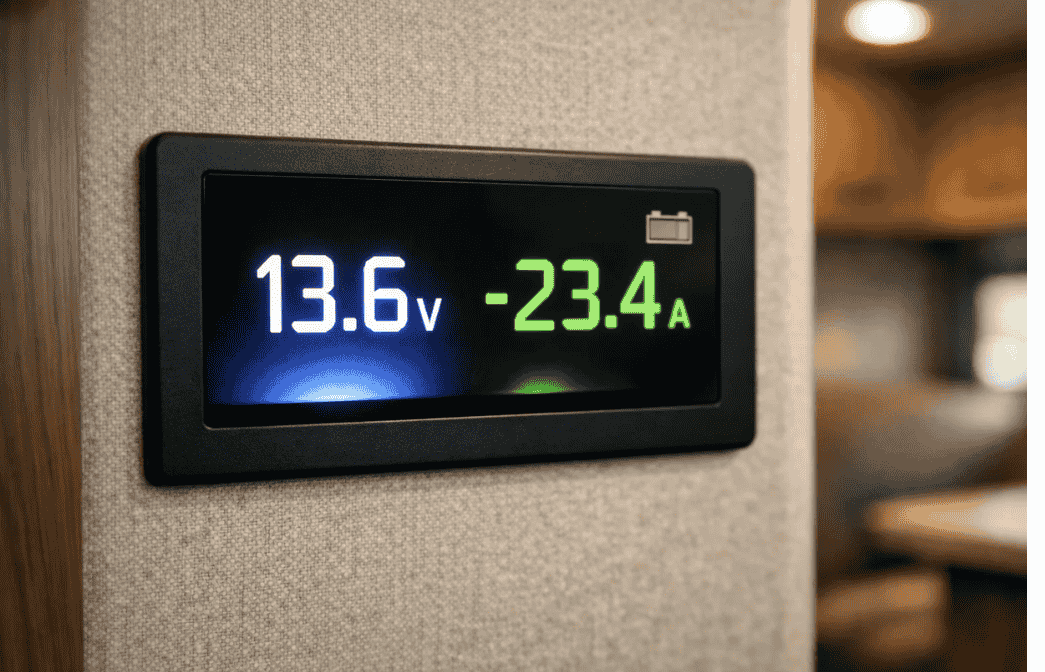
Monitoring Should Help You Decide
A good monitor is not there to impress you with numbers. It is there to tell you whether you are gaining power, losing power, charging properly, or slowly falling behind.
Start With the Real Question
The point of RV energy monitoring is not to collect information. It is to answer practical questions in real time:
Am I gaining power or losing it right now?
How fast is my battery draining?
Is my charging source actually doing its job?
How much usable energy do I really have left?
If your monitor cannot help you answer those questions, then you are either tracking the wrong metrics or reading the right metrics the wrong way.
The Four Numbers That Matter Most
Battery current in amps
This is one of the most useful numbers in your system. Amps tell you whether energy is flowing into the battery or out of it. Positive amps mean charging. Negative amps mean the battery is being drained.
Power draw in watts
Watts tell you how much power your devices are actually using. This is often the number that explains why a battery never lasts as long as expected.
State of charge or battery percentage
Battery percentage is useful, but it is still an estimate. It should be read together with current flow and real behavior, not alone.
Voltage
Voltage matters, but it is not the whole story. It is best used as supporting context rather than as a perfect battery gauge.

What Most People Monitor Incorrectly
The most common mistake is simple: people monitor the battery like it is a fuel gauge.
That sounds reasonable, but RV electrical systems do not behave that cleanly. A battery is part of a moving system. Loads change. Charging sources come and go. Solar fluctuates. Driving charge changes. Inverter use can spike suddenly.
Treating voltage as a perfect battery gauge
Voltage is useful, but it can be misleading under load or during charging.
Trusting battery percentage alone
Battery percentage helps, but it can drift or hide what is happening right now.
Ignoring watts and amps
Without flow data, you miss the real behavior of the system.
Assuming charging is strong because something is connected
A connected source is not the same as useful recovery.
The Simplest Way to Read Your System in Real Time
First question: am I charging or discharging?
Look at amps. Positive means charging. Negative means discharging. That is your first truth.
Second question: how fast?
Look at amps or watts. A small positive charge may exist, but still be too weak to recover the battery meaningfully.
Third question: does it match what I expected?
If the numbers do not match your assumptions, then the system is telling you something important.
Fourth question: where is the imbalance?
Is it battery size, inverter demand, hidden loads, weak solar, or poor charging? Monitoring helps you locate the real issue.
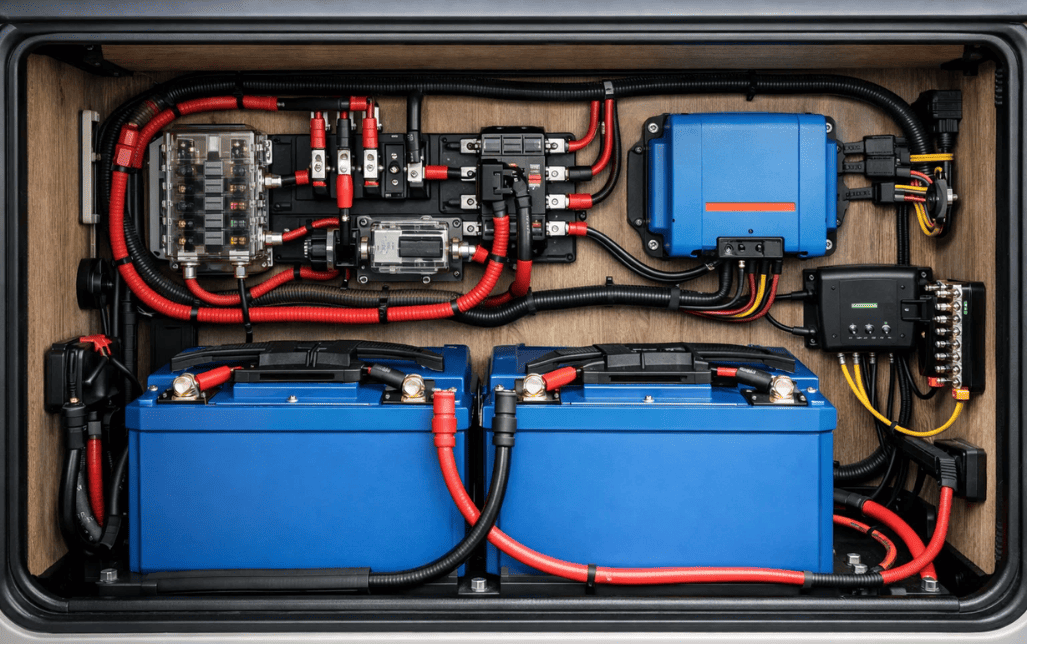
Monitoring Makes the Whole System Easier to Understand
Monitoring does not only tell you battery status. It helps you understand whether your battery, loads, solar, inverter, and charging sources are balanced as a system.

A Real-World Example of Why This Matters
Imagine an evening where your RV is running lights, a fridge, a fan, phone charging, laptop charging, and a few standby electronics.
None of those loads feels extreme on its own. But a good monitor may show that your system is drawing more power than expected. What felt like a light evening becomes a meaningful overnight drain.
The next day, solar starts charging, but not strongly because of shade or poor sun angle. Then you drive for two hours and assume the alternator fully recovered the battery. But the monitor shows only modest net recovery.
Without monitoring, you think the battery is weak. With monitoring, you realize the system was never balanced in the first place.
If You Want the Most Value With the Least Effort, Track These First
That order matters. If you only track battery percentage and voltage, you may miss what the system is doing right now. If you track current and power flow, you understand motion. Once you understand motion, the rest becomes easier.
Monitoring Connects Everything Else in Your RV Power System
RV energy monitoring is not separate from the rest of your system. It connects directly to:
- battery runtime
- solar sizing
- inverter choice
- charging while driving
- daily energy needs
That is why monitoring is often the missing layer between “installed” and “understood”.

Quick Answers
What is the most important RV energy metric to track?
Battery current in amps is one of the most useful because it tells you whether the battery is charging or discharging right now.
Is battery percentage enough?
No. It is helpful, but it should be read together with current flow and system behavior.
Is voltage a reliable battery gauge?
Not by itself. Voltage is useful for context, but it can be misleading under load or during charging.
Should I track watts too?
Yes. Watts help you understand real appliance use and unexpected power draw.