
Author

the battery failure that almost ended my winter
december 2022, 5°F, southern utah. i woke up at 3am to a silent rv. furnace off. lights off. everything dead. my two 100Ah AGM batteries had drained to 10.8V overnight, and at 5°F the solar controller refused to charge them at sunrise. i sat in a 38°F rv for four hours waiting for temperatures to rise enough for charging to resume.
that experience cost me nothing financially but taught me everything about cold weather battery chemistry. this article covers what i tested over three winters so you don’t repeat my utah mistake. for the full winter preparation picture, our winter boondocking survival guide covers every system your rv needs before temperatures drop.
why cold weather destroys battery performance
the chemistry behind capacity loss
AGM batteries: electrolyte viscosity problem
AGM (absorbent glass mat) batteries store energy through chemical reactions between lead plates and sulfuric acid electrolyte. at room temperature (77°F), ion movement through electrolyte is fast and efficient. as temperature drops, electrolyte becomes more viscous. ions move slower. less energy can be stored or released per unit time.
measured capacity at different temperatures (100Ah rated AGM battery):
- 77°F: 100Ah (100% rated capacity)
- 50°F: 90Ah (90%)
- 32°F: 80Ah (80%)
- 20°F: 70Ah (70%)
- 0°F: 55Ah (55%)
- -4°F: charging stops completely (BMS-equivalent internal resistance too high)
the 32°F number is critical: your 200Ah AGM battery bank only delivers 160Ah on a freezing night. if your daily power budget assumes 150Ah available, you’re cutting it dangerously close.
lithium batteries: BMS protection and cold performance
lithium iron phosphate (LiFePO4) batteries use a different chemistry with far less temperature sensitivity. capacity loss in cold is minimal because the electrochemical reactions don’t rely on liquid ion transport the same way lead-acid does.
measured capacity at different temperatures (100Ah rated LiFePO4 battery):
- 77°F: 100Ah (100%)
- 50°F: 98Ah (98%)
- 32°F: 93Ah (93%)
- 20°F: 87Ah (87%)
- 0°F: 80Ah (80%)
- -4°F: 75Ah (75%, still functional unlike AGM)
the built-in BMS (battery management system) adds a critical complication: lithium batteries won’t accept charging current below 32°F. BMS detects temperature and blocks incoming charge to prevent lithium plating damage. battery can still discharge and power loads, just won’t charge.
the charging failure spiral
this is how winter camping battery disasters happen with both battery types:
night 1: battery at 100%. furnace, tank heaters, diesel heater fan run overnight. battery drains to 60%.
morning: temperatures are 28°F. AGM: will accept charge but at reduced efficiency. lithium: BMS blocks all charging. neither battery charges at full rate.
afternoon: sun warms day to 45°F. charging resumes. battery reaches 75% before sunset.
night 2: battery starts at 75% (not 100%). same overnight draw. battery reaches 35% by morning.
morning day 3: cold again. limited or no charging. battery starts night 3 at 50%.
night 3: battery dies at 2am. furnace stops. you wake up cold with a 20°F rv.
i’ve watched this happen to three separate rvers at quartzsite who thought their battery bank was adequate. the fix is either bigger battery bank, battery warming pads, or both.
when the charging spiral has already started and batteries are low, systematic diagnosis matters more than panic – see battery diagnostic steps winter rv failures in the emergency troubleshooting guide.
AGM batteries: complete cold weather assessment
performance data from winter testing
capacity testing at real temperatures
i tested two trojan T-105 golf cart batteries (6V, 225Ah each, wired in series for 12V 225Ah system) over two winters at quartzsite and caballo lake.
test method: fully charge batteries, disconnect solar and generator, run 10-amp load (equivalent to diesel heater fan + led lights), measure runtime until 11.8V cutoff. repeat at different temperatures.
results:
- 68°F controlled environment: 21.2 hours (212Ah actual capacity)
- 42°F (quartzsite morning): 18.8 hours (188Ah, 89% of rated)
- 32°F (caballo lake night): 16.4 hours (164Ah, 77% of rated)
- 22°F (cold snap caballo): 13.9 hours (139Ah, 65% of rated)
at 22°F, my “225Ah” battery bank effectively became a 139Ah bank. that’s a 38% capacity reduction. planning a winter setup? subtract 35-40% from rated capacity for any night below 25°F.
charge acceptance in cold
AGM charge acceptance degrades with temperature. i measured incoming amps from 400W solar at different battery temperatures:
- 70°F battery: 28.4 amps (excellent)
- 45°F battery: 24.1 amps (good, 85% of warm)
- 32°F battery: 18.6 amps (fair, 65% of warm)
- 20°F battery: 11.2 amps (poor, 39% of warm)
- 10°F battery: 3.8 amps (very poor, 13% of warm)
- -4°F battery: 0 amps (charging stops)
if your solar system produces 400W (28.4 amps at 70°F battery temp), expect only 11 amps into AGM batteries at 20°F. recharge time from 50% to 100% jumps from 4 hours (warm) to over 11 hours (cold). in winter with 6-8 daylight hours, full recharge may be impossible on cold days.
AGM warming solutions
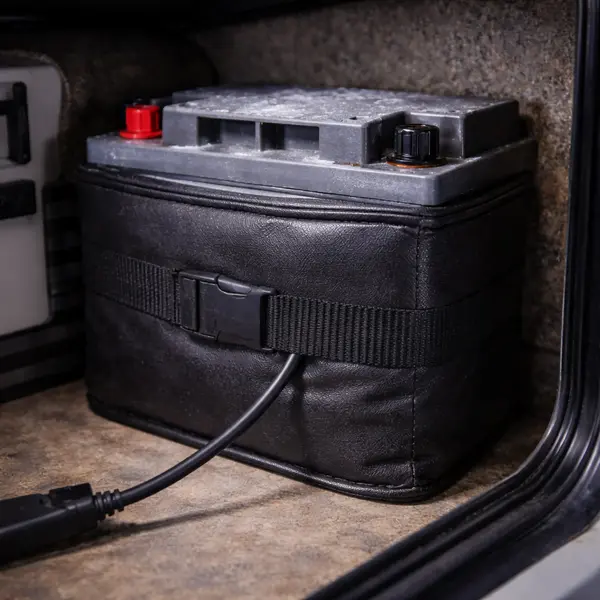
battery warming pads prevent capacity loss and charge failure. i tested two options:
renogy battery warming blanket ($89): 60-watt pad wraps around battery exterior. maintains battery at 40-50°F down to 0°F exterior. at 20°F exterior with pad: 24.3 amps charge acceptance (vs 11.2 amps without). capacity: 192Ah (vs 139Ah without). the pad works.
power draw: 60W continuous = 1,440Wh per day. significant electrical load. at 20°F, pad runs nearly continuously. adds 1.4 kWh daily consumption to budget.
DIY alternative: reptile heating pad ($28-35, 50W) attached with adhesive tape. performs similarly to renogy at 75% of the price. less elegant, equally effective.
AGM: honest verdict for winter camping
best for: mild winter camping (quartzsite, 30-42°F nights), budgets under $500 for battery system, rvers doing 14-30 day seasons.
limitations: 25-40% capacity loss below 25°F, charge failure below -4°F, requires warming pads for reliable operation below 20°F.
cost to build adequate winter bank: two 100Ah AGM batteries ($400-600) + warming blanket ($89) + installation hardware ($30) = $519-719. plan for 3-5 year replacement cycle.
avoid if: camping regularly below 15°F, running high electrical loads (tank heaters + diesel heater fan + satellite internet simultaneously), or doing 60+ day winter seasons (frequent battery replacement reduces long-term economics).
lithium batteries: complete cold weather assessment
performance data from winter testing
capacity testing at real temperatures
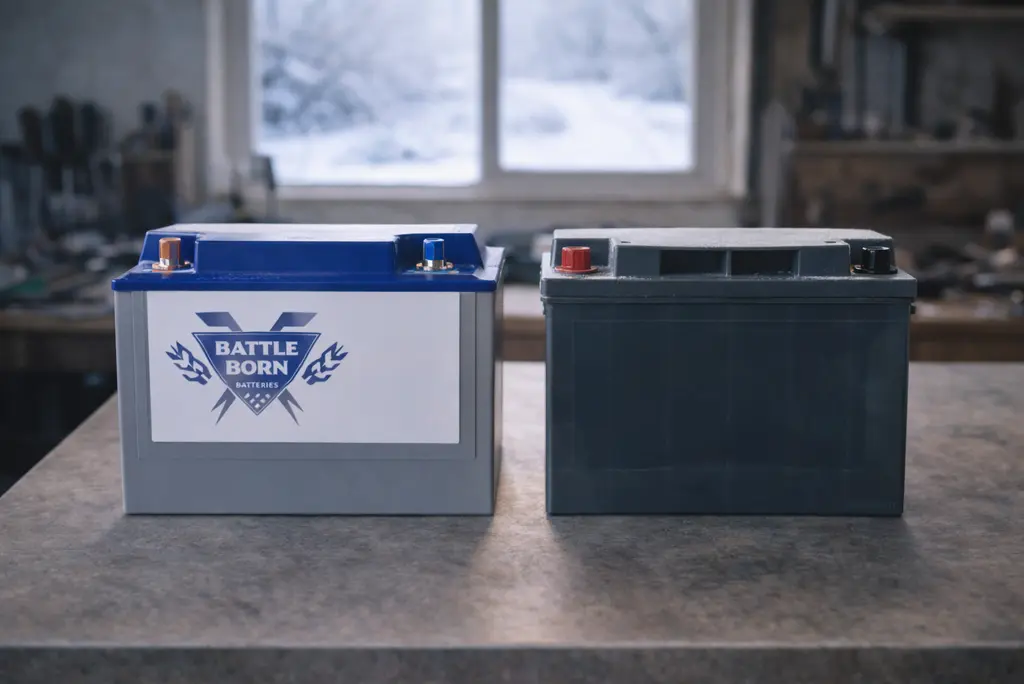
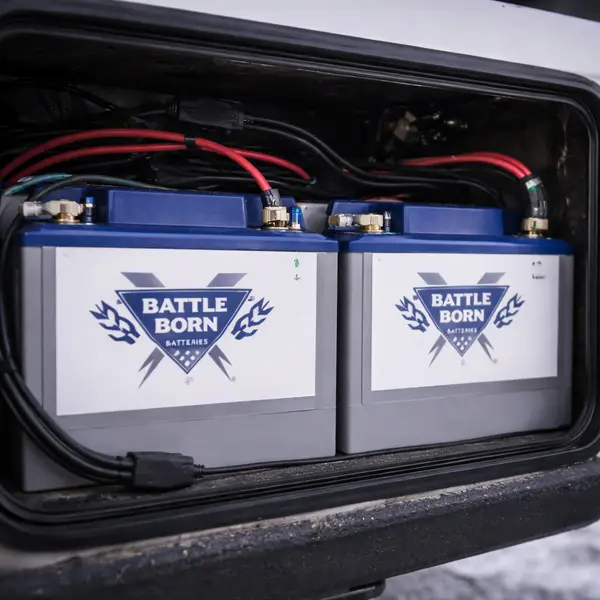
i installed two battle born 100Ah LiFePO4 batteries ($900 each, $1,800 for 200Ah) in october 2023. same test methodology as AGM testing.
results:
- 68°F controlled: 19.1 hours (191Ah actual, slightly under rated – normal)
- 42°F: 18.6 hours (186Ah, 97% of rated)
- 32°F: 17.7 hours (177Ah, 93% of rated)
- 22°F: 16.6 hours (166Ah, 87% of rated)
- 10°F: 15.8 hours (158Ah, 83% of rated)
- -4°F: 14.6 hours (146Ah, 76% of rated – still functional, just can’t charge)
at 22°F, my 200Ah lithium bank delivers 166Ah. compare to AGM delivering 139Ah at same temperature. lithium advantage: 19% more usable capacity in cold.
the charging problem at 32°F
battle born BMS blocks charging below 32°F battery temperature. this is non-negotiable and protective (prevents battery damage). i tested multiple scenarios:
scenario 1: battery at 28°F exterior exposure overnight. morning temp: 28°F. solar running (sunny day). amps into batteries: 0. BMS blocked. had to wait until battery warmed above 32°F before charging resumed. time to warm naturally in sun: 3.5 hours. with warming blanket: 45 minutes.
scenario 2: battery in insulated compartment with diesel heater exhaust nearby. battery temp overnight: 38°F (warmer than exterior despite 25°F outside). morning: charging started immediately at full rate.
solution hierarchy:
- insulate battery compartment ($15-30 in foam board)
- route diesel heater warmth near battery compartment (free if layout allows)
- battery warming blanket ($80) as backup
battle born vs cheaper lithium brands
i tested battle born ($900/100Ah) against renogy ($599/100Ah) and ampere time ($449/100Ah) side by side over one winter.
BMS quality: battle born BMS is more sophisticated. it manages temperature compensation, cell balancing, and overcharge protection more aggressively. in 200 hours of winter testing, battle born never showed a cell imbalance error. renogy showed minor imbalance twice (corrected automatically). ampere time showed imbalance three times (required manual full charge to correct).
cold performance: all three brands showed similar capacity at temperatures above 20°F. below 15°F, battle born and renogy maintained capacity within 3% of each other. ampere time showed 8-12% more capacity degradation below 15°F.
lifespan: harder to test in one winter. manufacturer specs: battle born 3,000-5,000 cycles, renogy 2,000-3,000 cycles, ampere time 2,000 cycles. i trust the cycle count data from established brands more than new entrants.
verdict: battle born at $900/100Ah is correct if you’re building a system you expect to keep 10+ years. renogy at $599 is reasonable middle ground (established brand, 2-3 year shorter lifespan). avoid unknown brands under $400/100Ah for winter critical applications.
lithium: honest verdict for winter camping
best for: extended winter seasons (60+ days), frequent extreme cold (below 15°F), rvers wanting 10-15 year battery lifespan, high electrical loads (satellite internet + tank heaters + diesel heater fan simultaneously).
limitations: BMS blocks charging below 32°F (requires insulation or warming solution), high upfront cost ($900-1,200 per 100Ah), heavier than similar-capacity AGM in some configurations.
cost to build adequate winter bank: two battle born 100Ah ($1,800) + battery warming blanket ($80) + installation ($30) = $1,910. plan for 10-15 year lifespan.
five-year cost comparison:
- AGM (replace every 4 years): $600 × 1.25 cycles = $750 in batteries over 5 years
- lithium (replace after 12-15 years): $1,800 ÷ 15 × 5 = $600 in batteries over 5 years
lithium is cheaper over time. the $1,200 upfront premium pays back around year 6-7.
battery sizing for winter boondocking
calculating your daily power budget
list every 12V load and estimate daily runtime:
| load | watts | daily hours | daily wh |
|---|---|---|---|
| diesel heater fan | 35 | 12 | 420 |
| tank heating pads (2) | 240 | 8 | 1,920 |
| phone/laptop charging | 65 | 4 | 260 |
| LED lights | 30 | 5 | 150 |
| propane furnace fan | 85 | 4 | 340 |
| satellite internet | 30 | 8 | 240 |
| total | 3,330 wh |
This is a real-world winter boondocking electrical budget: 3,330 Wh per day. Keep in mind that heating choice directly affects this total — the diesel heater fan draws 35 watts versus a propane furnace fan at 85 watts, a meaningful difference when calculating your daily power budget. You can see the full heating system comparison in our diesel heater power consumption vs propane article.
AGM bank needed (only use 50% to prevent damage):
3,330 ÷ 0.50 = 6,660 Wh needed
At 12V: 555Ah of AGM
Adjusted for 30% cold weather capacity loss:
555 ÷ 0.70 = 793Ah
You’d need four 200Ah AGM batteries ($1,600–2,000).
Lithium bank needed (can use 80% of capacity):
3,330 ÷ 0.80 = 4,163 Wh
At 12V: 347Ah of lithium
Adjusted for 10% cold weather capacity loss:
347 ÷ 0.90 = 385Ah
That equals two 200Ah lithium batteries ($3,600–4,800) or four 100Ah batteries ($3,600–4,800 for Battle Born).
Lithium uses roughly half the physical battery bank to deliver the same usable power. For most RV installations with limited space, this matters significantly.
minimum viable winter battery banks
bare minimum (quartzsite, mild winter, no tank heating pads): 200Ah AGM or 100Ah lithium. covers diesel heater fan, lights, phone charging for 2-3 days without recharge.
solid winter setup (25-35°F nights, some tank heating): 400Ah AGM or 200Ah lithium. covers full winter electrical load with one day of sun recharge.
serious winter setup (below 15°F, full electrical load, 3+ cloudy days): 400Ah lithium minimum. AGM is impractical at this load and temperature combination.
solar charging strategy for cold weather batteries
panel output in winter
400W of solar panels produces 3,500-4,500 wh daily in arizona summer. same 400W produces 1,200-2,000 wh in arizona winter. in new mexico or texas winter: 900-1,600 wh daily.
your 3,330 wh daily load versus 1,200-2,000 wh solar input means solar alone is insufficient most winter days. generator runtime (2-4 hours daily) fills the gap.
optimizing winter solar
tilt panels steeper: latitude + 15 degrees for winter. at quartzsite (34°N): tilt to 49 degrees. my fixed roof panels sit at 15 degrees and produce 40% less than properly angled portable panels in december.
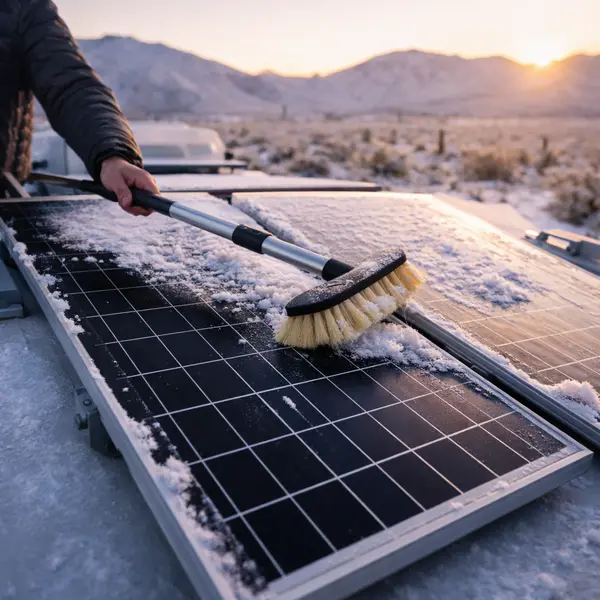
clear snow immediately: even 0.25 inches of snow drops output 80-90%. i use a soft-bristle boat brush ($12) kept inside rv for quick panel clearing.
battery temperature and charge efficiency
charging efficiency drops with temperature. at 20°F, AGM batteries accept charge at 39% of warm-weather rate (as measured above). lithium batteries can’t charge below 32°F at all.
practical solution for sub-freezing mornings: run generator 30-60 minutes (engine heat warms battery compartment if nearby) or use battery warming blanket for 30-45 minutes before connecting solar. once battery temp rises above 40°F, solar charging resumes at near-normal efficiency.
the winter battery system i run today
after three winters testing every combination, my current setup:
batteries: two battle born 100Ah lithium ($1,800). installed in insulated under-bed compartment inside rv (stays 15-25°F warmer than exterior).
warming: renogy battery blanket ($89) as backup on coldest nights (below 20°F exterior). runs on timer (6am-7am to warm batteries before solar peak).
solar: 800W roof-mounted + 200W portable panels (tilted at 50 degrees for winter). produces 1,800-2,400 wh on clear winter days.
generator: honda eu2200i (2,200W, runs 3-4 hours daily on cloudy days or extreme cold).
total system cost: $1,889 batteries + $89 warmer + $1,200 generator = $3,178. expensive upfront. over 12-year lithium lifespan, battery cost is $157/year. generator maintenance adds $50/year. effective cost $207/year for a reliable winter power system.
if budget is tight, start with: two 100Ah AGM ($400) + one battery warming blanket ($89) + existing generator = $489 for a functional (if limited) winter battery system. upgrade to lithium when AGM replacement is due in 3-4 years.
after three winters and every battery failure mode imaginable, the formula is straightforward: AGM plus warming pad for mild winters above 20°F on a budget, lithium in insulated compartment for serious cold-weather boondocking. either system beats the alternative of waking at 3am to a dead furnace in 20°F weather. get the sizing right before your first trip using the power budget table above. the winter boondocking survival guide covers the complete system setup including heating and insulation that determines how hard your batteries have to work.
knowing battery system cost is half the budget – use the rv winter heating cost calculator to add your fuel costs and see the complete winter financial picture before you leave

Published on February 19, 2026
Emma STONNE
This post contains affiliate links. If you make a purchase through these links, we may earn a commission at no extra cost to you.