
Author

After three years of full-time RV living powered entirely by solar, I’ve answered the same questions hundreds of times in forums, Facebook groups, and campground conversations. This comprehensive FAQ compiles the most common questions with honest, experience-based answers. No sales pitches, no theoretical calculations just practical advice from someone who’s lived with solar daily through every season and weather condition. Whether you’re researching your first system or troubleshooting an existing installation, these answers address the real questions RVers actually ask.
For complete technical details and systm design principles, see our comprehensive guide to RV power systems that covers everything from component selection to installation
System Sizing & Planning
How much solar do I really need for my RV?
Calculate your daily consumption in amp-hours, multiply by 1.5 for weather buffer, then divide by 5 (average peak sun hours). A couple using 100Ah daily needs roughly 300W minimum. Families or remote workers consuming 180-200Ah daily need 600-800W.
The “1.5× buffer” is critical. I initially sized my system for exact consumption and regretted it immediately. Cloudy days, winter sun angles, and unexpected usage spikes mean you need significant overhead. Size for your worst-case realistic day, not your average day.
Size for your worst-case realistic day, not your average day, using a complete system design approach that accounts for weather variability and seasonal changes
Can I run my RV air conditioner on solar?
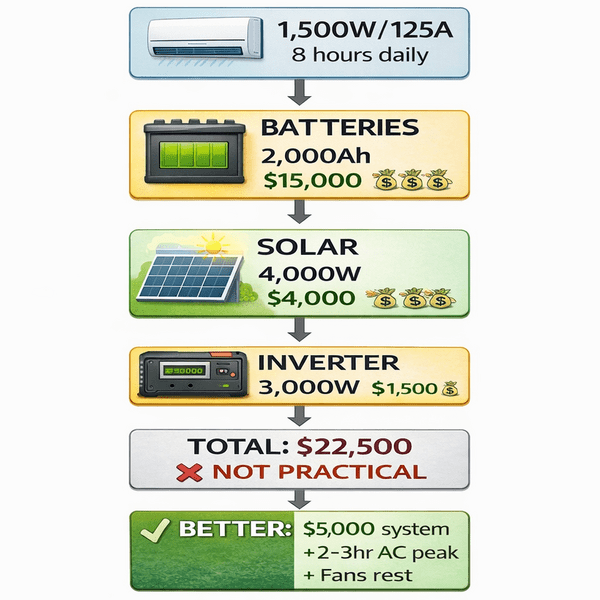
Technically yes, practically difficult. A 13,500 BTU AC draws 130-150A continuously that’s 1,560-1,800 watts. You’d need 2,000W+ of panels, 400-600Ah of batteries, and a 3,000W inverter. Total cost: $8,000-$12,000 just for AC capability.
Better solution: Camp in cooler climates during summer, use fans extensively, or accept limited AC runtime during peak solar hours. I run my AC for 2-3 hours midday using my 800W system, but not all day.
Is 200 watts enough solar for an RV?
For occasional weekend camping with modest loads (lights, phones, 12V fridge), yes. For extended boondocking or working remotely, absolutely not. I started with 200W and upgraded to 800W within a year because 200W couldn’t keep up with real usage
The problem isn’t peak production 200W can generate 60-80Ah daily t’s that cloudy days devastate small systems. One overcast day and you’re running your generator for hours
How long does it take solar to pay for itself?
Depends on camping frequency and whether you’re avoiding campground fees. At 60 nights annually boondocking versus $55/night campgrounds, a $3,500 system pays for itself in 13 months. At 20 nights annually, payback stretches to 3+ years
My $4,200 system paid for itself in 11 months based on 70 nights of boondocking. After that, every night is pure $55 savings. Over 10 years, that’s $38,500 in avoided campground fees
Components & Equipment
Flexible or rigid solar panels which should I buy?
Rigid panels unless you have a curved Airstream roof or extreme weight restrictions. Flexible panels cost more per watt, produce 20-30% less power due to heat, and last 5-8 years versus 20-25 years for rigid panels.
I wasted $800 on flexible panels that degraded to 65% capacity in three years. Replaced them with rigid panels that are still at 97% capacity after three years. The installation complexity of rigid panels is worth it for dramatically better long-term performance
Do I need lithium batteries or will AGM work?
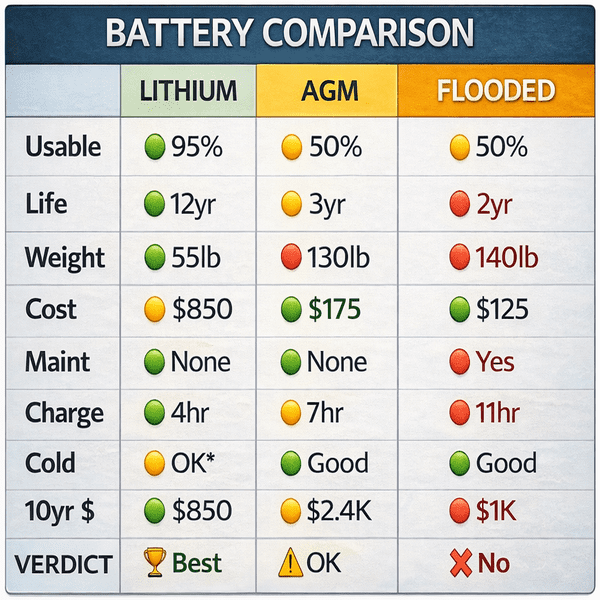
AGM works for occasional camping with hookups. Lithium is essentially mandatory for regular boondocking. The usable capacity difference (100Ah from 200Ah AGM versus 170Ah from 200Ah lithium), faster charging, and 10-15 year lifespan make lithium the better investment despite higher upfront cost
My AGM batteries needed replacement every 2.5 years at $680 per set. My lithium batteries cost $1,600 once and will last 10+ years. The math strongly favors lithium over time.
See our detailed lithium versus AGM comparison for complete ownership cost analysis over 10 years including replacement frequency and performance differences
What size charge controller do I need?
Calculate total panel wattage times 1.25, divided by battery voltage. For 400W of panels charging 12V batteries: (400 × 1.25) ÷ 12 = 42A minimum. I run a 30A controller because real-world production rarely exceeds 300W, making 30A adequate.
Also verify voltage rating 100V controllers handle most RV arrays unless you’re running 6+ panels in series. Include 25% voltage safety margin above your maximum series voltage.
MPPT or PWM charge controller?
MPPT absolutely, unless budget is desperately tight. PWM controllers waste 25-30% of available solar power. The $100-150 premium for MPPT pays for itself within a year through increased charging efficiency.
I started with a $45 PWM controller and watched 30% of my solar production disappear. Upgrading to a $170 MPPT controller immediately increased daily yield by 35-40Ah enough to eliminate most generator use.
See our MPPT controller comparison and recommendations for specific model testing results including real-world efficiency measurements
Which solar panels are best for RVs?
Renogy offers excellent value for mid-range budgets. Battle Born and Victron are premium but worth it if you can afford them. Avoid ultra-cheap Amazon brands quality control is inconsistent and efficiency often falls short of ratings.
I run a mix of Renogy and Rich Solar panels that have performed flawlessly for three years. Friends with premium brands report slightly better performance but not enough to justify 40-50% higher costs for most people.
Pair quality panels with our tested lithium battery recommendations for optimal system performance and longevity
Installation Questions
Can I install solar panels myself?
If you have basic electrical skills and are comfortable working on your roof, yes. The actual installation isn’t complicated mount panels, run wiring, connect controller. The scary part is drilling roof penetrations correctly.
Follow our complete DIY installation guide with safety protocols, wiring diagrams, and step-by-step instructions for professional-quality results
I paid for professional installation on my first system ($1,200) to ensure no leaks. Second system expansion I did myself and saved the labor cost. If you’re mechanically inclined, DIY is definitely feasible with careful research.
How do I mount solar panels without damaging my roof?
Use quality mounting brackets or rails, seal every penetration generously with Dicor self-leveling sealant, and don’t overtighten screws. Apply sealant in the hole before inserting screws, then wipe away excess that squeezes out.
I’ve had zero leaks in three years using this method. The key is generous sealant use more than seems necessary. Dicor is cheap compared to interior water damage repairs.
Can I tilt my solar panels for better performance?
Yes, tilt kits exist, but honestly I rarely use mine. The 20-30% production boost isn’t worth climbing on the roof to adjust panels daily. Exception: winter camping when every watt matters due to limited sun hours.
If you frequently winter camp, tilt kits provide significant benefit. For summer camping, flat-mounted panels work fine if you sized the array with adequate overhead capacity.
Where should I mount my charge controller?
As close to batteries as possible to minimize wire runs and voltage drop. Ensure adequate ventilation controllers generate heat and need airflow. I mounted mine on the wall above my battery compartment with 4 inches clearance on all sides.
Avoid enclosed cabinets without ventilation. I initially mounted my controller in a closed cabinet and it overheated repeatedly. Moving it to an open wall solved the problem immediately
Performance & Maintenance
How often do I need to clean solar panels?
Depends on environment. Desert camping with dust storms: every 2-3 weeks. Forest camping with tree debris: weekly. Normal conditions: monthly. Dirty panels lose 15-25% efficiency cleaning is the highest-impact maintenance task.
I carry a spray bottle, soft brush, and microfiber cloths. Takes 15 minutes to clean four panels and immediately boosts production back to normal levels.
Follow our complete maintenance schedule to keep your system at peak performance with minimal time investment throughout the yea
Why is my solar system not producing what I expected?
Most common reasons: dirty panels, partial shade, suboptimal mounting angle, heat reducing efficiency, or overestimating what “rated wattage” means. A 400W array rarely produces 400W expect 60-75% of rated capacity in real conditions.
When troubleshooting low production, start with the obvious: clean panels, verify no shade, check for loose connections. If those check out, measure voltage and current at multiple points to isolate issues.
Can I add more panels to my existing system?
Usually yes, but verify your charge controller can handle additional wattage. If your controller is maxed out, you’ll need to upgrade it. Also ensure your battery capacity matches expanded solar no point generating power your batteries can’t store.
I expanded from 400W to 800W by adding a second charge controller ($190) rather than replacing my existing 30A controller with a larger 60A model ($350). Sometimes parallel controllers cost less than upgrading.
Do solar panels work in winter/cloudy weather?
Yes, but production drops significantly. Winter sun angles and shorter days reduce output 40-60% compared to summer. Cloudy weather cuts production to 10-25% of sunny-day levels.
This is why proper system sizing matters. a barely-adequate system in summer becomes insufficient in winter. I sized my 800W system for winter production, which means I have substantial excess capacity in summer but that’s better than struggling in winter.
How long do RV solar systems last?
Quality rigid panels last 20-25 years with minimal degradation. Charge controllers last 10-15 years. Lithium batteries last 10-15 years or 3,000-5,000 cycles. Wiring and mounting hardware last indefinitely if properly installed
Your system should provide 15-20 years of reliable service with only battery replacement needed once around year 10-12. That long lifespan is why solar makes economic sense despite high initial costs.
Cost & Value
What does a complete RV solar system cost?
For detailed cost breakdown by system size with component itemization, installation costs, and ROI calculations based on camping frequency
Budget systems (200-300W): $1,500-$2,500 installed. Mid-range systems (400-600W): $3,000-$5,000 installed. Premium systems (800-1000W): $6,000-$10,000 installed. Prices include panels, controller, batteries, installation, and all hardware.
My 800W system with 400Ah lithium and professional installation cost $7,200 total. Friends who DIY similar systems report $4,500-$5,500 costs by saving on labor.
Is DIY installation significantly cheaper?
Yes save $800-$2,000 on labor for typical systems. But factor in tool costs ($150-$300 if you don’t own them) time investment (12-20 hours), and risk of mistakes that damage components or create leaks.
I calculated my DIY system expansion saved $1,400 on installation labor. Took me 16 hours spread over a weekend. Worth it financially, but stressful and physically demanding work.
Can I finance an RV solar system?
Some RV solar installers offer financing, but rates are typically high (8-15% APR). Better options: save up and pay cash, use a 0% credit card for 12-18 months, or get a personal loan at lower rates.
I paid cash but several friends financed through installers. Monthly payments of $150-200 for 3-4 years. They’re still saving money versus campground fees, but interest adds 20-30% to total system cost.
What’s the best way to save money on solar?
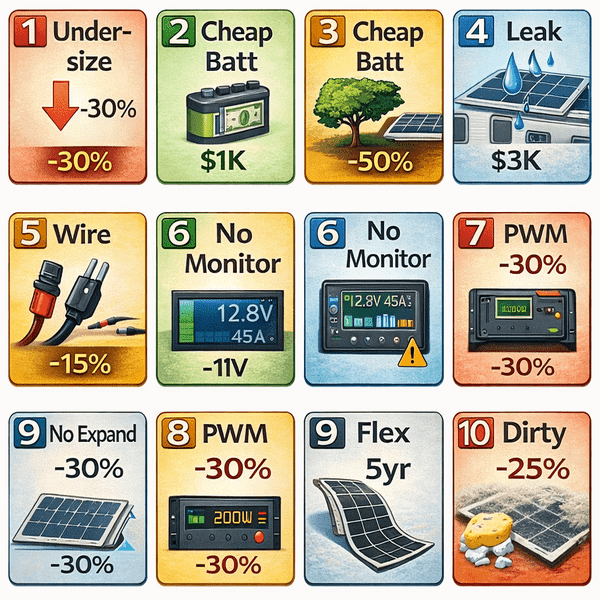
DIY installation saves the most (30-40% off total cost). Buying components during Black Friday/holiday sales saves 10-15%. Choosing mid-tier brands instead of premium saves 15-20% with minimal performance sacrifice.
I’ve watched people build $8,000 systems that could have been $5,000 with smarter shopping. Premium brands aren’t always worth the premium research which components justify higher costs and which don’t
Technical Questions
Can I mix different solar panel brands or wattages?
In parallel, yes not ideal but workable. In series, absolutely not. Series-wired panels must be identical same wattage, voltage, and current ratings. Mismatched panels in series perform at the level of the weakest panel, wasting capacity.
I run Renogy and Rich Solar panels in parallel strings with no issues. But each series string contains only identical panels to avoid performance mismatches.
What gauge wire do I need for solar installation?
Depends on amperage and distance. For 30A over 10 feet, use 10 AWG minimum. For 60A over 10 feet, use 6 AWG. Undersized wire creates voltage drop that wastes power and generates dangerous heat
Use online voltage drop calculators and stay under 3% drop for optimal performance. I initially used 12 AWG wire and measured 6% voltage drop. Upgrading to 10 AWG fixed the issue and increased charging efficiency noticeably
Do I need a battery monitor?
Not technically required but extremely valuable. Without a monitor, you’re guessing about state of charge, consumption rate, and system health. I installed a Victron BMV-712 ($180) six months after my initial system and immediately understood my power usage patterns better.
The data helped me identify phantom loads drawing 15Ah daily I didn’t know existed. Battery monitors pay for themselves through better system management and early problem detection.
Can I use my solar system while driving?
Yes, panels generate power whenever light hits them. Your charge controller continues charging batteries while driving. Some people disable charging while driving due to vibration concerns, but I’ve never had issues.
The power generation while driving is useful for charging after overnight consumption without stopping. I typically arrive at camp with batteries at 90-95% from drive-time solar charging.
Safety & Troubleshooting
Is solar installation dangerous?
Working with electricity always carries risk, but RV solar operates at relatively safe voltages (12-48V typically). The main dangers are: falling from the roof during installation, creating shorts that cause fires, and accidentally reversing polarity which damages components.
I’ve made one scary mistake (reversed polarity during expansion) that created a dramatic arc flash and melted a wire terminal. Always double-check connections before energizing systems, and consider hiring professionals if you’re uncomfortable with electrical work.
What happens if my charge controller fails?
Your batteries stop charging from solar but continue powering loads normally. You’ll need to run your generator or find hookups until you replace the controller. This is why I carry a spare budget controller as emergency backup $80 insurance against being stranded without solar.
Controllers rarely fail, but when they do, having backup options matters. Some people carry portable solar panels with built-in controllers as backup power sources.
Why do my batteries not hold charge like they used to?
Battery degradation is normal over time but should be gradual. Rapid capacity loss suggests: chronic undercharging, excessive heat exposure, deep discharge cycles, or manufacturing defects. Load test your batteries to verify actual capacity versus rated capacity.
My AGM batteries typically degraded to 70% capacity after 2-3 years. My lithium batteries are still at 97% capacity after three years. Proper charging management and avoiding temperature extremes extends battery life significantly.
Can lightning damage my solar system?
Theoretically yes, but I’ve never heard of it happening to anyone I know personally. Solar panels are grounded through your RV’s electrical system, providing some protection. If you’re paranoid, disconnect panels during severe thunderstorms.
I camp through plenty of lightning storms and have never disconnected my system. The risk seems minimal compared to the inconvenience of disconnecting and reconnecting regularly.
Building and maintaining an effective solar system requires understanding how all components work together from proper panel sizing and battery selection to charge controller optimization all of which combine to create the reliable off-grid power that enables true boondocking freedom and energy independence
Related RV Solar Guides
- How to Choose Solar Panels for Your RV
- RV Solar Panel Sizing Guide
- RV Power Usage Calculator Guide
- The Smart Method for Mobile Power

Published on December 27, 2025
Emma STONNE
This post contains affiliate links. If you make a purchase through these links, we may earn a commission at no extra cost to you.