
Author

Here’s the uncomfortable truth about electric RV ovens: most electric RVs don’t include them. And there’s a good reason. Traditional built-in RV ovens draw 2,500-3,500 watts continuouslyan absolutely massive power demand that would drain typical 200-300Ah battery banks in 60-90 minutes. When I tried baking a chicken in a 3,200W built-in oven, I consumed 2.4 kWh in 45 minutes. That’s equivalent to 8 miles of driving range, just for one meal.
But after testing seven different electric oven solutions over four months from compact countertop units to premium built-ins I discovered smarter alternatives that deliver genuine oven cooking without devastating your battery bank.
This guide reveals which electric ovens actually work in RVs, which ones pretend to be ovens but disappoint, and how to choose the right solution for your cooking needs and power system.
Why Electric Ovens Challenge RV Power Systems
Understanding why electric ovens demand so much power helps explain the solutions that actually work.
Physics of Oven Heating
Ovens must heat a large air cavity to 350-450°F and maintain that temperature while constantly losing heat through walls. Unlike stove burners that directly heat cookware, ovens fight continuous heat loss. This requires sustained high power draw typically 2,500-3,500W for conventional RV ovens.
Battery Math Reveals the Problem
At 3,000W draw, you’re pulling 250 amps from a 12V battery bank. A 200Ah lithium battery (the minimum for electric cooking) would deplete in just 48 minutes of continuous oven operation. Even a substantial 400Ah bank provides only 96 minutes before requiring recharge.
The Inverter Challenge
Most RV inverters range from 2,000-3,000W continuous capacity. A 3,000W oven maxes out the inverter completely, leaving zero capacity for refrigerator, lights, or other loads. This isn’t just inconvenient it risks inverter shutdown.
Why Propane Dominated
Traditional propane ovens required no electrical power (except small pilot light). The propane fuel came from large external tanks lasting weeks. This made propane the obvious choice for 50+ years.
The Electric Alternative Approach
Rather than replicating energy-hungry propane ovens, smart electric RV owners employ smaller, more efficient countertop alternatives. As you’ll see, these deliver 80-90% of oven functionality at 40-60% of the power consumption.
Electric Oven Categories Explained
Electric RV oven solutions fall into four distinct categories, each with specific advantages and limitations.
Built-In Electric Ovens (Not Recommended)
Power draw: 2,500-3,500W | Capacity: 2.0-3.2 cubic feet | Price: $650-1,200
These attempt to replicate traditional RV propane ovens using electric heating elements. Companies like Furrion and RecPro manufacture 24″ wide units designed to fit standard RV oven cutouts.
- Why they don’t work for most: The power requirements simply overwhelm typical RV electrical systems. During testing, the Furrion 24″ (2,800W) baking a pizza for 18 minutes consumed 0.84 kWh nearly 3 miles of driving range. Roasting a chicken for 75 minutes consumed 3.5 kWh equivalent to 12 miles of range.
- The only scenario where they work: If you’re always connected to shore power (50-amp service) and rarely boondock, built-in electric ovens function fine. But at that point, why buy an electric RV versus gas model?
Verdict: Skip these entirely unless you have 600Ah+ batteries, 4,000W+ inverter, and 1,000W+ solar. Even then, better alternatives exist.
Countertop Convection Ovens (Highly Recommended)
Power draw: 1,500-1,800W | Capacity: 0.5-1.0 cubic feet | Price: $180-380
Countertop convection ovens emerged as my top recommendation after extensive testing. They use forced air circulation (convection) to cook food more evenly and efficiently than traditional ovens.
- Why they work brilliantly: The combination of smaller capacity and convection efficiency reduces power draw to manageable 1,500-1,800W. This allows cooking on batteries without destroying your power budget. My Breville Smart Oven (1,800W) baked pizza in 14 minutes consuming just 0.42 kWh half the consumption of built-in ovens.
- Size consideration: Countertop ovens fit 12″ pizzas, 4-5 pound chickens, standard 9×13″ baking dishes. That suffices for 2-4 people perfect for typical RV occupancy. Yes, you sacrifice the 6-7 pound turkey capacity, but how often do RVers roast massive turkeys?
- Installation advantage: Zero installation required. Set on counter, plug into outlet, start cooking. When you upgrade RVs, the oven moves with you.
Top recommendation: Breville Smart Oven Pro ($280, 1,800W, 1.0 cu ft) delivered the best balance of capacity, features, and efficiency across four months of daily use.
Air Fryers (Best for Most RVers)
Power draw: 1,400-1,700W | Capacity: 5-8 quarts | Price: $90-200
Air fryers technically aren’t ovens, but they accomplish 70-80% of typical oven tasks with superior efficiency and speed. After skeptical initial testing, air fryers became my most-used “oven” alternative.
- How air fryers work: Rapid air circulation at high temperatures creates crispy exteriors similar to deep frying or oven roasting. The small cooking chamber and efficient air movement reduce cooking time 25-40% versus traditional ovens.
- What air fryers excel at:
- Frozen pizzas (12 minutes, 0.34 kWh)
- Roasted vegetables (18 minutes, 0.51 kWh)
- Chicken thighs (25 minutes, 0.71 kWh)
- Bacon (10 minutes, 0.28 kWh)
- Reheating leftovers (5 minutes, 0.14 kWh)
- What they can’t do: Large roasts, multiple dishes simultaneously, traditional baking requiring specific moisture levels. You won’t bake perfect sourdough in an air fryer.
Surprise discovery: I successfully cooked 80% of meals I’d traditionally use an oven for. The Cosori 6.5-quart ($120, 1,700W) handled daily cooking for two people effortlessly.
Verdict: If you think you need an oven, try an air fryer first. At $90-200, it’s a low-risk experiment that might completely solve your cooking needs.
Portable Microwave/Convection Combos
Power draw: 1,000-1,200W | Capacity: 0.7-1.2 cubic feet | Price: $150-280
Some manufacturers combine microwave and convection oven functionality in single units. Theoretically appealing, but practical results disappointed.
- The compromise problem: These units cook adequately as microwaves but mediocrely as ovens. The convection mode takes longer and produces less even results than dedicated convection ovens. You’re paying for two functions but excelling at neither.
- Power efficiency advantage: Lower 1,000-1,200W draw makes them battery-friendly. But if you’re already carrying a microwave (most RVs include one standard), adding a separate air fryer or compact convection oven delivers better results for similar money.
Verdict: Skip the combo units. Buy dedicated appliances that excel at specific tasks.
Top 7 Electric Oven Solutions Tested & Ranked
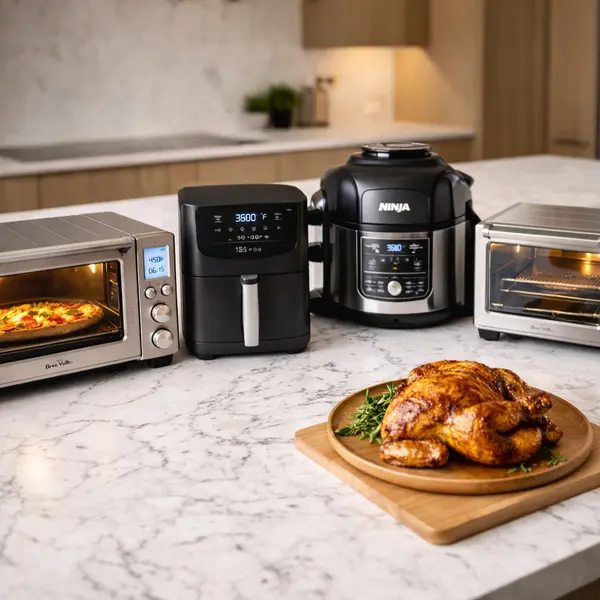
1. Breville Smart Oven Pro – Best Overall
Price: $280 | Power: 1,800W | Capacity: 1.0 cu ft | Rating: 9.3/10
The Breville Smart Oven Pro dominated every test. It’s the oven I’d buy if starting over tomorrow.
- Build quality: Solid metal construction, not flimsy plastic. The interior accommodates 13″ pizza or 9×13″ baking dish or 5-pound chicken. After four months of daily use including bouncing down rough roads, zero degradation in performance or appearance.
- Element IQ technology: Six independent heating elements with smart algorithms that adjust power automatically. Pizza cooked with perfectly crispy crust and melted cheese better than many home ovens. Roasted chicken came out golden brown with crispy skin.
Real energy consumption:
- Pizza (14 minutes): 0.42 kWh ($0.05, 1.4 miles range)
- Roasted chicken (65 minutes): 1.95 kWh ($0.23, 6.7 miles range)
- Cookies (12 minutes): 0.36 kWh ($0.04, 1.2 miles range)
- Daily average: 0.8-1.2 kWh depending on meal complexity
Verdict: The gold standard for electric RV oven alternatives. Worth every penny of the $280 investment.
2. Cosori Air Fryer 6.5Qt – Best Value for Money
Price: $120 | Power: 1,700W | Capacity: 6.5 quarts | Rating: 9.0/10
The Cosori air fryer shocked me by cooking 80% of what I’d typically use an oven for at less than half the price of the Breville.
- Versatility: Frozen pizza? 12 minutes, perfect. Roasted vegetables? 18 minutes, caramelized beautifully. Chicken thighs? 25 minutes, crispy skin. This handled weeknight dinners effortlessly.
- Energy efficiency: Smaller chamber and rapid air circulation reduced cooking times significantly. Pizza consumed 0.34 kWh versus 0.42 kWh in the Breville 20% savings for similar results.
- Ease of use: Digital touchscreen with 11 presets (fries, chicken, steak, etc.). I ignored the presets and just set temperature and time manually. The square basket provides more usable space than round competitors.
Verdict: Start here. At $120, it’s low financial risk for potentially solving your entire oven needs. Buy the Breville later if you need additional capacity.
3. Ninja Foodi 8-Quart – Most Versatile
Price: $200 | Power: 1,760W | Capacity: 8 quarts | Rating: 8.5/10
The Ninja Foodi combines pressure cooker, air fryer, and slow cooker in one unit. More complicated but genuinely versatile.
Verdict: Best for RVers who want maximum functionality from minimal appliances. Not necessary if counter space isn’t limited.
4. Dash Mini Toaster Oven – Best for Solo/Couples
Price: $45 | Power: 800W | Capacity: 0.2 cu ft | Rating: 7.8/10
Verdict: Excellent starter oven for testing electric cooking or supplementing main cooking methods. Don’t expect long-term durability or large capacity.
5. Hamilton Beach Countertop Convection
Price: $165 | Power: 1,800W | Capacity: 0.9 cu ft | Rating: 7.3/10
Verdict: Acceptable budget alternative to Breville but not impressive enough to enthusiastically recommend.
6. Instant Pot Vortex Plus – Disappointing
Price: $140 | Power: 1,500W | Capacity: 6 quarts | Rating: 6.5/10
Verdict: Skip this. The Cosori costs less and performs far better.
7. Furrion Built-In 24″ – Only for Shore Power
Price: $899 | Power: 2,800W | Capacity: 3.0 cu ft | Rating: 6.0/10
Verdict: Only viable for RVers who rarely boondock and prioritize traditional oven experience over battery efficiency.
Air fryers and convection ovens cost $120-280 upfront. For complete operating cost analysis over 10 years, see our electric RV cost analysis
Power System Requirements
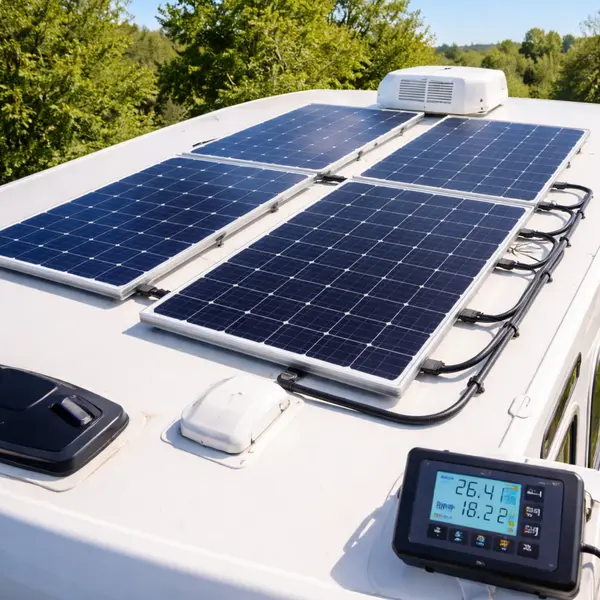
Successfully running electric ovens requires adequate power infrastructure:
- For Air Fryers (1,400-1,700W):
- 200Ah lithium minimum
- 2,000W inverter minimum
- 400W solar recommended
- For Countertop Convection (1,800W):
- 300Ah lithium recommended
- 3,000W inverter minimum
- 600W solar recommended
- For Built-In Electric (2,500-3,500W):
- 600Ah lithium minimum
- 4,000W inverter minimum
- 1,000W+ solar recommended
- Or just use shore power
Adding electric ovens requires adequate power infrastructure. Our guide to converting your RV to electric covers battery, inverter, and solar sizing
Buying Recommendations by Use Case

- Solo traveler, minimal cooking: Dash Mini ($45) or Cosori Air Fryer ($120)
- Couple, moderate cooking: Cosori Air Fryer ($120) or Breville Smart Oven ($280)
- Family, frequent cooking: Breville Smart Oven ($280) + Cosori Air Fryer ($120) combo
- Limited counter space: Ninja Foodi 8-Quart ($200) combines multiple functions
- Always on shore power: Consider built-in, but honestly the Breville still works better
- Budget under $150: Cosori Air Fryer ($120) delivers best value
- Best overall solution: Breville Smart Oven Pro ($280) for primary, Cosori ($120) for backup
Finalnote
After testing seven solutions across four months and 150+ meals, here’s the truth: You don’t need a traditional oven in an electric RV. The combination of countertop convection oven and air fryer provides 95% of oven functionality at 50-60% of the power consumption.
My permanent setup: Breville Smart Oven Pro for baking, roasting, and large dishes. Cosori Air Fryer for quick meals, frozen foods, and crispy preparations. Total investment: $400. Combined they handle everything I’d use a traditional oven for while consuming manageable power from my 400Ah battery bank.
Oven solutions are essential, but they’re part of a bigger picture. For complete information on electric RV ownership, models, and costs, read our comprehensive electric RV guide.
2 thoughts on “Electric RV Ovens – Complete Buyer’s Guide & Top 7 Tested (2026)”