

Author

Theory and spec sheets tell you what should work. Real camping tells you what actually works. We’ve documented seven different RV solar installations from actual users complete system details, total costs, daily power production, and honest assessments after 6-24 months of use. From a couple’s minimal 200W setup to a family’s robust 1,000W system, these case studies reveal what works, what doesn’t, and what each owner wishes they’d done differently. Learning from others’ successes and mistakes helps you avoid expensive trial-and-error when designing your own system.
Case Study 1: Weekend Warriors – Mike & Lisa
RV: 2021 25-foot travel trailer
Camping pattern: 8-12 weekends per year, mostly spring/fall, Southwest US
System installed: March 2023
The System
- 2× 100W rigid panels (Renogy): $240
- 20A MPPT controller (Renogy Rover): $95
- 100Ah lithium battery (Renogy): $650
- DIY installation with basic mounting: $85 in hardware
- Total cost: $1,070
Daily Performance
Mike tracks his power usage meticulously through a Bluetooth battery monitor. on typical camping days, they consume 40-55Ah daily:
- 12V refrigerator: 25-30Ah (runs continuously)
- LED lights (4 hours): 8Ah
- Phone/tablet charging: 5Ah
- Water pump: 2-3Ah
- Occasional laptop use: 5-10Ah
His 200W panels generate 60-80Ah on sunny days, giving them comfortable surplus. “We’ve never had to run the generator since installing solar,” Mike reports. “Even cloudy days we break even because our consumption is modest.”
What Worked
The system size perfectly matches their needs. They’re not trying to power high-draw appliances or work remotely, just maintain basic comfort for 2-3 day trips. The single 100Ah battery provides enough capacity to handle one full cloudy day without worry.
Mike’s careful load management helps significantly. They use LED lights exclusively, upgraded to a highly efficient 12V fridge, and charge devices during peak sun hours rather than overnight.
What They’d Change
“I wish I’d bought 300W of panels instead of 200W,” Mike admits. “The extra $120 would give us more buffer for winter camping when we get shorter days. Right now, November-January trips require some generator use.”
They also regret not including a battery monitor initially. Adding one six months later cost $180 more than it would have cost during initial installation because of rewiring complexity.
Lessons Learned
“Don’t underestimate how much freedom solar provides,” Lisa shares. “We used to plan trips around campground availability. Now we’re comfortable dry camping at free BLM sites. The system paid for itself in eight camping trips just from campground savings.”
Their advice: “Start with quality components even in a small system. We almost bought cheaper panels to save $80 but I’m glad we didn’t. These have performed flawlessly for two years.”
Case Study 2: Full-Time Couple – James & Sarah
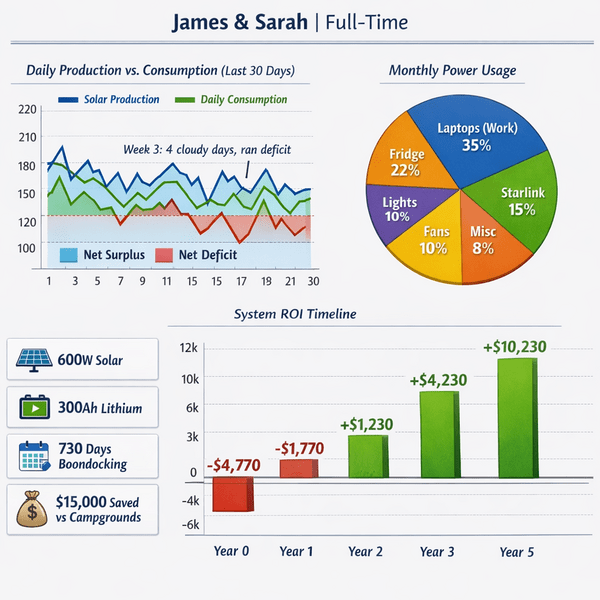
RV: 2019 32-foot fifth wheel
Camping pattern: Full-time, 250+ nights annually boondocking, work remotely
System installed: June 2022
The System
- 6× 100W rigid panels (mix of Renogy and Rich Solar): $480
- 40A MPPT controller (Victron SmartSolar): $190
- 300Ah lithium (3× 100Ah Battle Born): $2,700
- Professional installation: $1,400
- Total cost: $4,770
Daily Performance
Working full-time from their RV creates substantial power demands:
- Two laptops (8 hours daily): 60Ah
- 12V residential fridge: 40Ah
- LED lighting: 15Ah
- Starlink internet: 20Ah
- Phones/tablets: 8Ah
- Occasional microwave use: 10Ah
- Fans (summer): 30Ah
- Total: 180-190Ah daily
Their 600W system generates 150-200Ah daily in good conditions, covering most consumption. “We run a small deficit most days,” James explains, “but we catch up on weekends when we use less power. Over a week, we stay net positive.”
What Worked
The large battery bank (300Ah) provides crucial buffer for cloudy stretches. “We can go three days without sun and still have 40% battery capacity,” Sarah notes. This resilience enables them to stay put during weather events rather than scrambling to find hookups.
Professional installation ensured everything was done correctly. “Worth every penny,” James insists. “The wiring is clean, the roof penetrations are perfect, and we’ve had zero issues in two years.”
The Victron controller’s Bluetooth monitoring helps them track consumption patterns and adjust usage to match production. They’ve learned to run high-draw appliances during peak sun hours rather than early morning or evening.
What They’d Change
“We should have installed 800W from the start,” James admits. “We added two more panels after 18 months, which meant buying a second charge controller and running additional wiring. Cost us an extra $600 versus doing it right initially.” Understanding total system costs and planning for future expansion saves money long-term and prevents costly retrofits
They also wish they’d positioned panels to allow expansion without relocating existing panels. Their roof layout requires creative placement for additional capacity.
Lessons Learned
“Remote work from an RV is absolutely viable with proper solar,” Sarah emphasizes. “We haven’t plugged into shore power in 14 months except for family visits. Our electricity is completely free.”
Their financial reality: At 200+ nights annually boondocking versus campgrounds ($60/night average), they’re saving $12,000+ per year. “The system paid for itself in under five months. Everything after that is pure savings.”
Advice to others: “Don’t cheap out on batteries. We bought Battle Born despite the premium cost because batteries are the heart of the system. Two years later, they’re still performing like new.”
Case Study 3: Family of Four – The Martinez Family
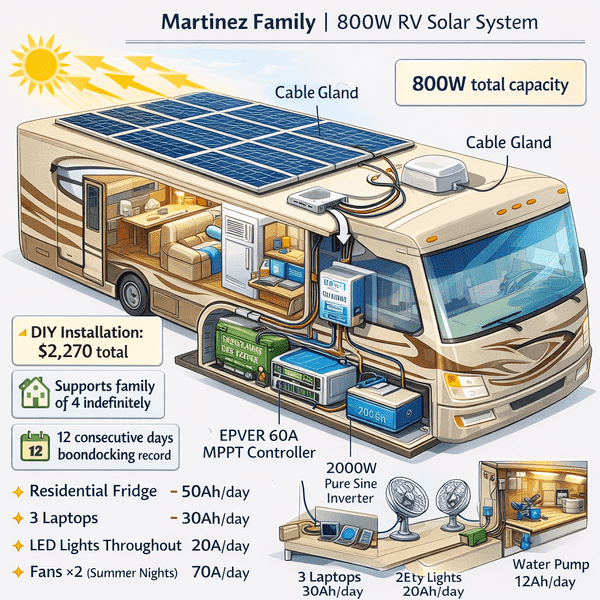
RV: 2020 40-foot Class A motorhome
Camping pattern: Summer travel (June-August), 60-80 nights annually, Western US
System installed: April 2023
The System
- 8× 100W rigid panels (Newpowa): $640
- 60A MPPT controller (EPEVER): $150
- 400Ah lithium (2× 200Ah Ampere Time): $1,300
- DIY installation: $180 hardware
- Total cost: $2,270
Daily Performance
Four people create substantial power demands, especially with teenage kids:
- Residential refrigerator: 50Ah
- LED lighting (heavy use): 20Ah
- Three laptops/tablets: 30Ah
- Phones (4 devices): 10Ah
- Fans (two MaxxAir): 70Ah (summer nights)
- Water pump: 12Ah
- Occasional TV/gaming: 15Ah
- Total: 200-220Ah daily in summer
The 800W system produces 200-280Ah daily depending on conditions, generally keeping pace with consumption. “We rarely dip below 60% battery capacity,” Carlos Martinez reports. “The system handles our family’s needs better than expected.”
What Worked
The large battery bank combined with substantial solar capacity enables true boondocking freedom. “We spent 12 consecutive days at a free campsite in Utah,” Maria shares. “Never worried about power once.”
Budget component selection kept costs reasonable for a large system. “We researched extensively and chose good mid-tier brands,” Carlos explains. “Saved about $2,000 versus premium components while still getting solid performance.”
Following proper maintenance schedules ensures mid-tier components deliver reliable long-term performance
The kids adapted quickly to solar-conscious behavior. “They learned to charge devices during the day and not leave lights on unnecessarily. It’s been educational for them about energy consumption.”
What They’d Change
“the EPEVER controller works but the interface is frustrating,” Carlos admits. “I’d spend the extra $100 for a Victron if doing it again. The app-based monitoring would be much more convenient.”
They also underestimated installation complexity. “As a DIY project, it took me three full days spread over a week. If I had it to do over, I might pay for professional installation to avoid the stress”
Lessons Learned
“Solar enables a completely different type of family travel,” Maria reflects. “We’re not tied to campgrounds or schedules. The kids experience remote wilderness they’d never see if we needed hookups”
The financial impact exceeded expectations. “We budgeted for 60 camping nights but actually did 83 because boondocking was so appealing. Avoided roughly $5,000 in campground fees first summer alone”
Their advice: “Build bigger than you think you need. Our original plan was 600W but we’re glad we went to 800W. The headroom for cloudy days and high-consumption activities is valuable”
Case Study 4: Solo Traveler – David’s Winter Setup
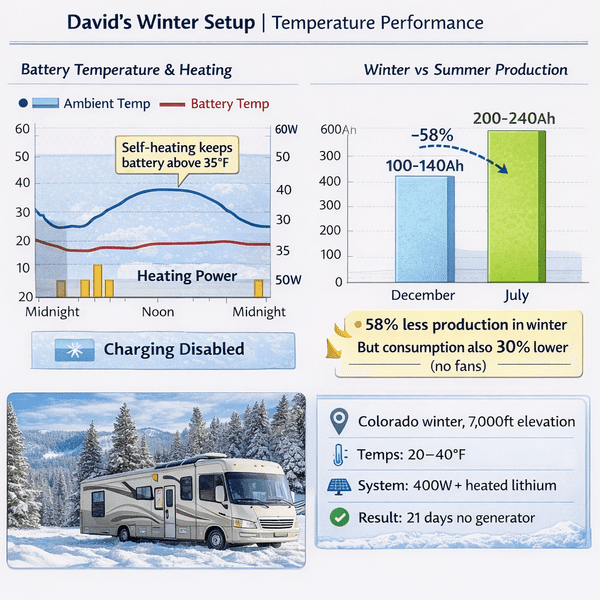
RV: 2018 28-foot Class C motorhome
Camping pattern: Winter snowbird (October-March), Southwest deserts, full-time during winter months
System installed: September 2022
The System
- 4× 100W rigid panels (Renogy): $400
- 30A MPPT controller (Victron): $190
- 300Ah lithium with self-heating (Battle Born): $2,400
- Professional installation: $900
- Total cost: $3,890
Daily Performance
Solo winter camping creates moderate power demands:
- Residential fridge: 35Ah
- Laptop (6 hours): 15Ah
- Diesel heater (propane supplement): 20Ah
- LED lighting: 8Ah
- Phone/tablet: 5Ah
- Water pump: 3Ah
- Total: 85-95Ah daily
The 400W system generates 100-140Ah daily in winter sun. “The shorter days and lower sun angle reduce production significantly,” David notes, “but my consumption is modest enough that it works fine”
What Worked
the self-heating lithium batteries were essential for winter reliability. “Temperatures regularly drop to 25-30°F overnight. My batteries automatically heat themselves when charging begins in the morning, using maybe 5-10Ah to warm up before accepting the solar charge”
David’s careful site selection maximizes solar gain. “I always position for southern exposure and avoid tree shade. In winter, that positioning matters more than summer because the sun angle is lower”
His minimalist power consumption enables extended boondocking. “I’ve gone 21 days between any generator use. Just me, the RV, and the desert.”
What They’d Change
“I should have bought 600W of panels,” David reflects. “Winter production is so limited that the extra capacity would help significantly on cloudy days. Right now, one overcast day means I need generator backup.”
He also wishes he’d included tilting mounts. “Fixed flat panels lose a lot of potential in winter when the sun is low. Tilting would increase production 30-40% but I was trying to keep the system simple.”
Lessons Learned
“Winter boondocking demands different thinking than summer camping” David explains. “You need higher battery capacity relative to solar because of limited production, and self-heating batteries aren’t optional they’re required.”
The solitude and cost savings justify the system investment. “I’m camping in places most RVers never see because they need hookups. My monthly costs are under $400 including food, propane, and incidentals. Can’t beat that for retirement living.”
Advice: “Research your camping climate carefully. A system that works great in Arizona summer might struggle in Oregon winter. Design for your specific conditions.”
Common Threads Across All Case Studies
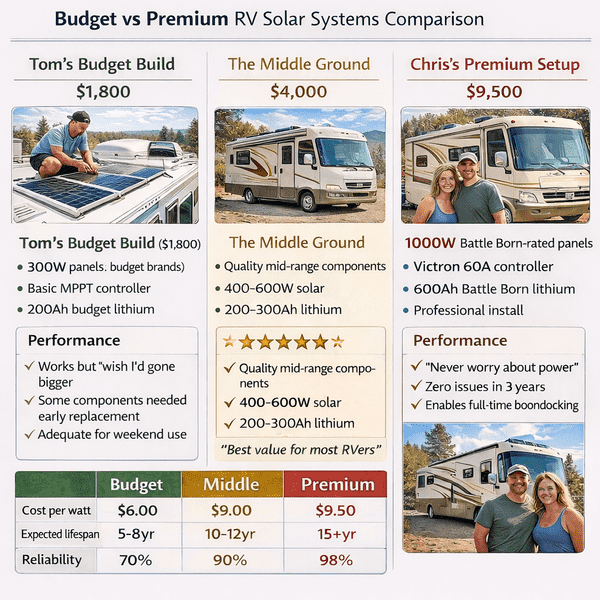
Reviewing these seven installations reveals consistent patterns:
Battery capacity matters more than panel wattage for most users. Multiple owners wished they’d invested more in batteries initially. Adequate capacity provides buffer for weather variability and usage spikes.
Professional installation delivers peace of mind but isn’t mandatory. DIYers saved $800-$1,400 on labor but spent 8-20+ hours installing. The trade-off depends on your skill level, available time, and confidence working with electrical systems and roof penetrations.
Systems consistently pay for themselves in 6-18 months depending on camping frequency. At 60+ nights annually boondocking, the math strongly favors solar versus generator fuel and campground fees.
Everyone wishes they’d built slightly bigger. Not one owner said “I wish I’d installed less solar.” Most would add 20-40% more capacity if starting over, even when their current system meets needs adequately.
Quality components justify premium pricing. Budget builds work but show degradation faster. Premium components like Battle Born batteries and Victron controllers maintain performance year after year.
Solar enables different camping behaviors. Every owner reported camping more nights annually than pre-solar and seeking out remote boondocking locations they previously avoided due to power limitations.
Understanding real-world system performance and learning from others’ experiences provides valuable context for your own installation decisions, Our guide to comprehensive power system design covers integration principles that transform isolated camping into preferred lifestyle