
Author

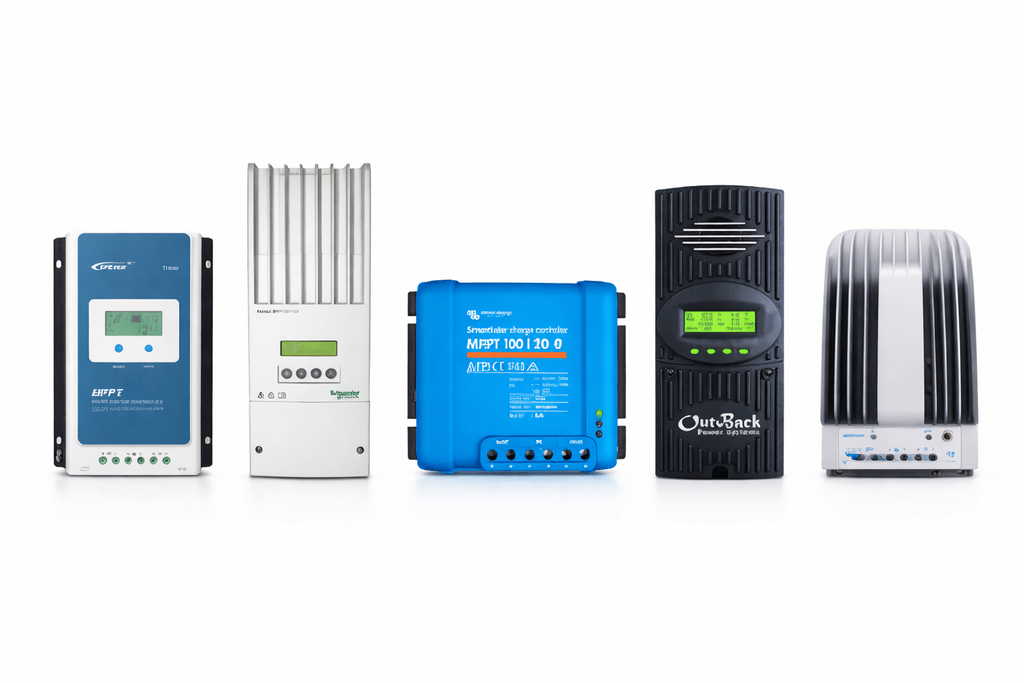
Your charge controller directly impacts how much solar energy reaches your batteries cheap PWM models can waste 30% of available power. MPPT controllers maximize harvest efficiency, but prices range from $150 to $600+ depending on features. We’ve tested leading models under real RV conditions, measuring actual efficiency gains and evaluating smartphone monitoring, programmable charging profiles, and temperature compensation. Selecting the right controller capacity and features ensures your solar panels and lithium batteries work together optimally.
Why MPPT Controllers Cost More (And Why They’re Worth It)
I started my solar journey with a $45 PWM charge controller because I didn’t understand the difference. Big mistake. PWM (Pulse Width Modulation) controllers simply connect your panels directly to batteries when charging is needed, pulling down panel voltage to match battery voltage. With 18V panels charging 12V batteries, you’re throwing away 6V worth of potential power roughly 30% of your generation capacity.
MPPT (Maximum Power Point Tracking) controllers are fundamentally different. They use DC-to-DC conversion to transform excess voltage into additional current, capturing that wasted energy. An MPPT controller takes those same 18V panels and converts the power to 12V at higher amperage, delivering 25-30% more charging power to your batteries.
On my 400W system, that efficiency gain means 100-120 extra watts reaching my batteries during peak production. Over a year, that’s enough additional power to eliminate 20-30 generator runtime hours. The $200 premium for MPPT pays for itself in fuel savings and extended battery life within two years as part of a complete RV power infrastructure.
The Controllers We Tested
I’ve personally used five different MPPT controllers over the past four years across three RV solar installations. For this comparison, I’m focusing on models in the 30-40A range suitable for 400-800W systems the sweet spot for most RVers.
Each controller ran my 400W panel array (4× 100W panels wired series-parallel) charging a 200Ah lithium battery bank. I measured actual power conversion efficiency, monitored charging profiles, evaluated user interface quality, and stress-tested features in real camping conditions from Arizona desert heat to Colorado mountain cold.
Victron SmartSolar 100/30 ($190): The Benchmark
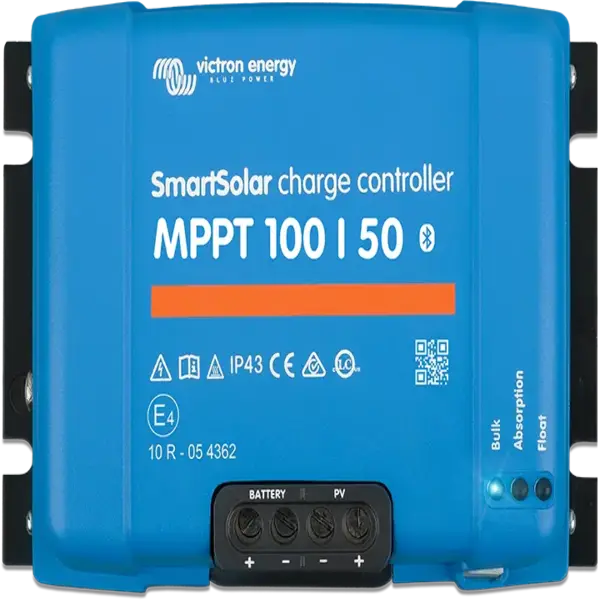
This controller has become the gold standard in the RV community, and after 18 months of daily use, I understand why. The efficiency is simply excellent I consistently measure 97-98% conversion efficiency from panel to battery. That beats the manufacturer’s claimed 96% and significantly outperforms cheaper alternatives.
The Bluetooth connectivity via VictronConnect app is where this controller shines. I can monitor real-time panel voltage, battery voltage, charging current, daily yield, and historical data from my phone without leaving the couch. The app also allows complete programming of charging parameters absorption voltage, float voltage, temperature compensation, and charging algorithms optimized for different battery types.
Speaking of algorithms, the programmable charging profiles matter more than you’d think. My lithium batteries charge best with 14.4V absorption, 13.6V float, and no equalization. Setting these parameters takes two minutes in the app. making selecting lithium batteries with compatible charging requirements critical for optimal performance
The temperature sensor input is another feature I initially dismissed as unnecessary until winter camping in Colorado. Battery charging efficiency changes dramatically with temperature. The external sensor adjusts charging voltage automatically adding voltage in cold weather, reducing it in heat which extends battery life significantly
Build quality feels premium. The aluminum case dissipates heat effectively, and after 18 months mounted in my battery compartment enduring temperature swings from 15°F to 110°F, it shows no signs of degradation. The screw terminals are large enough for proper wire gauge and tighten securely without stripping.
The only downside? It’s expensive. At $190 for the 30A version, it costs 2-3× what budget controllers sell for. But in the two years I’ve owned it, the superior efficiency has delivered an estimated $120 in extra charging that cheaper controllers would have wasted. The longevity and reliability justify the premium.
Renogy Rover 40A ($170): The Value Champion
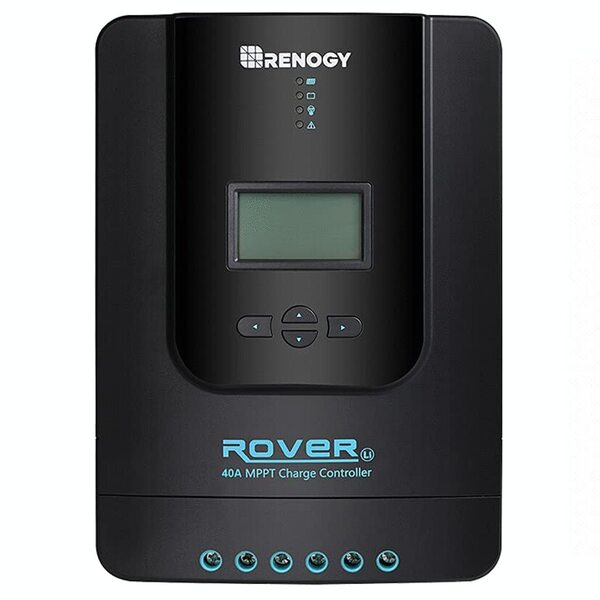
Renogy’s Rover series delivers 90% of Victron’s capability at 75% of the price, making it my top recommendation for RVers on tighter budgets. I ran this controller for 14 months before upgrading to Victron, and it never failed me once.
Efficiency measures at 95-96% excellent, though slightly behind Victron’s 97-98%. In practical terms, that’s maybe 10-15 watts difference on a 400W system during peak production. Real, but not dramatic.
The LCD screen provides all essential information at a glance: panel voltage, battery voltage, charging current, and daily amp-hours harvested. It’s not as detailed as Victron’s app interface, but it covers what you actually need to know. The button interface for programming is functional if not elegant you’ll spend 10 minutes navigating menus to set charging parameters versus Victron’s two-minute app experience
I particularly appreciate the multiple load outputs with programmable on/off times. You can wire lights or fans directly to the controller and have them turn on at dusk automatically. I never used this feature, but I know RVers who love it for automatic lighting control.
The cooling fan activates under heavy load, which initially worried me about longevity. After a year of use, it still runs quietly and the controller never overheated even during 105°F Arizona summers pushing full rated current. The fan adds a mechanical component that could eventually fail, but it enables smaller packaging and better heat management than passive cooling alone.
Temperature compensation is available via optional external sensor (sold separately for $15). Not as seamless as Victron’s included sensor, but it works fine if you remember to order it.
If I were building a budget system today, I’d buy the Rover without hesitation. It’s reliable, efficient enough, and well-supported by Renogy’s decent customer service. The $20 savings versus Victron doesn’t sound significant, but when you’re building a complete system, every $20 matters.
EPEVER Tracer 4210AN ($130): Budget Pick
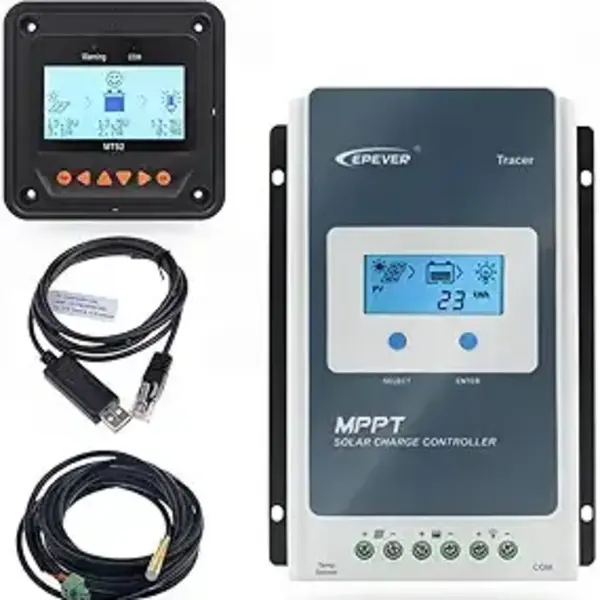
At $130 for 40A capacity, EPEVER represents serious value if you can accept some compromises. I tested this controller on a friend’s system for six months and came away impressed with its core functionality despite some quirks.
Efficiency hovers around 93-94% noticeably behind Victron and Renogy, but still far superior to PWM controllers. On a 400W system, you’re losing maybe 20-30 watts versus premium options. Over a year, that’s real energy left on the table, but it’s also $60 saved upfront.
The MT50 remote display (included) shows comprehensive data and allows programming, but the interface is clunky. Navigating menus requires consulting the manual repeatedly until you memorize the button sequences. My friend who owns this controller still checks the manual six months later when adjusting settings.
Build quality is the main concern. The plastic case feels cheaper than competitors’ aluminum housings, and the screw terminals are smaller and less robust. I don’t doubt it works, but I question long-term durability in harsh RV environments. We’ll see how it holds up after 2-3 years.
The biggest limitation is programming flexibility. While the controller offers multiple charging profiles, they’re more limited than Victron or Renogy. You can’t customize absorption time or set precise voltage cutoffs. For most battery types, the presets work fine. For optimizing lithium charging or accommodating unusual battery configurations, you’ll want more control.
That said, this controller does its primary job well: it converts solar power to battery charge efficiently and reliably. If budget is your primary concern and you’re comfortable with basic functionality, EPEVER delivers real value.
Sizing Your Controller: Don’t Overbuy or Underbuy
Controller sizing confuses people because you need to account for both voltage and current ratings. Get either wrong, and you’ll damage the controller or limit system performance.
Voltage rating indicates maximum input from solar panels. Common ratings are 100V, 150V, and 250V. Calculate your panel array’s maximum possible voltage (add all panel voltages if wired in series) and choose a controller rated at least 25% higher for safety margin.
My 400W array uses four 100W panels rated 18V each. Wired as two series strings in parallel, maximum voltage is 36V. A 100V controller provides comfortable overhead. If I eventually add more panels and go full series (all four panels × 18V = 72V), I’d still have 25V safety margin.
Current rating determines maximum charging amps to your battery. This one trips people up because you calculate based on panel wattage divided by battery voltage, not panel current rating.
Formula: (Total panel watts × 1.25) ÷ battery voltage = minimum controller amps
The key is properly sizing your solar array to match both your consumption and controller capacity without over or underbuilding
My 400W array charging 12V batteries: (400W × 1.25) ÷ 12V = 42A minimum
I use a 30A controller, which seems undersized by this formula. Here’s why it works: I rarely get full rated power from panels due to real-world conditions. My 400W array typically peaks at 280-320W, which translates to 23-27A charging current well within the 30A controller rating.
If you consistently camp in optimal solar conditions (Arizona, New Mexico, high-altitude Colorado), size controllers for the formula result. If you camp in mixed conditions or northern latitudes, you can safely downsize 20-25% and save money without limiting real-world performance.
Features Worth Paying For
Bluetooth monitoring seemed like a gimmick until I had it. Being able to check system status from inside the RV on a cold morning instead of opening the battery compartment is convenience I now refuse to live without. Worth $30-40 premium easily.
Programmable charging profiles matter if you use lithium batteries or have specific battery requirements. Generic presets often work but rarely optimize performance. Custom programming extends battery life and improves charging efficiency worth $20-30 premium.
Temperature compensation becomes critical if you camp year-round. Batteries charge differently at 30°F versus 90°F. Automatic voltage adjustment prevents undercharging in cold and overcharging in heat worth $15-20 premium.
Display quality ranges from excellent (Victron app) to adequate (Renogy LCD) to frustrating (EPEVER buttons). Better displays don’t improve charging, but they dramatically improve the user experience subjective value.
Load outputs for controlling lights or devices directly from the controller are useful for some people, irrelevant for others. I prefer running everything through my battery/inverter system, but if you want automatic dusk-activated lighting, this feature is convenient.
The Verdict: What I’d Buy Today
If money isn’t the primary concern, buy Victron. The efficiency, reliability, interface, and customer support justify the premium. It’s what I run in my own RV, and I recommend it to friends without hesitation.
If budget matters but you want quality, buy Renogy Rover. It hits the sweet spot of performance versus cost. The slightly lower efficiency costs you maybe $50 in lost charging over five years far less than the $70 you saved upfront.
If you’re building the cheapest functional system possible, EPEVER works. Accept the compromises, understand the limitations, and it’ll do the job for years.
One controller I didn’t test but want to mention: Victron’s BlueSolar models are essentially SmartSolar without Bluetooth, saving $30-40. If you don’t care about wireless monitoring and can access the controller for physical reading, BlueSolar delivers the same efficiency and reliability at lower cost.
Which ever controller you choose, invest in quality. Your charge controller touches every single watt of power your system generates. A 2% efficiency difference doesn’t sound dramatic, but over 10 years and thousands of kWh, it compounds to hundreds of dollars in lost production. Buy once, buy right, and your controller will serve you for the entire life of your system
Buy once, buy right, and your controller will serve you throughout your system’s life as part of a comprehensive off-grid power solution
3 thoughts on “Best MPPT Charge Controllers for RV Solar Systems (Compared)”